

Maths
Get insights from 6.5k questions on Maths, answered by students, alumni, and experts. You may also ask and answer any question you like about Maths
Follow Ask QuestionQuestions
Discussions
Active Users
Followers
New answer posted
a year agoContributor-Level 10
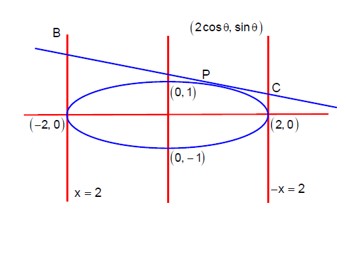
Equation of tangent of P (2cosθ, sinθ) is
(cosθ)x + (2sinθ)y = 4
Solving equation of tangent with equation of tangents at major axis ends, i.e. x = -2 and x = 2
For point 'B' (at x=-2):
-2cosθ + 2sinθ y = 4 ⇒ y = (2+cosθ)/sinθ
B (-2, (2+cosθ)/sinθ)
For point 'C' (at x=2):
2cosθ + 2sinθ y = 4 ⇒ y = (2-cosθ)/sinθ
C (2, (2-cosθ)/sinθ)
Now BC is the diameter of circle
Equation of circle: (x+2) (x-2) + (y - (2+cosθ)/sinθ) (y - (2-cosθ)/sinθ) = 0
x²-4 + y² - (4/sinθ)y + (4-cos²θ)/sin²θ = 0
Check if (√3, 0) satisfies this:
(√3)²-4 + 0 - 0 + (4-cos²θ)/sin²θ = -1 + (3+sin²θ)/sin²θ = -1 + 3/sin²θ + 1 = 3/sin²
New answer posted
a year agoContributor-Level 10
ai+aj+ck, i+k and ci+cj+bk are co-planar,
|a c; 1 0 1; c b| = 0
a (0-c) - a (b-c) + c (c-0) = 0
-ac - ab + AC + c² = 0
c² = ab
c = √ab
New answer posted
a year agoContributor-Level 10
R? → R? -R? , R? → R? -R?
|sinx-cosx, cosx-sinx, 0; 0, sinx-cosx, cosx-sinx; cosx, sinx| = 0
(sinx-cosx)² |1, -1, 0; 0, 1, -1; cosx, sinx| = 0
(sinx-cosx)² (1 (sinx+cosx) + 1 (cosx) = 0
(sinx-cosx)² (sinx + 2cosx) = 0
sin x = cos x
tan x = 1 ⇒ x = π/4
or
sin x = -2cos x
tan x = -2
Not within given range.
New answer posted
a year agoContributor-Level 10
∑? [ (-1)? n / 2]
= [8/2] + [-9/2] + [10/2] + [-11/2] + . + [-99/2] + [100/2]
= 4 - 5 + 5 - 6 + . + (-50) + 50
= 4
New answer posted
a year agoContributor-Level 10
Some of the common mistakes that people usually make while using logarithmic differentiation have been mentioned below:
- Not Multiplying by y: After logarithmic differentiation, it is mandatory to multiply by y to solve for dy/dx?
- Incorrectly Applying the Chain Rule: Make sure that you have correctly used the chain rule whenever you are differentiating a logarithmic expression.
- Using Wrong Logarithm: It is always advisable to use the natural logarithm (ln) instead of logarithms with other bases.
- Ignoring Domain Restrictions: Natural logarithm is only defined for the positive real numbers; therefore, y>0 whenever you apply logarithmic diffe
New answer posted
a year agoContributor-Level 10
Logarithmic differentiation is used in the following cases:
- Logarithmic differentiation is used with functions that have a variable in both base and exponents. In such a case, standard differentiation rules do not apply directly to such functions. This differentiation converts exponentiation into multiplication.
- Another area where logarithmic differentiation is used is with a function which is the product of a quotient of multiple terms.
- Whenever a function has a complex combination of multiplication, division and exponentiation, logarithmic differentiation is preferred. This differentiation eases the complexity by converting multip
Taking an Exam? Selecting a College?
Get authentic answers from experts, students and alumni that you won't find anywhere else
Sign Up on ShikshaOn Shiksha, get access to
- 67k Colleges
- 1.2k Exams
- 717k Reviews
- 1850k Answers