

Maths
Get insights from 6.5k questions on Maths, answered by students, alumni, and experts. You may also ask and answer any question you like about Maths
Follow Ask QuestionQuestions
Discussions
Active Users
Followers
New answer posted
a year ago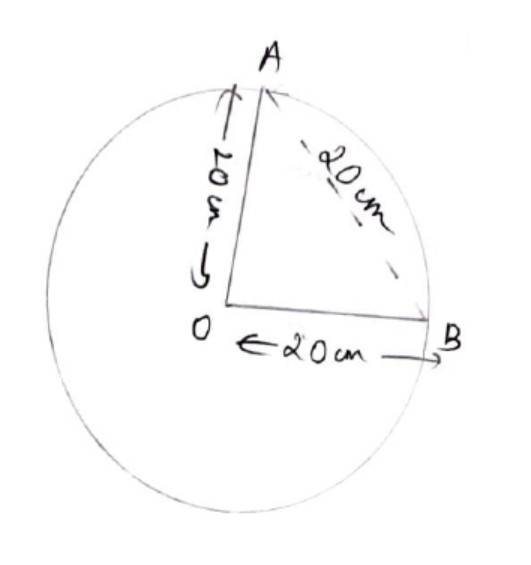
Contributor-Level 10
So, radius, r = cm = 20 cm
Length of chord (AB) = 20cm
In OAB
OA = OB=AB=20 cm
Hence, AOAB is equilateral triangle and end of the angle is 60°
:. Ø =60° = 60 *
radian = radian
Hence, length of minor are of the chord, l=rØ.
l = 20 * cm
l = cm.
New answer posted
a year agoContributor-Level 10
4. Here l = 22cm.
r =100cm.
Ø =?
Hence by r =
= Ø = = radian
= * /π
= * 180° *
=
=12 = 12°
New answer posted
a year ago3. A wheel makes 360 revolutions in one minute. Through how many radians does it turn in one second?
Contributor-Level 10
3. Given that a wheel makes 360 revolutions in one minute
Then, number of revolutions in one second = =6.
In 1 complete revolution the wheel turns 360°= 2π radian.
So, In 6 revolution, the wheel will turns 6*2π radian = 12π radian.
Hence, in one second the wheel will turn an angle of 12π radian.
New answer posted
a year agoContributor-Level 10
2. (i)
We know that radian= 180°,
Hence, radian= *
= * = * *180
=
=39 0
= 39+ minute (as 1=60′)
=39°+22′+
=39°+22′+ (as 1′=60”)
=39°+22′+30”.
=39° 22′ 30”.
(ii) -4
We know that radian = 180°.
Hence: -4 radian = -4* = 4* = 4*180°* .
= -
=229 0
=229+
=229+5′+ .
=229°+5′+27″
=229° 5′27″
(iii) .
Solution: We know that, π radian= 180°.
Here radian = *
=300°
(iv)
Solution: We know that radian =180° .
Here, &n
New answer posted
a year agoContributor-Level 10
1. (i) 25°
Solution:We know that 180° = π radian.
Hence, 25° = 25 radian= radians.
(ii) 47°30′
Solution: We know that 180° = π radian,
Hence, -47°30′= -47 * degree= * radians.
= radians
(iii) 240°
Solution:We know that, 180°= radian.
Hence, 240°= 240* radian.
= radian.
(iv) 520°
Solution: We know that, 180= radian.
Hence, 520°= 520°* radian.
= radian.
New answer posted
a year agoContributor-Level 10
90. There are four entries in a determinant of 2 x 2 order. Each entry may be filled up in two ways with 0 or 1.
Number of determinants that can be formed = (2)4 = 16
The value of determinants is positive in the following cases:
Therefore, the probability that the determinant is positive = 3/16
New answer posted
a year agoContributor-Level 10
89. A patient has options to have the treatment of yoga and meditation and that of prescription of drugs.
Let these events be denoted by E1 and E2 i.e.,
E1 = Treatment of yoga and meditation
E2 = Treatment of prescription of certain drugs
P (E1) = P (E2) = 1/2
Let A denotes that a person has heart attack, then P (A) = 40% = 0.40
Yoga and meditation reduces heart attack by 30.
Inspite of getting yoga and meditation treatment heart risk is 70% of 0.40
P (A|E1) = 0.40 x 0.70 = 0.28
Also, Drug prescription reduces the heart attack rick by 25%
Even after adopting the drug prescription hear rick is 75% of 0.40
P (A|E2)&
New answer posted
a year agoContributor-Level 10
88. Let R be the event of drawing the red marble.
Let EA, EB, and EC respectively denote the events of selecting the box A, B, and C.
Total number of marbles = 40
Number of red marbles = 15
P (R) = 15/40 = 3/8
Probability of drawing the red marble from box A is given by P (EA|R).
Probability that the red marble is from box B is P (EB|R).
Probability that the red marble is from box C is P (EC|R).
New answer posted
a year agoContributor-Level 10
87. When a die is thrown, then probability of getting a six = 16
then, probability of not getting a six = 1 - 16 = 56
If the man gets a six in the first throw, then
probability of getting a six = 16
If he does not get a six in first throw, but gets a six in second throw, then
probability of getting a six in the second throw = 56*16 = 536
If he does not get a six in the first two throws, but gets in the third throw, then
probability of getting a six in the third throw = 56*56*16 = 25216
probability that he does not get a six in any of the three throws = 56*56*56 = 125216
In the first throw he gets a six, then he will receive Re 1.
If he gets a si
New answer posted
a year agoContributor-Level 10
86. Let the man toss the coin n times. The n tosses are n Bernoulli trials.
Probability (p) of getting a head at the toss of a coin is 1/2.
∴ p = 1/2 ⇒ q = 1/2
It is given that,
P (getting at least one head) > 90/100
P (x ≥ 1) > 0.9
⇒ 1 − P (x = 0) > 0.9
The minimum value of n that satisfies the given inequality is 4.
Thus, the man should toss the coin 4 or more than 4 times.
Taking an Exam? Selecting a College?
Get authentic answers from experts, students and alumni that you won't find anywhere else
Sign Up on ShikshaOn Shiksha, get access to
- 66k Colleges
- 1.2k Exams
- 711k Reviews
- 1850k Answers