Maths

Get insights from 6.5k questions on Maths, answered by students, alumni, and experts. You may also ask and answer any question you like about Maths

Follow Ask Question
6.5k

Questions

0

Discussions

29

Active Users

0

Followers

New answer posted

a year ago

0 Follower 3 Views

A
alok kumar singh

Contributor-Level 10

47. Given, f (x) = (ax + b) (cx + d)2

So, f?(x) = (ax +b) ddx(cx+d)2+(cx+d)2ddx(ax+b)

=(ax+b)ddx[(c+d)(cx+d)]+(cx+d)2a

=(ax+b)[(c+d)ddx(x+d)+(c+d)ddx(c+d)]+a(cx+d)2

=(ax+b)[c(cx+d)+c(cx+d)]+a(cx+d)2

=(ax+b)·2·c(cx+d)+a(cx+d)2

New answer posted

a year ago

0 Follower 22 Views

A
alok kumar singh

Contributor-Level 10

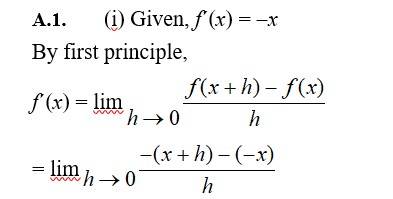
44.
= l i m h 0 x h + x h
= l i m h 0 h h
= l i m h 0 1

= - 1.

(ii) Given, f(x) = (-x)-1

by first principle,

f(x) l i m h 0 [ ] ( x + h ) 1 ( x ) 1 h

(iii) Given, f(x) = sin(x + 1)

By first principle,

f'(x) = limh0f(x+h)f(x)h

=limh0sin(x+h+1)sin(x+1)h

=limh02h·cos(x+h+1+x+12)·sin(x+h+1(x+1)2)

=limh02hcos(2x+2+h2)sin(h2).

=limh0cos(2x+2+h2)limh0sinh2h2

=cos(2x+2+02)*1.

= cos (x + 1)

(iv) Given, f(x) = cos (xπ8)

By first principle,

f(x) = limh0f(x+h)f(x)h

=limh0cos(x+hπ8)cos(xπ8)h


New answer posted

a year ago

0 Follower 5 Views

A
alok kumar singh

Contributor-Level 10

. (i) f(x)=sin x cos x

So, f?(x)=limh?0f(x+h)?f(x)h

=limh?0sin(x+h)cos(x+h)?sinxcosxh

=limh?012h*[2sin(x+h)cos(x+h)?2sinxcosx]

=limh?012h[sin2(x+h)?sin2x]

=limh?012h[2cos2(x+h)+2x2sin2(x+h)?2x2]

=limh?01h[cos(2x+h)sinh]

=limh?0cos(2x+h)*limh?0sinhh

=cos(2x+0)

=cos2x

(ii) f(x)=secx

So, f?(x)=limh?0f(x+h)?f(x)h

=limh?01h[sec(x+h)?secx]

=limh?01h[1cos(x+h)?1cosx]

=limh?01h[cosx?cos(x+h)cos(x+h)cosx]

=limh?01h[?2sin(x+x+h2)sin(x?(x+h)2)cos(x+h)cosx]

=limh?01h[?2sin(2x+h2)sin(?h/2)cos(x+h)cosx]

=limh?0(?1sin(2x+h2)cos(x+h)cosx*limh?0(?1)sinh/2h/2

=sinxcosx?cosx*1

=tanx?secx.

(iii) Given f(x)=5 sec x+4 cosx.

So, f?(x)=limh?0f(x+h)?f(x)h

=limh?05sec(x+h)+4cos(x+h)?[5secx+4cosx]h.

=limh?05h[sec(x+h)?secx]+limh?04h[cos(x+h)?cosx]

=limh?05h[1cos(x+h)?1cosx]+limh?04h[?2sin(x+h+x2)sin(x+h?x2)]

=limh?05h[cosx?cos(x+h)cos(x+h)(cosx)]+limh?04h[?2sin(2x+h2)sinh2]

=limh?05h[?2sin(2x+h2)sin(?h/2)cos(x+h)cosx]?4limh?0sin(2x+h2)limh?0sinh/2h/2

=sin(2x+02)cos(x+0)cosx*1?4sin(2x2)

=5sinxcosx?1cosx?4sinx

=5tanx?secx?4sinx

(iv) Given f(x)=cosecx

f?(x)=limh?0f(x+h)?f(x)h

=limh?01h[cosec(x+h)?cosecx]

=limh?01h[1sin(x+h)?1sinx]

=limh?01h[sinx?sin(x+h)sin(x+h)sinx]

=limh?01h[2cos(x+x+h2)sin(x?(x+h)2)]sin(x+h)sinx]

=limh?01h[2cos(x+x+h2)sin(x?(x+h)2)sin(x+h)sinx]

=limh?01h[2cos(2x+h2)sin(?h/2)]sin(x+h)sinx]

=limh?0cos(2x+h2)sin(x+h)sinx*(?1)sin(2)h/2)

=cos(2x+02)sin(x+0)sinx*(?1)

=?cosxsinx*1sinx

=?cotx?cosecx

(v) Given,f(x)=3 cot x+5cosecx.

So, f?(x)=limh?0f(x+h)?f(x)h =2cos(x+0)cosx*1+7sin(2x+02)*(?1)

=limh?03cot(x+h)+5cosec(x+h)?[3cotx+5cosx)

h?03h[cot(x+h)?cotx]+limh?0

=?5h[cosec(x+h)?cosecx]

=limh?03h[cos(x+h)sin(x+h)?cosxsinx]+limh?05h[1sin(x+h)?1sinx]

=limh?03h[cos(x+h)sinx?cosxsin(x+h)sin(x+h)sinx]+limh?05h[sinx?sin(x+h)sin(x+h)sinx]

=limh?03h[sin(x?(x+h))sin(x+h)sinx+limh?05h[2cos(x+x+h2)sin(x?(x+h)2)sin(x+h)sinx

=limh?03sin(x+h)sinx*limh?0(?1)sinhh+limh?05h[2cos(2x+h2)sin(?h/2)sin(x+h)sinx

=3sinx?sinx*(?1)+5lim

New answer posted

a year ago

0 Follower 4 Views

A
alok kumar singh

Contributor-Level 10

(i) f(x)=sin x cos x

So, f?(x)=limh?0f(x+h)?f(x)h

=limh?0sin(x+h)cos(x+h)?sinxcosxh

=limh?012h*[2sin(x+h)cos(x+h)?2sinxcosx]

=limh?012h[sin2(x+h)?sin2x]

=limh?012h[2cos2(x+h)+2x2sin2(x+h)?2x2]

=limh?01h[cos(2x+h)sinh]

=limh?0cos(2x+h)*limh?0sinhh

=cos(2x+0)

=cos2x

(ii) f(x)=secx

So, f?(x)=limh?0f(x+h)?f(x)h

=limh?01h[sec(x+h)?secx]

=limh?01h[1cos(x+h)?1cosx]

=limh?01h[cosx?cos(x+h)cos(x+h)cosx]

=limh?01h[?2sin(x+x+h2)sin(x?(x+h)2)cos(x+h)cosx]

=limh?01h[?2sin(2x+h2)sin(?h/2)cos(x+h)cosx]

=limh?0(?1sin(2x+h2)cos(x+h)cosx*limh?0(?1)sinh/2h/2

=sinxcosx?cosx*1

=tanx?secx.

(iii) Given f(x)=5 sec x+4 cosx.

So, f?(x)=limh?0f(x+h)?f(x)h

=limh?05sec(x+h)+4cos(x+h)?[5secx+4cosx]h.

=limh?05h[sec(x+h)?secx]+limh?04h[cos(x+h)?cosx]

=limh?05h[1cos(x+h)?1cosx]+limh?04h[?2sin(x+h+x2)sin(x+h?x2)]

=limh?05h[cosx?cos(x+h)cos(x+h)(cosx)]+limh?04h[?2sin(2x+h2)sinh2]

=limh?05h[?2sin(2x+h2)sin(?h/2)cos(x+h)cosx]?4limh?0sin(2x+h2)limh?0sinh/2h/2

=sin(2x+02)cos(x+0)cosx*1?4sin(2x2)

=5sinxcosx?1cosx?4sinx

=5tanx?secx?4sinx

(iv) Given f(x)=cosecx

f?(x)=limh?0f(x+h)?f(x)h

=limh?01h[cosec(x+h)?cosecx]

=limh?01h[1sin(x+h)?1sinx]

=limh?01h[sinx?sin(x+h)sin(x+h)sinx]

=limh?01h[2cos(x+x+h2)sin(x?(x+h)2)]sin(x+h)sinx]

=limh?01h[2cos(x+x+h2)sin(x?(x+h)2)sin(x+h)sinx]

=limh?01h[2cos(2x+h2)sin(?h/2)]sin(x+h)sinx]

=limh?0cos(2x+h2)sin(x+h)sinx*(?1)sin(2)h/2)

=cos(2x+02)sin(x+0)sinx*(?1)

=?cosxsinx*1sinx

=?cotx?cosecx

(v) Given,f(x)=3 cot x+5cosecx.

So, f?(x)=limh?0f(x+h)?f(x)h =2cos(x+0)cosx*1+7sin(2x+02)*(?1)

=limh?03cot(x+h)+5cosec(x+h)?[3cotx+5cosx)

h?03h[cot(x+h)?cotx]+limh?0

=?5h[cosec(x+h)?cosecx]

=limh?03h[cos(x+h)sin(x+h)?cosxsinx]+limh?05h[1sin(x+h)?1sinx]

=limh?03h[cos(x+h)sinx?cosxsin(x+h)sin(x+h)sinx]+limh?05h[sinx?sin(x+h)sin(x+h)sinx]

=limh?03h[sin(x?(x+h))sin(x+h)sinx+limh?05h[2cos(x+x+h2)sin(x?(x+h)2)sin(x+h)sinx

=limh?03sin(x+h)sinx*limh?0(?1)sinhh+limh?05h[2cos(2x+h2)sin(?h/2)sin(x+h)sinx

=3sinx?sinx*(?1)+5limh

New answer posted

a year ago

0 Follower 5 Views

A
alok kumar singh

Contributor-Level 10

42. Given, f(x) = cos x

f(x+h)=cos(x+h)

By first principle,

f(x)=limxhf(x+h)f(x)h

=limxh1h[cos(x+h)cosx]

=limxh1h[2sin(x+h+x2)sin(x+hx2)]

=limxh1h[2sin(2x+h2)sin(h2)]

=limxh1h[2sin(2x+h2)sin(h2)]

=limxhsin(2x+h2)*limxhsinh/2h/2

=sin(2x+02)*1=sinx.

New answer posted

a year ago

0 Follower 32 Views

A
alok kumar singh

Contributor-Level 10

41. (i) f(x)=2x34

f(x)=ddx(2x34)

=2dxdx0

=2.

(ii) Given, f(x)= (5x3+3x1)(x1)

So, f(x)=(5x3+3x1)ddx(x1)+(x1)ddx(5x3+3x1)

=(5x3+3x1).1+(x1)(15x2+3)

5x3+3x1+i5x3+3x15x23

=20x315x2+6x4.

(iii) Given, f(x) = x3(5+3x)

So, f(x)=x3ddx(5+3x)+(5+3x)dx3dx=x33+(5+3x)(3)x4

=3x315x49x3

=15x46x3

=3x4(5+2x).

(iv) Given, f(x)= x5(36x9).

f(x)=x5ddx(36x9)+(36x9)ddxx5.

=x5(6x9x10)+(36x9)5x4

x5(54x10)+15x430x5

=54x530x5+15x4

=24x5+15x4

(v) Given, f(x)= x4(34x5).

So, f(x)=x4ddx(34x5)+(34x5)ddxx4

=x4(4x5*x6)+(34x5)(4x5)

=20x1012x5+16x10.

=36x1012x5.

=36x1012x5.

(vi) Given, f(x)= 2x+1x23x1

So, f(x)=ddx(2x+1)ddx(x23x1)

=(x+1)ddx2ddx(x+1)(x+1)2(3x1)dx2dxx2ddx(3x1)(3x1)2

=2(x+1)22x(3x1)3x2(3x1)2

=2(x+1)26x22x3x2(3x1)2

=2(x+1)23x22x(3x1)2

=2(x+1)2x(3x2)(3x1)2

New answer posted

a year ago

0 Follower 2 Views

A
alok kumar singh

Contributor-Level 10

40. Given, f(x)= xnanxa.

So, f(x)=(xa)ddx(xna3)ddx(xa)(xnan)(xa)2=(xa)nxn1(xnan)(xa)2

=(xa)nxn1(xnan)(xa)2

=nxn1xnaxn1xn+an(xa)2

=nxnxxnaxn1+an(xa)2

New answer posted

a year ago

0 Follower 6 Views

P
Payal Gupta

Contributor-Level 10

14. Let A(x1, y1, z1) and B(x2, y2, z2) trisect the line segment joining the points P(4, 2, –6) and Q(10, –16, 6).

Since A divides PQ internally in ratio 1 : 2. Then co-ordinates of A

(1(10)+2(4)1+2,1(16)+2(2)1+2,1(6)+2(6)1+2)

(10+83,16+43,6123)

(183,123,63)

= (6, –4, –2)

Similarly B divides PQ internally in ratio 2 : 1. Then co-ordinates of B

(2(10)+1(4)2+1,2(16)+1(2)2+1,2(6)+1(6)2+1)

(20+43·,·32+23·,·1263)

(243,303,63)

= (8, –10, 2)

Hence the points which trisects the line segment joining the points P(4, 2, –6) and Q(10, –16, 6) are (6, –4, –2) and (8, –1)

New answer posted

a year ago

0 Follower 15 Views

P
Payal Gupta

Contributor-Level 10

13. Let P divides AB in ratio k : 1. Then co-ordinates of point P are

(k(1)+1(2)k+1,k(2)+1(3)k+1,k(1)+1(4)k+1)

(k+2k+1,2k3k+1,k+4k+1)

Let us examine whether the value of k, the point P coincides with point C

Putting k+2k + 1=0

=> k+2=0

=> k=2

Put k=2 in

2k  3k + 1

2(2)  32 + 1

4  33

13

And put k=2 in

k + 4k + 1

2 + 42 + 1

63

= 2

Therefore, C (0,13,2) is a point which divides AB internally in ratio 2 : 1 and is same as P. Hence A, B and C are collinear.

New answer posted

a year ago

0 Follower 2 Views

P
Payal Gupta

Contributor-Level 10

12. Let YZ-plane divides the line segment joining A (–2, 4, 7) and B (3, –5, 8) at point P (x, y, z) in the ratio k : 1.

Then the co-ordinates of P are.

(k (3)+1 (2)k+1, k (5)+1 (4)k+1, k (8)+1 (7)k+1)

(3k2k+1, 5k+4k+1, 8k+7k+1)

As P lies on YZ-plane its x-coordinate is zero.

i.e. 3k2k + 1=0

=> 3k2=0

=> k=23

Hence the YZ-plane divides AB internally in ratio.

23 : 1 = 2 : 3

Get authentic answers from experts, students and alumni that you won't find anywhere else

Sign Up on Shiksha

On Shiksha, get access to

  • 66k Colleges
  • 1.2k Exams
  • 711k Reviews
  • 1850k Answers

Share Your College Life Experience

×
×

This website uses Cookies and related technologies for the site to function correctly and securely, improve & personalise your browsing experience, analyse traffic, and support our marketing efforts and serve the Core Purpose. By continuing to browse the site, you agree to Privacy Policy and Cookie Policy.