

Maths
Get insights from 6.5k questions on Maths, answered by students, alumni, and experts. You may also ask and answer any question you like about Maths
Follow Ask QuestionQuestions
Discussions
Active Users
Followers
New answer posted
a year agoContributor-Level 10
7. One rolling a dice we have the possible outcome 1, 2, 3, 4, 5 and 6. Let us denote R, W and B as red, white and blue respectively. So, the desired sample space is
S = { (R, 1), (R, 2), (R, 3), (R, 4), (R, 5), (R, 6), (W, 1), (W, 2), (W, 3), (W, 4), (W, 5), (W, 6), (B, 1), (B, 2), (B, 3), (B, 4), (B, 5), (B, 6)}
New answer posted
a year agoContributor-Level 10
6. Let us denote B1, B2 to be the boys and G1, G2 to be the girls in Room X and B3 to be the boy and G3, G4, G5 to the girls in Room Y. Hence the desired sample space is
S = { (X, B1), (X, B2), (X, G1), (X, G2), (Y, B3), (Y, G3), (Y, G4), (Y, G5)}
New answer posted
a year agoContributor-Level 10
5. When a coin is tossed we have the outcomes of a head or a tail and when a dieice is rolled we have the outcome 1, 2, 3, 4, 5 or 6. So, the desired sample space is
S = {T, (H, 1), (H, 2), (H, 3), (H, 4), (H, 5), (H, 6)}
New answer posted
a year agoContributor-Level 10
4. The possible outcomes of throwing a coin and rolling a dice are Head and tail and 1, 2, 3, 4, 5 and 6 respective. So, the desired sample space is
S = { (H, 1), (H, 2), (H, 3), (H, 4), (H, 5), (H, 6), (T, 1), (T, 2), (T, 3), (T, 4), (T, 5), (T, 6)}
New answer posted
a year agoContributor-Level 10
3. On tossing a coin the possible outcomes are Head and Tail. The sample space of tossing a coin four times is
S = {HHHH, THHH, HTHH, HHTH, HHHT, TTTT, HTTT, THTT, TTHT, TTTH, TTHH, HHTT, THTH, HTHT, THHT, HTTH}
New answer posted
a year agoContributor-Level 10
2. When a dice is thrown, we have 36 the possible outcome.
Dice 2 Dice 1 | 1 | 2 | 3 | 4 | 5 | 6 |
1 | (1, 1) | (1, 2) | (1, 3) | (1, 4) | (1, 5) | (1, 6) |
2 | (2, 1) | (2, 2) | (2, 3) | (2, 4) | (2, 5) | (2, 6) |
3 | (3, 1) | (3, 2) | (3, 3) | (3, 4) | (3, 5) | (3, 6) |
4 | (4, 1) | (4, 2) | (4, 3) | (4, 4) | (4, 5) | (4, 6) |
5 | (5, 1) | (5, 2) | (5, 3) | (5, 4) | (5, 5) | (5, 6) |
6 | (6, 1) | (6, 2) | (6, 3) | (6, 4) | (6, 5) | (6, 6) |
New answer posted
a year agoContributor-Level 10
1. On tossing a coin the possible outcomes are that of a head or a tail. So, the angle space of tossing a coin three times is
S = {HHH, HHT, HTH, THH, TTH, THT, HTT, TTT}
New answer posted
a year agoContributor-Level 10
76.
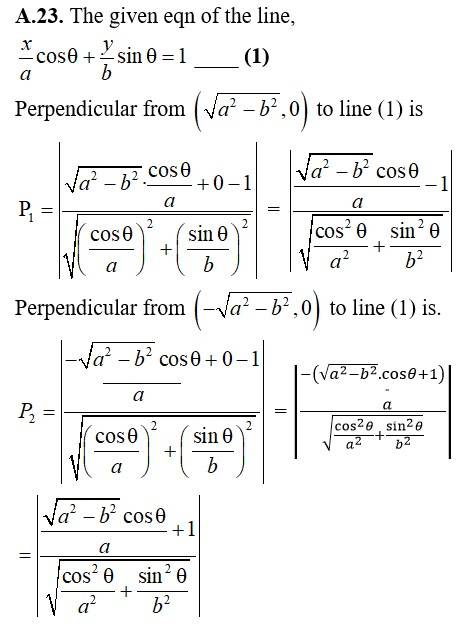
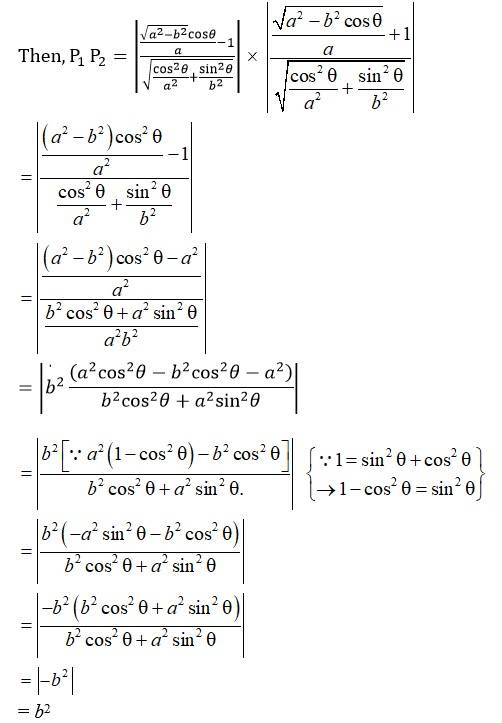
If point P be the junction between the lines
2x – 3y + 4 = 0 ______ (1)
3x + 4y – 5 = 0 ______ (2)
Solving (1) and (2) using 3 * (1) – 2 * (2) we get,
6x – 9y + 12 – (6x + 8y – 10) = 0
–17y + 22 = 0
y =
And 2x = 3y– 4
=> 2x = 3 * – 4
x = – 2 = =
Hence, the co-ordinate of the junction is P
The eqn of the path to be reach is
6x – 7y + 8 = 0 _____ (3)
Then, least distance will be perpendicular path.
So, slope of ⊥ path =
Hence eqn of shortest/least distance path from P is
119x + 102y – 125 = 0

New answer posted
a year agoContributor-Level 10
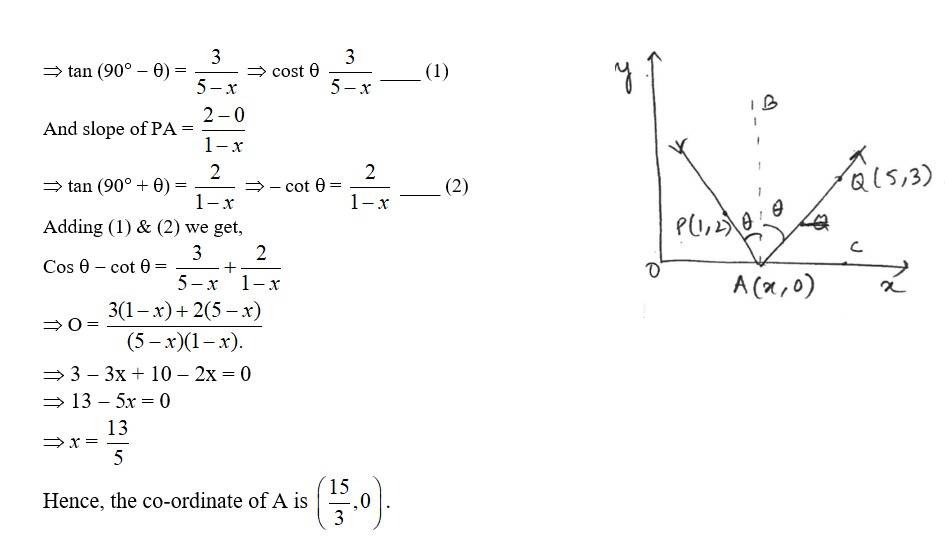
Let A have the co-ordinate (x, o)
By laws of reflection
∠PAB = ∠ QAB = θ
And ∠ CAQ + θ = 90°
As normal is ⊥ to surface (x-axis)
⇒ ∠CAQ = 90° - θ
and ∠CAP = 90° + θ

Taking an Exam? Selecting a College?
Get authentic answers from experts, students and alumni that you won't find anywhere else
Sign Up on ShikshaOn Shiksha, get access to
- 66k Colleges
- 1.2k Exams
- 712k Reviews
- 1850k Answers