

Maths
Get insights from 6.5k questions on Maths, answered by students, alumni, and experts. You may also ask and answer any question you like about Maths
Follow Ask QuestionQuestions
Discussions
Active Users
Followers
New answer posted
a year agoContributor-Level 10
73. The given eqn of limes are.
9x + 6y – 7 = 0 ______ (1)
3x + 2y + b = 0 ______ (2)
Let P (x0, y0) be a point equidistant from (1) and (2) so

9x0 + 6y - 7 = ± 3 (3x0 + 2y0 + 6)
When, 9x0 + 6y0 – 7 = 3 (3x0 + 2y0 + 6)
⇒ 9x0 + 6y0 - 7 = 9x0 + 6y0 + 18
⇒ - 7 = 18 which in not true
So, 9x0 + 6y0 - 7 = -3 (3x0 + 2y0 + 6)
⇒ 9x0 + 6y0 -7 = -9x0 -6y0 -18
⇒ 18x0 + 12y0 + 11= 0.
Hence, the required eqn of line through (x0, y0) & equidistant from parallel line 9x + 6y - 7 = 0
and 3x + 2y + 6 = 0 is 18x + 12y + 11 = 0.
New answer posted
a year agoContributor-Level 10
72. The given eqn of the lines are.
x + y ? 5 = 0 _______ (1)
3x ? 2y + 7 = 0 ______ (2)
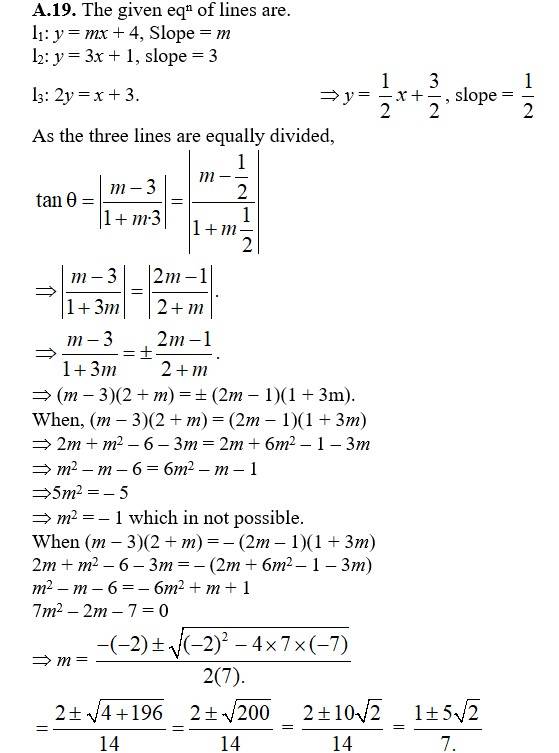
Given, sum of perpendicular distance of P (x, y) from the two lines is always 10 .

The above eqn can be expressed as a linear combination Ax + By + C = 0 where A, B & C are constants representing a straight line
P (x, y) mover on a line.
New answer posted
a year agoContributor-Level 10
70. The given equation of the line is
l1: x + y = 4
Let P (x0, y0) be the point of intersect of l1 and the line to be drawn.
Then, x0 + y0 = 4 ⇒ y0 = 4? x
Given, distance between P (x0, y0) and Q (? 1, 2) is 3
ie, 
⇒ (x0 + 1)2 + (y? 2)2= 9
⇒x20+1+ 2x0 + (4? x? 2)2 = 9
⇒ x20+ 2x0 + 1 + (2? x0 )2 = 9
⇒x20+ 2x0 + 1 + 4 + x20 ? 4x0 ?9 = 0
⇒ 2 x20 ?2x0 ? 4 = 0
x20 ? x0 ? 2 = 0
x20 + x0 ? 2x0 ? 2 = 0
x0 (x +1)? 2 (x0 +1) = 0
(x0 +1) (x0 ? 2) = 0
x0 = 2 and x0 =? 1
When, x0 = 2, y0 = 4 ?2 = 2.
and when x0 =? 1, y0 = y? (?1) =5.
The points of interaction of line l1which are at distance 3 unit

New answer posted
a year agoContributor-Level 10
36. Given, A={9,10,11,12,13}.
f(x)=the highest prime factor of n.
and f: A → N.
Then, f(9)=3 [? prime factor of 9=3]
f (10)=5 [? prime factor of 10=2,5]
f(11)=11 [? prime factor of 11 = 11]
f(12)=3 [? prime factor of 12 = 2, 3]
f(13)=13 [? prime factor of 13 = 13]
?Range of f=set of all image of f(x) = {3,5,11,13}.
New answer posted
a year agoContributor-Level 10
35. Given, f={(ab, a+b): a, b z}
Let a=1 and b=1; a, b z.
So, ab=1 * 1=1
a+b=1+1=2.
So, we have the order pair (1,2).
Now, let a= –1 and b= –1; a, b z
So, ab=(–1) * (–1)=1
a+b=(–1)+(–1)= –2
So, the ordered pair is (1, –2).
?The element 1 has two image i.e., 2 and –2.
Hence, f is not a function.
New answer posted
a year agoContributor-Level 10
34. Given,
A={1,2,3,4}
B={1,5,9,11,15,16}
f={(1,5),(2,9),(3,1),(4,5),(2,11)}.
(i) As every element of f is an element of A * B
We can clearly say that f A * B.
?f is a relation from A to B.
(ii) As the element 2 of the domain has two image i.e., 9 and 11. f is not a function.
New answer posted
a year agoContributor-Level 10
69.
The given eqn of the lines are.
4x + 7y + 5 = 0______ (1)
2x - y = 0 ______ (2)
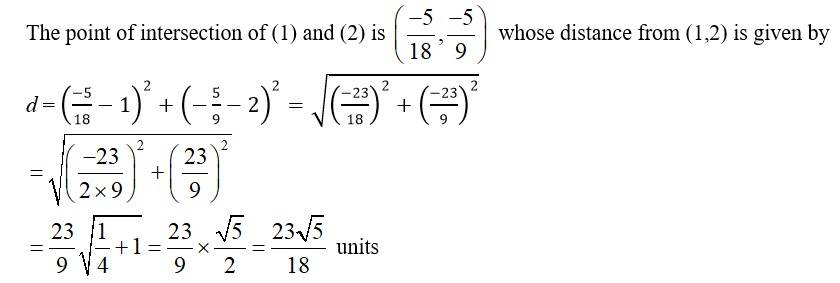
Solving (1) and (2) we get,
4 x + 7 (2 x)+5 = 0
4x +14 x + 5= 0
x =
and y = 2x =
New answer posted
a year agoContributor-Level 10
33. Given, R= { (a, b): a, b N and a = b2}
(i) Let a = 2 N
Then b = 22 = 4 N
but a ≠ b.
Hence the given statement is not true.
(ii) For a=b2 the inverse b=a2 may not hold true
Example (4,2) R, a=4, b=2 and a=b2
but (2,4) R.
Hence, the given statement is not true.
(iii) If (a, b) R
a=b2…… (1)
and (b, c) R
b=c2……. (2)
so for (1) and (2),
a= (c2)2=c4.
is, a ≠c2,
Hence, (a, c) R.
? The given statement is false.
New answer posted
a year agoContributor-Level 10
32. Given, f(x) = (ax + b)
= {(1,1),(2,3),(0, – 1),(–1, –3)} .
As (1,1) f.
Then, f(1)=1 [? f(x) = y for (x, y)]
a * 1+b=1
a+b=1…… (1)
and (0, – 1) f .
Then, f(0)= –1
a* 0+b= –1
b= –1…….(2)
Putting value of (2) in (1) we gets
a – 1=1
a=1+1
a=2
So, (a, b)=(2, –1)
Taking an Exam? Selecting a College?
Get authentic answers from experts, students and alumni that you won't find anywhere else
Sign Up on ShikshaOn Shiksha, get access to
- 66k Colleges
- 1.2k Exams
- 712k Reviews
- 1850k Answers