
Ncert Solutions Chemistry Class 12th
Get insights from 2.6k questions on Ncert Solutions Chemistry Class 12th, answered by students, alumni, and experts. You may also ask and answer any question you like about Ncert Solutions Chemistry Class 12th
- 2.6k
Questions
- 0
Discussions
- 0
Active Users
- 79
Followers
Have a question about Ncert Solutions Chemistry Class 12th? Ask our experts
Keep it short & simple. Type complete word. Avoid abusive language.
Which of the following is not a broad spectrum antibiotic?
Which of the following is not a broad spectrum antibiotic?
Penicillin is not a broad spectrum artibiotic and is used to treat only certain infections caused by streptococci and staphylococci such as pneumonia.
 Upvote

Kindly consider the following figure
Upvote 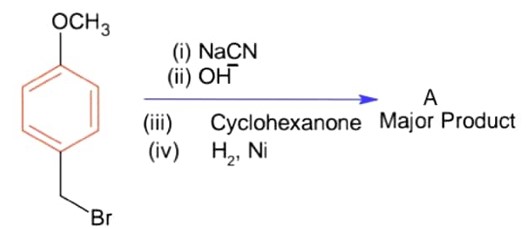
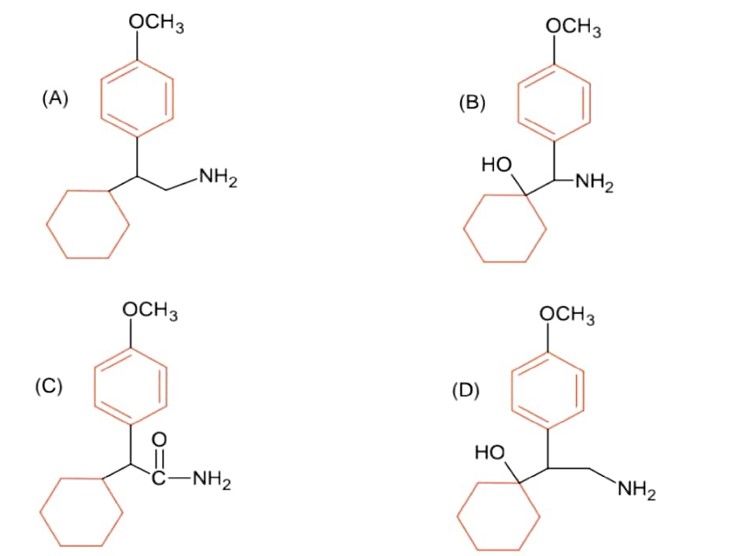
Kindly consider the following figure
Upvote Which of the following is an example of conjugated diketone?
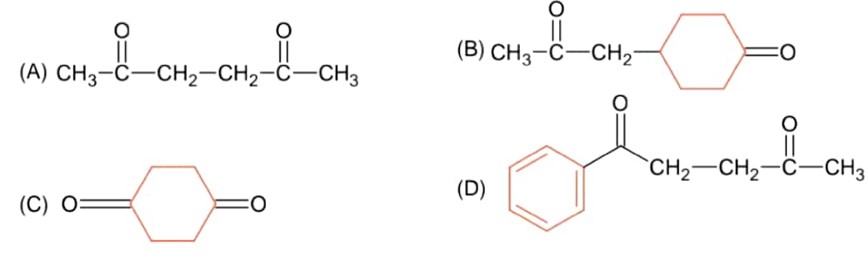
Which of the following is an example of conjugated diketone?
Kindly consider the following figure
Upvote Two statement are given below:
Statement I : The melting point of monocarboxylic acid even number of carbon atoms is higher than that of with odd number of carbon atoms acid immediately below and above it in the series.
Statement II : The solubility of monocarboxylic acids in water decreases with increases in molar mass.
Choose the most appropriate options
Two statement are given below:
Statement I : The melting point of monocarboxylic acid even number of carbon atoms is higher than that of with odd number of carbon atoms acid immediately below and above it in the series.
Statement II : The solubility of monocarboxylic acids in water decreases with increases in molar mass.
Choose the most appropriate options
Melting point of monocarboxylic acids with even number of carbon is more than that with odd number of carbon due to lattice energy.
With increase in molar mass of monocarboxylic acids size of alkyl group (Hydrophobic portion) increases and therefore solubility in water decreases.
Upvote In the given reaction sequence, the major product ‘C’ is : :
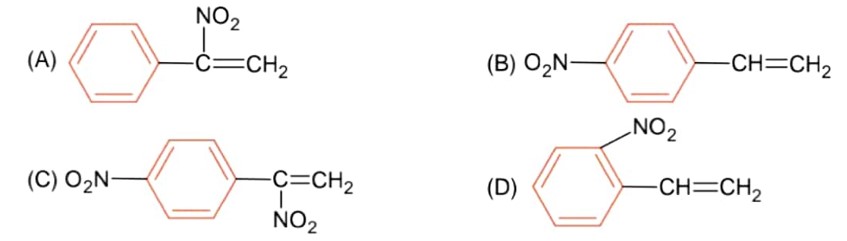
In the given reaction sequence, the major product ‘C’ is : :
Kindly consider the following figure
Upvote Match List – I with List – II:
List – I List – II
(A) Sphalerite (I) FeCO3
(B) Calamine (II) PbS
(C) Galena (III) ZnCO3
(D) Siderite (IV) ZnS
Choose the most appropriate answer from the options given below :
Match List – I with List – II:
List – I List – II
(A) Sphalerite (I) FeCO3
(B) Calamine (II) PbS
(C) Galena (III) ZnCO3
(D) Siderite (IV) ZnS
Choose the most appropriate answer from the options given below :
Sphalarite ZnS
Calamine ZnCO3
Galena PbS
Siderite &
Upvote Given below are two statements :
Statement I : Emulsions of oil in water are unstable and sometimes they separate into two layers on standing.
Statement II : For stabilization of an emulsion, excess of electrolyte is added. In the light of the above statements, choose the most appropriate answer from the options given below :
Given below are two statements :
Statement I : Emulsions of oil in water are unstable and sometimes they separate into two layers on standing.
Statement II : For stabilization of an emulsion, excess of electrolyte is added. In the light of the above statements, choose the most appropriate answer from the options given below :
Emulsions gets separated into two layers on standing.
For stabilization of emulsion. Emulsifying agents added into it but not electrolyte.
Upvote 0.01 M KMnO4 solution was added to 20.0mL of 0.05 M Mohr’s salt through a burette. The initial reading of 50mL burette is zero. The volume of KMnO4 solution left in the burette after the end point is__________ mL. (nearest integer)
0.01 M KMnO4 solution was added to 20.0mL of 0.05 M Mohr’s salt through a burette. The initial reading of 50mL burette is zero. The volume of KMnO4 solution left in the burette after the end point is__________ mL. (nearest integer)
n-factor of KMnO4 in acidic medium = 5
n-factor of Mohr's salt = 1
meq of KMnO4 = meq of Mohr's salt
0.01 * 5 * V = 0.05 * 1 * 20
Volume of KMnO4 used, V = 20 mL
So; Volume of KMnO4 left in burette = 50 -20mL
= 30 mL
Upvote The complete combustion of 0.492g of an organic compound containing ‘C’, ‘H’ and ‘O’ given 0.793g of CO2 and 0.442g H2O. The percentage of oxygen composition in the organic compound is __________. (nearest integer)
The complete combustion of 0.492g of an organic compound containing ‘C’, ‘H’ and ‘O’ given 0.793g of CO2 and 0.442g H2O. The percentage of oxygen composition in the organic compound is __________. (nearest integer)
Moles of C = moles of CO2
=
Mass of C =
= 0.261g
Moles of H = 2 ×
Mass of H =
Total mass of compound = 0.492g (given)
So; mass of O = (0.492 – 0.216 – 0.049) g
= 0.227g
% of O =
= 46.14%
the nearest integer = 46
Upvote