
Ncert Solutions Chemistry Class 12th
Get insights from 2.6k questions on Ncert Solutions Chemistry Class 12th, answered by students, alumni, and experts. You may also ask and answer any question you like about Ncert Solutions Chemistry Class 12th
- 2.6k
Questions
- 0
Discussions
- 0
Active Users
- 79
Followers
Have a question about Ncert Solutions Chemistry Class 12th? Ask our experts
Keep it short & simple. Type complete word. Avoid abusive language.
Number of paramagnetic oxides among the following given oxides is_________.
Li2O, CaO, Na2O2, KO2, MgO and K2O
Number of paramagnetic oxides among the following given oxides is_________.
Li2O, CaO, Na2O2, KO2, MgO and K2O
Given are the oxide of alkali and alkaline earth metals which are ionic in nature.
Simple oxide are Li2O, CaO, MgO and K2O.
Peroxide is Na2O2 and superoxide is KO2.
All simple oxides are diamagnetic as it has no unpaired electron.
 Upvote

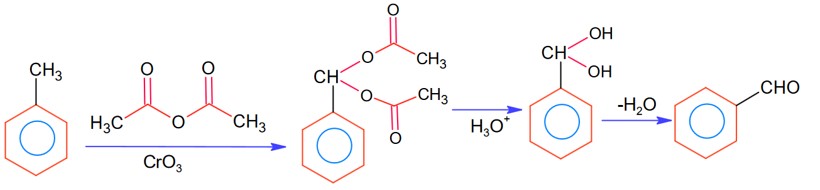
Oxidation of toluene to benzaldehyde can be easily carried out with which of the following
Oxidation of toluene to benzaldehyde can be easily carried out with which of the following
The reaction of H2O2 with potassium permanganate in acidic medium leads to the formation of mainly.
The reaction of H2O2 with potassium permanganate in acidic medium leads to the formation of mainly.
Nucleophilicity is directly proportional to the electron density of atom and inversely proportional to its electronegativity.
Upvote The IUPAC nomenclature of an element with electronic configuration [Rn] 5f146d17s2 is:
The IUPAC nomenclature of an element with electronic configuration [Rn] 5f146d17s2 is:
IUPAC nomenclature of element with atomic no. 103 is uniltrium.
Upvote 

Match the List-I with List-II
List-I
List-II
(A) N2(g) + 3H2(g) -> 2NH3(g)
(I) Cu
(B) CO(g) + 3H2(g) -> CH4(g) + H2O(g)
(II) Cu/ZnO – Cr2O3
(C) CO(g) + H2(g) -> HCOH(g)
(III) FexOy + K2O + Al2O3
(D) CO(g) + 2H2(g) -> CH3OH(g)
(IV) Ni
Choose the correct answer from the options given below:
Match the List-I with List-II
|
List-I |
List-II |
|
(A) N2(g) + 3H2(g) -> 2NH3(g) |
(I) Cu |
|
(B) CO(g) + 3H2(g) -> CH4(g) + H2O(g) |
(II) Cu/ZnO – Cr2O3 |
|
(C) CO(g) + H2(g) -> HCOH(g) |
(III) FexOy + K2O + Al2O3 |
|
(D) CO(g) + 2H2(g) -> CH3OH(g) |
(IV) Ni |
Choose the correct answer from the options given below:
Uses of catalyst is very specific for a particular reaction.
Upvote SO2Cl2 on reaction with excess of water results into acidic mixture
SO2Cl2 + H2O -> H2SO4 + 2HCl
16 moles of NaOH is required for the complete neutralization of the resultant acidic mixture. The number of moles of SO2Cl2 used is:
SO2Cl2 on reaction with excess of water results into acidic mixture
SO2Cl2 + H2O -> H2SO4 + 2HCl
16 moles of NaOH is required for the complete neutralization of the resultant acidic mixture. The number of moles of SO2Cl2 used is:
Let a moles of SO2Cl2 is taken
Then no. of moles of H2SO4 = a moles
No. of moles of HCl = 2a moles
No. of moles of NaOH required = 2a + 2a = 4a = 16
Upvote