
Ncert Solutions Chemistry Class 12th
Get insights from 2.6k questions on Ncert Solutions Chemistry Class 12th, answered by students, alumni, and experts. You may also ask and answer any question you like about Ncert Solutions Chemistry Class 12th
- 2.6k
Questions
- 0
Discussions
- 0
Active Users
- 79
Followers
Have a question about Ncert Solutions Chemistry Class 12th? Ask our experts
Keep it short & simple. Type complete word. Avoid abusive language.
Diamond has a three dimensional structure of C atoms formed by covalent bonds. The structure of diamond has face centre cubic lattice where 50% of the tetrahedral voids are also occupied by carbon atoms. The number of carbon atoms present per unit cell of diamond is_________.
Diamond has a three dimensional structure of C atoms formed by covalent bonds. The structure of diamond has face centre cubic lattice where 50% of the tetrahedral voids are also occupied by carbon atoms. The number of carbon atoms present per unit cell of diamond is_________.
In fcc structure of diamond four C present in fcc lattice and other four C present in tetrahedral voids where 50% of tetrahedral voids are occupied. Hence number of carbon atoms present per unit cell of diamond is 8.
 Upvote

An aqueous solution of NiCl2 was heated with excess sodium cyanide in presence of strong oxidizing agent to form <!-- [if gte mso 9]><xml>
An aqueous solution of NiCl2 was heated with excess sodium cyanide in presence of strong oxidizing agent to form <!-- [if gte mso 9]><xml>
Complex has Ni4+ and strong ligand, hence following are the metal ion electronic configuration
Change of unpaired electron = 2
Upvote 100ml of 0.0018% (w/v) solution of Cl- ion was the minimum concentration of Cl- required to precipitate a negative sol in one h. THE coagulating value of Cl- ion is_________.
(Nearest integer)
100ml of 0.0018% (w/v) solution of Cl- ion was the minimum concentration of Cl- required to precipitate a negative sol in one h. THE coagulating value of Cl- ion is_________.
(Nearest integer)
Wt of Cl- in 100 ml = 1.8 × 10⁻³ gm
Mol. of Cl- in 100 ml =
i.e. 0.507 milli mole in one lit required in one hr.
Coagulation value = (millimole/lit) required in one hr = 0.507
= 1 (the nearest integer)
Upvote The wavelength of electrons accelerated from rest through a potential difference of 40 kV is x × 10-12m. The value of x is________. (Nearest Integer)
Given : Mass of electron = 9.1 × 10⁻³¹kg
Charge on an electron = 1.6 × 10⁻¹⁹C
Planck’s constant = 6.63 × 10⁻³⁴Js
The wavelength of electrons accelerated from rest through a potential difference of 40 kV is x × 10-12m. The value of x is________. (Nearest Integer)
Given : Mass of electron = 9.1 × 10⁻³¹kg
Charge on an electron = 1.6 × 10⁻¹⁹C
Planck’s constant = 6.63 × 10⁻³⁴Js
Here,
[the nearest integer = 6]
Upvote When 0.15g of an organic compound was analyzed using carius method for estimation of bromine, 0.2397g of AgBr was obtained. The percentage of bromine in the organic compound is_________. (Nearest Integer) (Atomic mass: Ag = 108, Br = 80)
When 0.15g of an organic compound was analyzed using carius method for estimation of bromine, 0.2397g of AgBr was obtained. The percentage of bromine in the organic compound is_________. (Nearest Integer) (Atomic mass: Ag = 108, Br = 80)
0.15 gm (organic compounds)
0.2397 gm
Weight of Br in A
Upvote <p><strong>When 0.15g of an organic compound was analyzed using carius method for estimation of bromine, 0.2397g of AgBr was obtained. The percentage of bromine in the organic compound is_________. (Nearest Integer) (Atomic mass: Ag = 108, Br = 80)</strong></p>
Benzene on nitration givens nitrobenzene in presence of HNO3 and H2SO4 mixture, where:
Benzene on nitration givens nitrobenzene in presence of HNO3 and H2SO4 mixture, where:
Due to the larger acid dissociation constant (Ka) sulphuric acid acts as an acid and HNO3 acts as a base.
Upvote The major product (P) in the following reaction is:
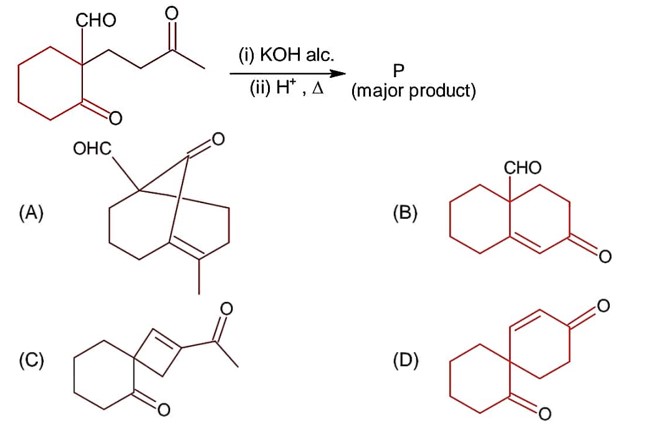
The major product (P) in the following reaction is:
Kindly consider the following figure
Upvote Due to the absence of acidic hydrogen in But – 2-yne, metallic sodium does not react with this.
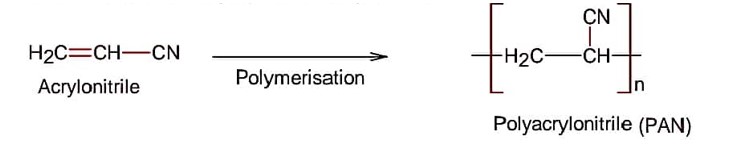
Upvote Orlon fibres are the polymer of acrylonitrile
Upvote