Ncert Solutions Chemistry Class 12th
Get insights from 2.6k questions on Ncert Solutions Chemistry Class 12th, answered by students, alumni, and experts. You may also ask and answer any question you like about Ncert Solutions Chemistry Class 12th
- 2.6k
Questions
- 0
Discussions
- 0
Active Users
- 79
Followers
Have a question about Ncert Solutions Chemistry Class 12th? Ask our experts
Keep it short & simple. Type complete word. Avoid abusive language.
Which one of the following 0.06M aqueous solutions has lowest freezing point?
Depression in freezing point will be maximum for Al2 (SO4)3 since its Van't Hoff factor is the highest. So its solution will have the lowest freezing point.
When silver nitrate solution is added to potassium iodide solution then the sol produced is:
When AgNO3 is added to Kl solution, precipitate of Agl is formed which adsorb I- ion from
Dispersion medium to give negatively charged sol
Agl/l-- negatively charged sol.
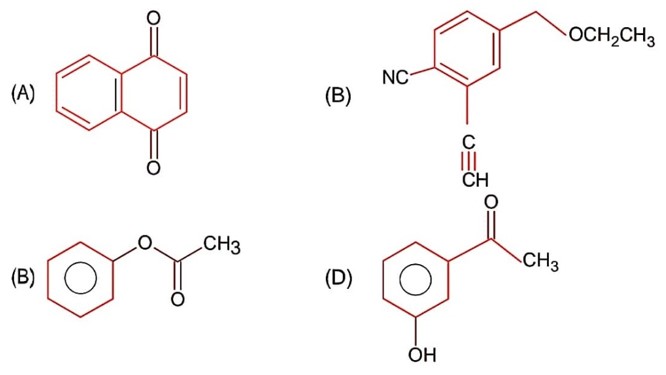
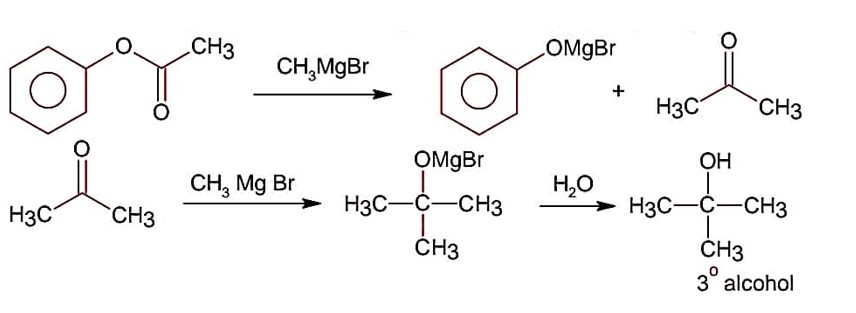
Which one of the following compounds will provide a tertiary alcohol on reaction with excess of CH3MgBr followed by hydrolysis?
Esters on treating with excess CH3MgBr followed by hydrolysis gives 3° alcohol.
The number of nitrogen atoms in a semicarbazone molecule of acetone is_________.
Reaction of acetone and semicarbazide
At 20°C the vapour pressure of benzene is 70 torr and that of methyl benzene is 20 torr. The mole fraction of benzene in the vapour phase at 20°C above an equimolar mixture of benzene and methyl benzene is__________ × 10-2. (Nearest integer)

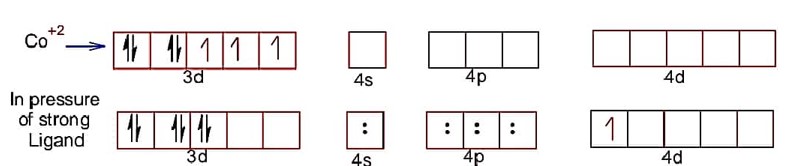
Hence, electronic configuration of CO2+ is
spin magnetic moment =
Given below are two statements. One is labelled as Assertion A and the other is labelled as Reason R.
Assertion A: Sharp glass edge becomes smooth on heating it upto its melting point.
Reason R: The viscosity of glass decreases on melting.
Choose the most appropriate answer from the options given below.
Both statement are correct for the glass body heating, but reason is not correct explanation during heating process of glass, constituents unit rupture of glass body and gives the edge smoothness.
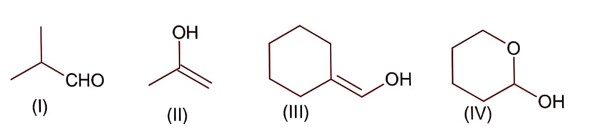
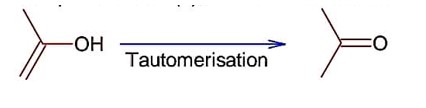
All structure can produce -CHO functional group which gives +ve test of Tollen's reagent except structure (II), because if forms ketonic group after tautomerisation
An inorganic compound ‘X’ on treatment with concentrated H2SO4 produces brown fumes and given dark brown ring with FeSO4 in presence of concentrated H2SO4. Also compound ‘X’ gives precipitate ‘Y’, when its solution in dilute HCl is treated with H2S gas. The precipitate ‘ Y’, on treatment with concentrated HNO3 followed by excess of NH4OH further given deep blue coloured solution, Compound ‘X’ is:
Deep blue colour solution
In cation analysis of Cu+ ions, precipitate formed is CuS on treating with H2S and HCl which dissolved in HNO3 and produced blue colour complex solution
The species given below that does NOT show disproportionation reaction is:
In