
Ncert Solutions Maths class 11th
Get insights from 1.6k questions on Ncert Solutions Maths class 11th, answered by students, alumni, and experts. You may also ask and answer any question you like about Ncert Solutions Maths class 11th
- 1.6k
Questions
- 0
Discussions
- 0
Active Users
- 83
Followers
Have a question about Ncert Solutions Maths class 11th? Ask our experts
Keep it short & simple. Type complete word. Avoid abusive language.
6. Given, 3x – 7 > 5x – 1.
7+1 > 5x – 3x
6 > 2x
–3 > x
So, x ∈ (–∞, – 3)
 Upvote

Kindly consider the following
68. (x + cos x) (x tan x)
Kindly consider the following
68. (x + cos x) (x tan x)
68. Given, f (x) = (x + cos x) (x tan x)
So, f?(x) = (x + cos x)
Let g (x) = tan x.
So, g?(x) = 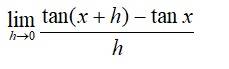
= sec2x ______ (2)
Put (2) in (1) we get,
f?(x) = (x + cos x) (1 - sec2x) +(1 - sin x) (x- tan x)
We know that,
Upvote Solve the inequalities in Exercises 5 to 16 for real x.
5. 4x + 3 < 5x + 7
Solve the inequalities in Exercises 5 to 16 for real x.
5. 4x + 3 < 5x + 7
5. Given,
4 x + 3 < 5 x+ 7.
3 – 7 < 5 x – 4 x.
–4 < x.
So, x ( –4, ∞)
Upvote 4. Solve 3x + 8 > 2, when
(i) x is an integer.
(ii) x is a real number.
4. Solve 3x + 8 > 2, when
(i) x is an integer.
(ii) x is a real number.
4. Given, 3x + 8 > 2
3x + 8 – 8 > 2 – 8
3x > – 6
x > – 2
(i) when x is an integer, x ∈ z all integer greater than – 2 are the soln. so, x = { – 1, 0, 1, 2, 3, …}.
(ii) when x is a real number, all real number greater than – 2 are the soln. so, x ( –2, ∞ )
Upvote 3. Solve 5x – 3 < 7, when
(i) x is an integer.
(ii) x is a real number.
3. Solve 5x – 3 < 7, when
(i) x is an integer.
(ii) x is a real number.
3. Given, 5x – 3 < 7.
5x – 3 + 3 < 7 + 3
5x< 10
x< 2.
(i) when x ∈ z, i. e, x is an integer all integers less than 2 are the soln so, x = {…., – 3, – 2, – 1, 0, 1}
(ii) when x ∈ R i, e x is a real number all t real number less than 2. are the soln so, x∈ (– ∞, 2)
Upvote 2. Solve – 12x > 30, when
(i) x is a natural number.
(ii) x is an integer.
2. Solve – 12x > 30, when
(i) x is a natural number.
(ii) x is an integer.
2. – 12 x> 30.
Dividing both sides by 12 we get,
Multiplying both side by ( – 1) the inequality will change.
i e, x< = – 2.5
(i) As x is a natural number, the soln of the given inequality does not exist in natural numbers.
(ii) As x is an integer, the soln of the given inequality will be all the i
Upvote Class 11 Math Linear Inequalities 5.1 Solution
1. Solve 24x < 100, when
(i) x is a natural number.
(ii) x is an integer.
Class 11 Math Linear Inequalities 5.1 Solution
1. Solve 24x < 100, when
(i) x is a natural number.
(ii) x is an integer.
1. 24x < 100.
Dividing both sides by 24 we get,
x< = 4.166
(i) As x is a natural no the soln of the given inequality are 1, 2, 3, 4.
(ii) As x is an integer the soln of the given inequality are 4, 3, 2, 1, 0, 1, 2, 3, ….
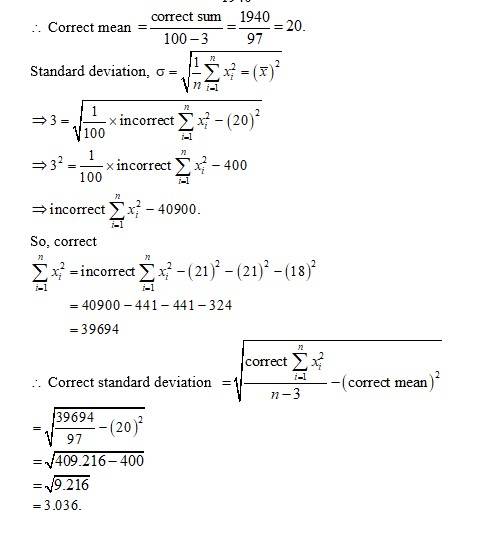
Upvote 34. The mean and standard deviation of a group of 100 observations were found to be 20 and 3, respectively. Later on it was found that three observations were incorrect, which were recorded as 21, 21 and 18. Find the mean and standard deviation if the incorrect observations are omitted.
34. The mean and standard deviation of a group of 100 observations were found to be 20 and 3, respectively. Later on it was found that three observations were incorrect, which were recorded as 21, 21 and 18. Find the mean and standard deviation if the incorrect observations are omitted.
34. Given, n = 100.
incorrect mean ( ) = 20.
incorrect standard deviation (σ) = 3
We know that,
So, incorrect sum of observation = 2000
Correct sum of observation
= 1940
Upvote 33. The mean and standard deviation of marks obtained by 50 students of a class in three subjects, Mathematics, Physics and Chemistry are given below:
Subject Mathematics Physics Chemistry
Mean 42 32 40.9
Standard 12 15 20
deviation
Which of the three subjects shows the highest variability in marks and which shows the lowest?
33. The mean and standard deviation of marks obtained by 50 students of a class in three subjects, Mathematics, Physics and Chemistry are given below:
Subject Mathematics Physics Chemistry
Mean 42 32 40.9
Standard 12 15 20
deviation
Which of the three subjects shows the highest variability in marks and which shows the lowest?
33. C.V in mathematics =
C.V in Physics =
C.V in chemistry =
Chemistry has the highest variability and mathematics has the lowest variability.
Upvote