
Ncert Solutions Maths class 11th
Get insights from 1.6k questions on Ncert Solutions Maths class 11th, answered by students, alumni, and experts. You may also ask and answer any question you like about Ncert Solutions Maths class 11th
- 1.6k
Questions
- 0
Discussions
- 0
Active Users
- 83
Followers
Have a question about Ncert Solutions Maths class 11th? Ask our experts
Keep it short & simple. Type complete word. Avoid abusive language.
2. Mean of the given observation is.
So,
xi | 38 | 10 | 48 | 40 | 42 | 55 | 63 | 46 | 54 | 44 |
| |xi - 50| | 12 | 20 | 2 | 10 | 8 | 5 | 13 | 4 | 6 |
Therefore, the required mean deviation about the mean is
= 8.4
 Upvote

Class 11 Maths Statistics exercise 15.1 Solution
1. Find the mean deviation about the mean for the data in Exercises 1 and 2.
4, 7, 8, 9, 10, 12, 13, 17
Class 11 Maths Statistics exercise 15.1 Solution
1. Find the mean deviation about the mean for the data in Exercises 1 and 2.
4, 7, 8, 9, 10, 12, 13, 17
1. Mean of the given observation is.
Deviation of the respective observation about the mean i.e., are 4–10,7–10,8–10,9–10,10–10,12–10,13–10,17–10
=6, -3, -2, -1,0,2,3,7
The absolute value of the deviation i.e., are 6,3,2,1,0,2,3,7.
Therefore, the required mean deviatio
Upvote 67.
Kindly consider the following
(ax2 + sin x) (p +q cos x)
67.
Kindly consider the following
(ax2 + sin x) (p +q cos x)
67. Given, f (x) = (ax2 + sin x) (p +q cos x).
So, f? (x) = (ax2 + sin x)
= q sin x (ax2 + sin x) + (p + q cos x) (2ax + cos x)
Upvote 66. Given, f (x) = (x2 + 1) cos x
f? (x) = (x2 + 1)
= x2 sin x sin x + 2x cos x.
Upvote 66.
Kindly consider the following
x4 (5 sin x 3 cos x)
66.
Kindly consider the following
x4 (5 sin x 3 cos x)
65. Given, f (x) = x4. (5 sin x 3 cos x)
As
and
Thus,
Upvote 64. Given, f (x) =
Let g?(x) = sin (x + a)
So, g?(x) =

= cos (x + a)
And P(x) = cos x
So, P?(x) =

Thus, f?(x) =
Upvote 63. Given, f (x) =
f?(x) =
{Copy (A)}
So, g?(x) =
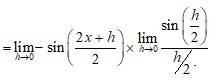
= sin x ______ (2)
And p?(x) =
= cos x _____ (3)
So, put (2) and (3) in (1) we get,
Upvote 62. Given, f (x) =sinnx
By chain rule,
f? (x) = n (sin x)n-1 sin x
Let (gx) = sinx
So, g? (x)
=
= cos x.
So, f? (x) = n (sin x)n-1 cos x.
Upvote 61. Given, f (x) =
So, f?(x) =
Let g(x) = cos x.
So, g?(x)
= -sin x.
So, f?(x)
Upvote