Ncert Solutions Maths class 12th
Get insights from 2.5k questions on Ncert Solutions Maths class 12th, answered by students, alumni, and experts. You may also ask and answer any question you like about Ncert Solutions Maths class 12th
- 2.5k
Questions
- 0
Discussions
- 0
Active Users
- 65
Followers
Have a question about Ncert Solutions Maths class 12th? Ask our experts
Keep it short & simple. Type complete word. Avoid abusive language.
Let f : R -> R be defined as f(x) = 2x -1 and g : R - {1} -> R be defined as g(x) = <!-- [if gte mso 9]><xml>
Let f : R -> R be defined as f(x) = 2x -1 and g : R - {1} -> R be defined as g(x) = <!-- [if gte mso 9]><xml>
One – one but not onto
 Upvote

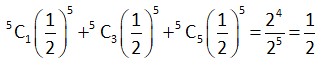
An ordinary dice is rolled for a certain number of times. If the probability of getting an odd number 2 times is equal to the probability of getting an even number 3 times, then the probability of getting an off number of times is:
An ordinary dice is rolled for a certain number of times. If the probability of getting an odd number 2 times is equal to the probability of getting an even number 3 times, then the probability of getting an off number of times is:
Let total number of throws = n
Probability of getting 2 times = Probability of getting an even number 3 times.
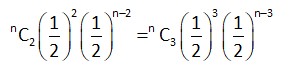
[as probability of getting odd number = probability of getting even number = ]
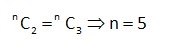
&
Upvote In a geometric progression the ratio of the sum of the first 5 terms to the sum of their reciprocals is 49 and sum of the first and the third term is 35. The fifth term of the G.P. is p, the value of 4p is __________
In a geometric progression the ratio of the sum of the first 5 terms to the sum of their reciprocals is 49 and sum of the first and the third term is 35. The fifth term of the G.P. is p, the value of 4p is __________
Let five terms in G.P. be a/r², a/r, a, ar, ar²
Then, a (r? ² + r? ¹ + 1 + r + r²) / (1/a) (r? ² + r? ¹ + 1 + r? ¹ + r? ²) = 49
⇒ a² = 49 ⇒ a = ±7
Also, a/r² + a = 35
Therefore, a = -7 is not possible
Now, fifth term = ar² = a (7/28) = p ⇒ 4p = 7
Upvote f(1) = 2, g(1) = 2, f'(x), g'(x) exist, then the value of lim(x→1) [f(1)g(x)-f(1)-g(1)f(x)+g(1)] / [f(1)g(x)-f(x)g(1)] is __________
f(1) = 2, g(1) = 2, f'(x), g'(x) exist, then the value of lim(x→1) [f(1)g(x)-f(1)-g(1)f(x)+g(1)] / [f(1)g(x)-f(x)g(1)] is __________
lim (x→1) [f (1)g (x)-f (1)-g (1)f (x)+g (1)] / [f (1)g (x)-f (x)g (1)], form: 0/0
lim (x→1) [f (1)g' (x)-g (1)f' (x)] / [f (1)g' (x)-f' (x)g (1)] = 1
Upvote The lines (x-2)/1 = (y-3)/1 = (z-4)/-k and (x-1)/k = (y-4)/2 = (z-5)/1 are coplanar, if
<!-- [if !supportLineBreakNewLine]-->
<!--[endif]-->
The lines (x-2)/1 = (y-3)/1 = (z-4)/-k and (x-1)/k = (y-4)/2 = (z-5)/1 are coplanar, if
<!-- [if !supportLineBreakNewLine]-->
<!--[endif]-->
| 1 -1 -1 |
| 1 -k | = 0
| k 2 1 |
⇒ 1 (1 + 2k) + 1 (1 + k²) – 1 (2 – k) = 0
2k + 1 + 1 + k² − 2 + k = 0
k² + 3k = 0
k = 0, -3
Upvote A student appeared in an examination consisting of 8 true – false type questions. The student guesses the answers with equal probability. The smallest value of n, so that the probability of guessing at least ‘n’ correct answers is less than 1/2, is :
<!-- [if !supportLineBreakNewLine]-->
<!--[endif]-->
A student appeared in an examination consisting of 8 true – false type questions. The student guesses the answers with equal probability. The smallest value of n, so that the probability of guessing at least ‘n’ correct answers is less than 1/2, is :
<!-- [if !supportLineBreakNewLine]-->
<!--[endif]-->
General form Σ? ? C? (1/2)? < 1/2
Σ? ? C? < 2?
⇒? C? +? C? +.? C? < 128
⇒256− (? C? +? C? +.? C? ) < 128
⇒? C? +? C? +.? C? > 128
n≥5
Upvote