
Ncert Solutions Maths class 12th
Get insights from 2.5k questions on Ncert Solutions Maths class 12th, answered by students, alumni, and experts. You may also ask and answer any question you like about Ncert Solutions Maths class 12th
- 2.5k
Questions
- 0
Discussions
- 0
Active Users
- 65
Followers
Have a question about Ncert Solutions Maths class 12th? Ask our experts
Keep it short & simple. Type complete word. Avoid abusive language.
If the system of equations x - λy - z = 0, λx - y - z = 0, x + y - z = 0 has a unique solution, then the range of λ is R-{a, b}. Then the value of (a2 + b2) is:
<!-- [if !supportLineBreakNewLine]-->
<!--[endif]-->
If the system of equations x - λy - z = 0, λx - y - z = 0, x + y - z = 0 has a unique solution, then the range of λ is R-{a, b}. Then the value of (a2 + b2) is:
<!-- [if !supportLineBreakNewLine]-->
<!--[endif]-->
Δ ≠ 0
| 1 -λ -1 |
| λ -1 -1 | ≠ 0
| 1 -1 |
1 (1+λ) + λ (-λ+1) - 1 (λ+1) ≠ 0
1 + λ - λ² + λ - λ - 1 ≠ 0
-λ² + λ ≠ 0
λ² = 1 ⇒ λ = 1, -1
a² + b² = 2
 Upvote

A JEE aspirant estimates that he will be successful with an 80% chance if he studies 10 hr/day with 60% chance if he studies 7hr/day and with 40% chance if he studies 4 hr/day. Further, he believes that he will study 10 hr, 7hr and 4 hr/day with probability 0.1, 0.2 and 0.7 respectively. Given that he is successful, the probability that he studies for 4 hr/day equals.
<!-- [if !supportLineBreakNewLine]-->
<!--[endif]-->
p (10hr) = .1
p (7hr) = .2
p (4hr) = .7
p (s / 10hr) = .8
p (s / 7hr) = .6
p (s / 4hr) = .4
p (s) = .1 × .8 + .2 × .6 + .7 × .4
p (4hr / s) = (.7 × .4) / (.1 × .8 + .2 × .6 + .7 × .4) = 28 / (8 + 12 + 28) = 28 / 48 = 7 / 12
Upvote Let the lines
L1 :
L2 :
intersects at the point. S. If a plane ax + by – z + d = 0 passes through S and is parallel to both lines L1 and L2, then the value of a + b + d is equal to…………
Let the lines
L1 :
L2 :
intersects at the point. S. If a plane ax + by – z + d = 0 passes through S and is parallel to both lines L1 and L2, then the value of a + b + d is equal to…………
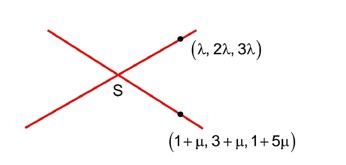
7x – 2y – z + d = 0
(2, 4, 6) Þ d = -14 + 8 + 6
d = 0
7x – 2y – z = 0
7 – 2 = 5
Upvote Let f : R ® R be a function defined by f(x) If the function g(x) = then the greatest integer less than or equal to g(1) is…….
Let f : R ® R be a function defined by f(x) If the function g(x) = then the greatest integer less than or equal to g(1) is…….
Let a circle C in complex plane pass through the points z1 = 3 + 4i, z2 = 4 + 3i and z3 = 5i. If is a point on C such that the line through z and z1 is perpendicular to the line through z2 and z3, then arg(z) is equal to:
Let a circle C in complex plane pass through the points z1 = 3 + 4i, z2 = 4 + 3i and z3 = 5i. If is a point on C such that the line through z and z1 is perpendicular to the line through z2 and z3, then arg(z) is equal to:
y – 4 = 2 (x – 3)
y = 2x – 2
x2 + (2x – 2)2 = 25
Upvote Let Q be the mirror image of the point P(1, 0, 1) with respect to the plane S : x + y + z = 5. If a line L passing through (1, -1, -1) parallel to the line PQ meets the plane S at R, then QR2 is equal to:
Let Q be the mirror image of the point P(1, 0, 1) with respect to the plane S : x + y + z = 5. If a line L passing through (1, -1, -1) parallel to the line PQ meets the plane S at R, then QR2 is equal to:

x + y + z = 5
M (2, 1, 2)
Q (3, 2, 3)
R (3, 1, 1), QR2 = 1 + 4 = 5
Upvote Let E1 and E2 be two events such that conditional probabilities
Then:
Let E1 and E2 be two events such that conditional probabilities
Then:
The equation of the plane passing through the point (1, 2, -3) and perpendicular to the planes 3x + y – 2z = 5 and
The equation of the plane passing through the point (1, 2, -3) and perpendicular to the planes 3x + y – 2z = 5 and
Let direction ratio of the normal to the required plane are l, m, n
Equation of required plane
11 (x – 1) + 1 (y – 2) + 17 (z + 3) = 0
Upvote The distance of the point (1, 1, 9) form the point of intersection of the line <!-- [if gte mso 9]><xml>
The distance of the point (1, 1, 9) form the point of intersection of the line <!-- [if gte mso 9]><xml>
Any point on line
5r + 12 = 17
r = 1
Upvote If f : R -> R is a function defined by f(x) = <!-- [if gte mso 9]><xml>
If f : R -> R is a function defined by f(x) = <!-- [if gte mso 9]><xml>
then f(x) = 0 as
LHL =
is continuous
Upvote