
Ncert Solutions Maths class 12th
Get insights from 2.5k questions on Ncert Solutions Maths class 12th, answered by students, alumni, and experts. You may also ask and answer any question you like about Ncert Solutions Maths class 12th
- 2.5k
Questions
- 0
Discussions
- 0
Active Users
- 65
Followers
Have a question about Ncert Solutions Maths class 12th? Ask our experts
Keep it short & simple. Type complete word. Avoid abusive language.
In a hurdle race, a runner has probability p of jumping over a specific hurdle. Given that in 5 trials, the runner succeeded 3 times, the conditional probability that the runner has succeeded in the first trial is
In a hurdle race, a runner has probability p of jumping over a specific hurdle. Given that in 5 trials, the runner succeeded 3 times, the conditional probability that the runner has succeeded in the first trial is
A: runner succeeded exactly 3 times out of 5.
B: runner succeeds on the first trial.
P (B/A) = P (B ∩ A) / P (A) = (p (? C? p² (1−p)²) / (? C? p³ (1-p)²) = 3/5 = 0.6
 Upvote

Let a, b, c be the roots of the equation x³ – 9x² + 15x + 2 = 0. The volume of a parallelopiped with nonparallel sides aî + bĵ + ck̂, bî + cĵ + ak̂ and cî + aĵ + bk̂ is
Let a, b, c be the roots of the equation x³ – 9x² + 15x + 2 = 0. The volume of a parallelopiped with nonparallel sides aî + bĵ + ck̂, bî + cĵ + ak̂ and cî + aĵ + bk̂ is
Volume = |a b c; b c a; c a b| = |3abc – a³ – b³ – c³|
= | (a + b + c) (a² + b² + c² – ab – bc – ca)| = | (a + b + c) (a + b + c)² – 3 (ab + bc + ca)|
= |9 (81-3 × 15)| = 324
Upvote The lines L1 : x = y = z, L2 : x = <!-- [if gte mso 9]><xml>
The lines L1 : x = y = z, L2 : x = <!-- [if gte mso 9]><xml>
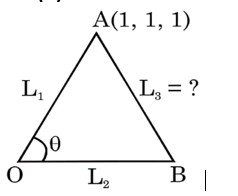
(where q is the angle between L1 & L2)
Upvote The value of 'a' for which the straight line 4x – 3y + 4z – 2 = 0 = 3x – 2y + z – 5 is parallel to the plane 2x – y + az – 7 = 0, is:
<!-- [if !supportLineBreakNewLine]-->
<!--[endif]-->
The value of 'a' for which the straight line 4x – 3y + 4z – 2 = 0 = 3x – 2y + z – 5 is parallel to the plane 2x – y + az – 7 = 0, is:
<!-- [if !supportLineBreakNewLine]-->
<!--[endif]-->
Kindly consider the following figure
Upvote If the value of <!-- [if gte mso 9]><xml>
If the value of <!-- [if gte mso 9]><xml>
The equation of plane which passes through the point of intersection of lines r = i+2j+3k + λ(3i+j+2k) and r = 3i+j+2k + µ(i+2j+3k) where λ,µ ∈ R and has the greatest distance from the origin is :
<!-- [if !supportLineBreakNewLine]-->
<!--[endif]-->
The equation of plane which passes through the point of intersection of lines r = i+2j+3k + λ(3i+j+2k) and r = 3i+j+2k + µ(i+2j+3k) where λ,µ ∈ R and has the greatest distance from the origin is :
<!-- [if !supportLineBreakNewLine]-->
<!--[endif]-->
For point of intersection
1 + 3λ = 3 + μ
2 + λ = 1 + 2μ
5λ = 5 ⇒ λ = 1, μ = 1
Point of intersection (4, 3, 5)
For the greatest distance from origin perpendicular from meet plane at point of intersection
Hence equation r . (4i + 3j + 5k) = 50
Upvote A quadratic function f(x) satisfies f(x) ≥ 0 for all real x. If f(2) = 0 and f(4) = 12, then the value of f(6) is :
<!-- [if !supportLineBreakNewLine]-->
<!--[endif]-->
A quadratic function f(x) satisfies f(x) ≥ 0 for all real x. If f(2) = 0 and f(4) = 12, then the value of f(6) is :
<!-- [if !supportLineBreakNewLine]-->
<!--[endif]-->
f (x) = λ (x-2)²
⇒ 12 = λ (2)² ⇒ λ = 3
f (x) = 3 (x-2)² f (6) = 3 × 4² = 48
Upvote Let Bi (i = 1, 2, 3) be three independent events in a sample space. The probability that only B1 occurs is a, only B2 occurs is b and B3 occurs is <!-- [if gte mso 9]><xml>
Let Bi (i = 1, 2, 3) be three independent events in a sample space. The probability that only B1 occurs is a, only B2 occurs is b and B3 occurs is <!-- [if gte mso 9]><xml>
Let P (B1) = a P (B2) = b P (B3) = c
Given a (1 – b) (1 – c) = a . (i)
b (1 – a) (1 – c) = b . (ii)
c (1 – b) (1 – a) =
Upvote