
Ncert Solutions Maths class 12th
Get insights from 2.5k questions on Ncert Solutions Maths class 12th, answered by students, alumni, and experts. You may also ask and answer any question you like about Ncert Solutions Maths class 12th
- 2.5k
Questions
- 0
Discussions
- 1
Active Users
- 65
Followers
Have a question about Ncert Solutions Maths class 12th? Ask our experts
Keep it short & simple. Type complete word. Avoid abusive language.
46. Given, ax + by2 = cos y.
Differentiating w r t ‘x’ we get,
= a + b 2y = - sin y + sin y = -a
=
= 2by
 Upvote
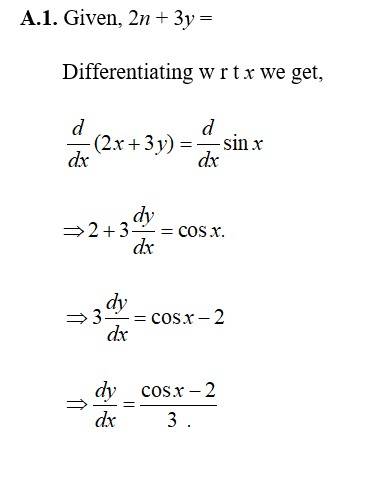
45. Given, 2x + 3y = sin y.
Differentiating w r t x. we get,
=cos y
=
Upvote 44. Kindly go through the solution
Upvote 43. Prove that the greatest integer function defined by
is not differentiable at = 1 and = 2.
43. Prove that the greatest integer function defined by
is not differentiable at = 1 and = 2.
43. The given f x n is
f(x) = 0 < < 3
At x = 1
L×H×L× =
Hence lines does not exist
Qf is not differentiable at x = 1
At x = 2
L×H×L =

Hence, limit does not exist.
Qf is not differentiable at x = 2
Upvote 42. Prove that the function given by
is not differentiable at = 1.
42. Prove that the function given by
is not differentiable at = 1.
42. The given f x v is
f(x) = |x- 1|, x ε R
For a differentiable f x v f at x = c,
and are finite & equal.
So, at x = 1. f(1) = |1 - 1| = 0.
Now,
L×H×L× =
=
R×H×L = = - 1.
= 1
Hence, L×H×S ¹ R×H×L×
So, f is not differentiable at x = 2.
Upvote 59. The planes: are
(A) Perpendicular (B) Parallel (C) intersect y-axis
(D) Passes through (0,0,5/4)
59. The planes: are
(A) Perpendicular (B) Parallel (C) intersect y-axis
(D) Passes through (0,0,5/4)
The equations of the planes are
It can be seen that,
Therefore, the given planes are parallel.
Hence, the correct answer is B.
Upvote Choose the correct answer in Exercise Q. 22 and 23.
58. Distance between the two planes: is
(A) 2 units (B) 4 units (C) 8 units (D) 2/√29 units
Choose the correct answer in Exercise Q. 22 and 23.
58. Distance between the two planes: is
(A) 2 units (B) 4 units (C) 8 units (D) 2/√29 units
The equations of the planes are
It can be seen that the given planes are parallel.
It is known that the distance between two parallel planes, is given by,
Thus, the distance between the lines is 2/√29 units.
Hence, the correct answer is D.
Upvote 57. Prove that if a plane has the intercepts a,b,c and is at a distance of P units from the origin, then
57. Prove that if a plane has the intercepts a,b,c and is at a distance of P units from the origin, then
The equation of a plane having intercepts a, b, c with x, y, and z axes respectively is given by,
The distance (p) of the plane from the origin is given by,
Upvote 56. Find the vector equation of the line passing through the point (1, 2, − 4) and perpendicular to the two lines:
and
56. Find the vector equation of the line passing through the point (1, 2, − 4) and perpendicular to the two lines:
and
Let the required line be parallel to the vector given by,
The position vector of the point (1, 2, − 4) is
The equation of the line passing through (1, 2, −4) and parallel to vector is
The equations of the lines are
Line (1) and
Upvote 55. Find the vector equation of the line passing through (1, 2, 3) and parallel to the plane and
55. Find the vector equation of the line passing through (1, 2, 3) and parallel to the plane and
Let the required line be parallel to vector given by,
The position vector of the point (1, 2, 3) is
The equation of line passing through (1, 2, 3) and parallel to is given by,
The equations of the given planes are
The line in equation (1) and plane in
Upvote