
Ncert Solutions Maths class 12th
Get insights from 2.5k questions on Ncert Solutions Maths class 12th, answered by students, alumni, and experts. You may also ask and answer any question you like about Ncert Solutions Maths class 12th
- 2.5k
Questions
- 0
Discussions
- 1
Active Users
- 65
Followers
Have a question about Ncert Solutions Maths class 12th? Ask our experts
Keep it short & simple. Type complete word. Avoid abusive language.
43. Find the vector equation of the line passing through and perpendicular to the plane
43. Find the vector equation of the line passing through and perpendicular to the plane
The position vector of the point is
The direction ratios of the normal to the plane, , are and the normal vector is
The equation of a line passing through a point and perpendicular to the given plane is given by,
 Upvote

42. If the lines are perpendicular, find the value of k
42. If the lines are perpendicular, find the value of k
The direction of ratios of the lines, , are respectively.
It is known that two lines with direction ratios, , are perpendicular, if
Therefore, for k= -10/7, the given lines are perpendicular to each other.
Upvote 41. If the coordinates of the points A, B, C, D be (1, 2, 3), (4, 5, 7), (−4, 3, −6) and (2, 9, 2) respectively, then find the angle between the lines AB and CD.
41. If the coordinates of the points A, B, C, D be (1, 2, 3), (4, 5, 7), (−4, 3, −6) and (2, 9, 2) respectively, then find the angle between the lines AB and CD.
The coordinates of and respectively.
The direction ratios of
The direction ratios of
It can be seen that,
Therefore, AB is parallel to CD.
Thus, the angle between
Upvote 40. Find the equation of the line parallel to x-axis and passing through the origin.
40. Find the equation of the line parallel to x-axis and passing through the origin.
The line parallel to x-axis and passing through the origin is x-axis itself.
Let A be a point on x-axis. Therefore, the coordinates of A are given by Direction ratios of
The equation of OA is given by,
Thus, the equation of line parallel to x-axis and passing throu
Upvote 39. If are the direction cosines of two mutually perpendicular lines, show that the direction cosines of the line perpendicular to both of these are
39. If are the direction cosines of two mutually perpendicular lines, show that the direction cosines of the line perpendicular to both of these are
It is given that are the direction cosines of two mutually perpendicular lines. Therefore,
Let be the direction cosines of the line which is perpendicular to the line with direction cosines
are the direction cosines of the line.
It is known that,
Subst
Upvote 38. Show that the line joining the origin to the point is perpendicular to the line determined by the points
38. Show that the line joining the origin to the point is perpendicular to the line determined by the points
Let OA be the line joining the origin, and the point,
Also, let BC be the line joining the points,
The direction ratios of
OA is perpendicular to
Thus, OA is perpendicular to BC.
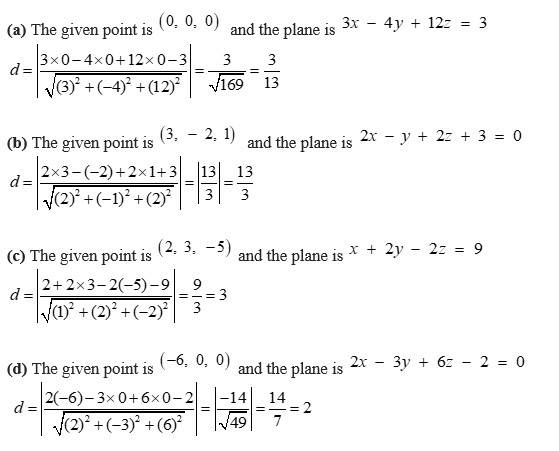
Upvote 37. In the following cases find the distances of each of the given points from the corresponding given plane:
37. In the following cases find the distances of each of the given points from the corresponding given plane:

36. In the following cases, determine whether the given planes are parallel or perpendicular and in case they are neither, find the angle between them.
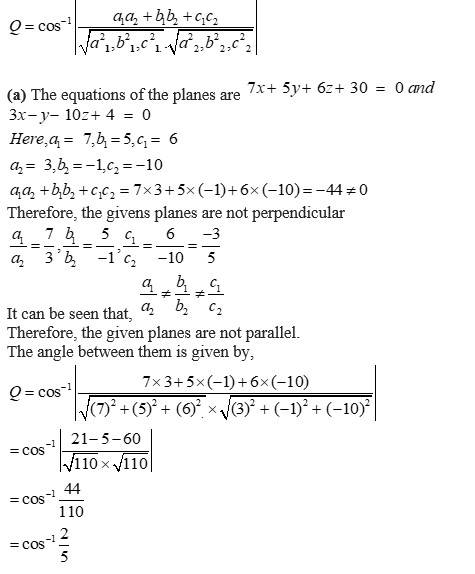
36. In the following cases, determine whether the given planes are parallel or perpendicular and in case they are neither, find the angle between them.
The direction ratios of normal to the plane, , are and
The angle between is given by,
(b) The equations of the planes are
Thus, the given planes are perpendicular to each other.
(c) The equations of the given planes are
Upvote 35. Find the angle between the planes whose vector equations are
35. Find the angle between the planes whose vector equations are
The equations of the given planes are
It is known that if n1 and n2 are normal to the planes, then the angle between them, Q, is given by,
Substituting the value of in equation (1), we obtain
Upvote 34. Find the equation of the plane through the line of intersection of the planes which is perpendicular to the plane
34. Find the equation of the plane through the line of intersection of the planes which is perpendicular to the plane
The equation of the plane through the intersection of the planes, , is
The direction ratios, of this plane are
The plane in equation (1) is perpendicular to
Its direction ratios, are .
Since the planes are perpendicular,
Subs
Upvote