
Ncert Solutions Maths class 12th
Get insights from 2.5k questions on Ncert Solutions Maths class 12th, answered by students, alumni, and experts. You may also ask and answer any question you like about Ncert Solutions Maths class 12th
- 2.5k
Questions
- 0
Discussions
- 1
Active Users
- 65
Followers
Have a question about Ncert Solutions Maths class 12th? Ask our experts
Keep it short & simple. Type complete word. Avoid abusive language.
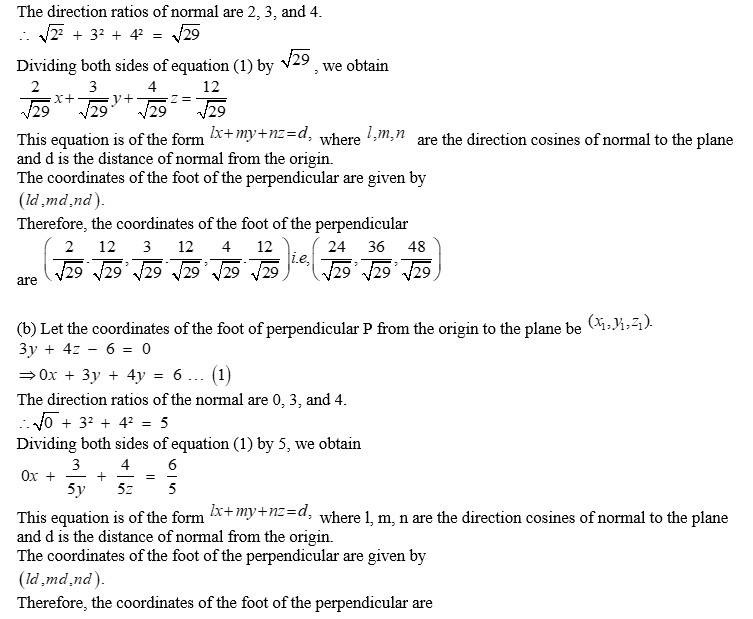
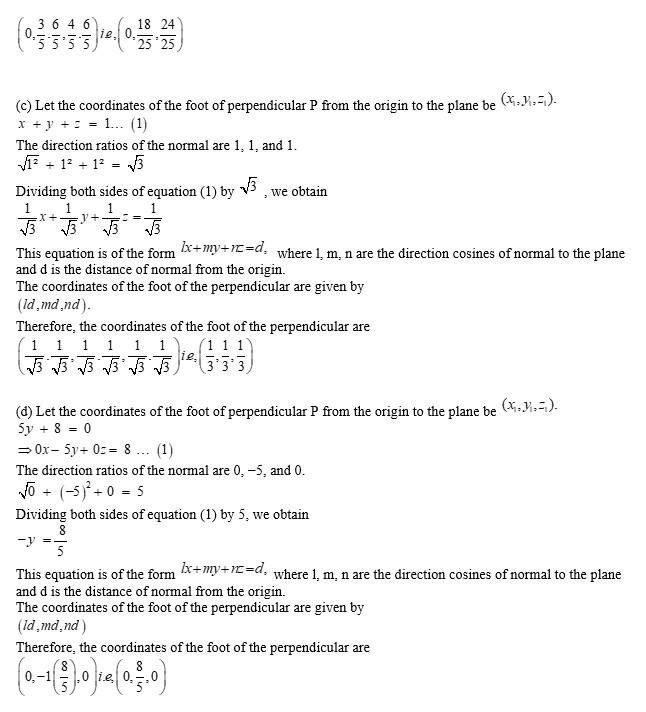
26. In the following cases, find the coordinates of the foot of the perpendicular drawn from the origin:
26. In the following cases, find the coordinates of the foot of the perpendicular drawn from the origin:
(a) Let the coordinates of the foot of perpendicular P from the origin to the plane be
 Upvote

25. Find the Cartesian equation of the following planes:
25. Find the Cartesian equation of the following planes:
(a) It is given that equation of the plane is
For any arbitrary point on the plane, position vector I s given by,
Substituting the value of in equation (1), we obtain
This is the Cartesian equation of the plane.
(b)
For any arbitrary po
Upvote 
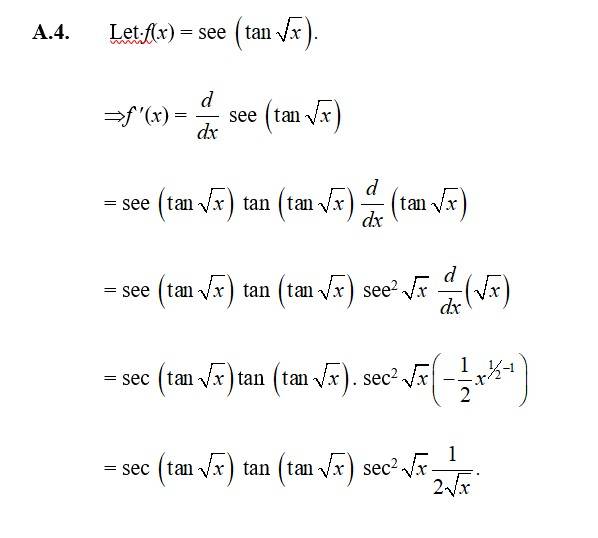
37. Kindly go through the solution
Upvote 24. Find the vector equation of a plane which is at a distance of 7 units from the origin and normal to the vector
24. Find the vector equation of a plane which is at a distance of 7 units from the origin and normal to the vector
(a) It is given that equation of the plane is
For any arbitrary point on the plane, position vector I s given by,
Substituting the value of in equation (1), we obtain
This is the Cartesian equation of the plane.
(b)
For any arbitrary po
Upvote 23. In each of the following cases, determine the direction cosines of the normal to the plane and the distance from the origin.
23. In each of the following cases, determine the direction cosines of the normal to the plane and the distance from the origin.
(a) The equation of the plane is
The direction ratios of normal are
Dividing both sides of equation (1) by 1, we obtain
This is of the form , where l, m, n are the direction cosines of normal to the plane and d is the distance of the perp
Upvote 36. Let f (x) = sin (ax + b)
f' (x) = sin (ax + b)
= cos (ax + b) (ax + b)
= a cos (ax + b).
Upvote 35. Let f (x) = cos (sin x).
f' (x) cos (sin x)
= - sin (sin x) sin x
= - sin (sin x) cos x.
Upvote 22. Find the shortest distance between the lines whose vector equations are
22. Find the shortest distance between the lines whose vector equations are
Here,
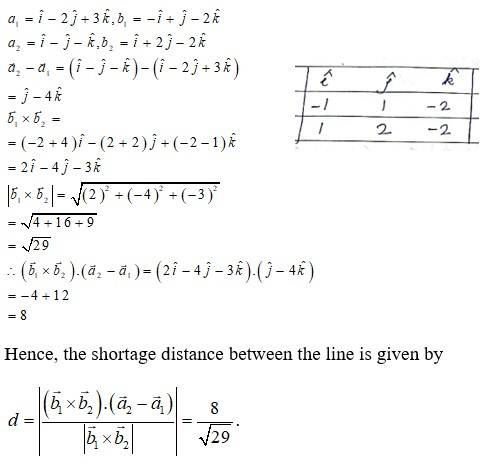
Hence, the shortage distance between the line is given by
Upvote 21. Find the shortest distance between the lines whose vector equations are
21. Find the shortest distance between the lines whose vector equations are
Here, comparing (1) and (2) with and , we have


 Upvote