
Ncert Solutions Maths class 12th
Get insights from 2.5k questions on Ncert Solutions Maths class 12th, answered by students, alumni, and experts. You may also ask and answer any question you like about Ncert Solutions Maths class 12th
- 2.5k
Questions
- 0
Discussions
- 1
Active Users
- 65
Followers
Have a question about Ncert Solutions Maths class 12th? Ask our experts
Keep it short & simple. Type complete word. Avoid abusive language.
52. Let the vectors and such that | | = 3 and | | = √2/3 then is a unit vector, if the angle between and is:
(A)
(B)
(C)
(D)
52. Let the vectors and such that | | = 3 and | | = √2/3 then is a unit vector, if the angle between and is:
(A)
(B)
(C)
(D)
(B) Given,

Hence, is a unit vector if angle between and is
 Upvote
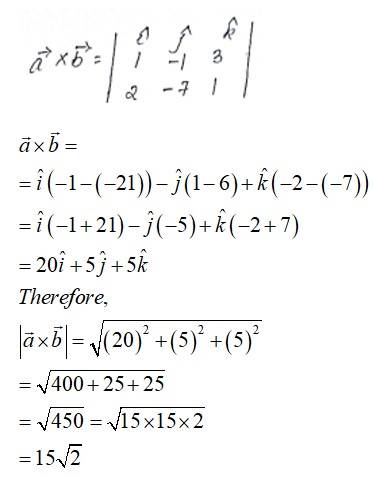
51. Find the area of the parallelogram whose adjacent sides are determined by the vectors
Given,
The area of a parallelogram with and as its adjacent sides is given by
 Upvote
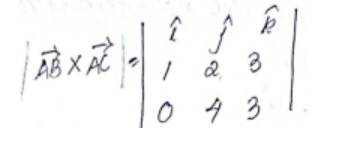
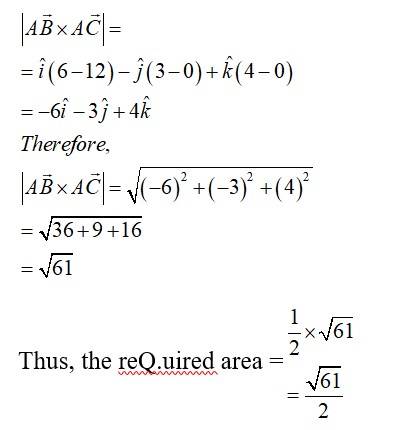
 50. Find the area of the triangle with vertices A (1, 1, 2), B (2, 3, 5) and C (1, 5, 5).
50. Find the area of the triangle with vertices A (1, 1, 2), B (2, 3, 5) and C (1, 5, 5).
Given,
We have,
The area of given triangle is
Upvote 5. Prove that the function continuous at where n is a positive integer.
5. Prove that the function continuous at where n is a positive integer.
4. Given, f (x) = x n > n = positive.
At x = 2,
(x) = n.
f (x) = x n = n
∴ f (x) = f (x)
So f is continuous at x = n.
Upvote 49. If either = 0 and = 0 then Is the converse true? Justify your answer with an example.
49. If either = 0 and = 0 then Is the converse true? Justify your answer with an example.
We take any parallel non- zero vectors so that .
 Upvote
 Given,


Adding (2) and (3), we get
From (1) and (4), we have
Hence, proved.
Upvote 3. Examine the following functions for continuity.
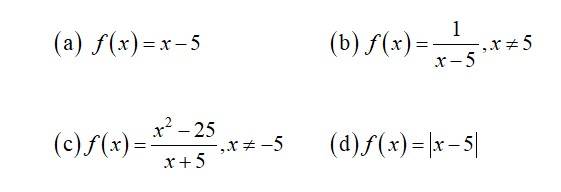
3. Examine the following functions for continuity.
3. (a) Given, f (x) = x 5.
The given f x n is a polynernial f xn and as every pohyouraial f xn is continuous in its domain R we conclude that f (x) is continuous.
(b). Given, f(x) =
For any a {5},
and f(a) =
i e, f(x) = f(a).
Hence f is continuous in its domain.
(c)
Upvote 47. Given that and What can you conclude about the vectors and ?
47. Given that and What can you conclude about the vectors and ?
Given,
and
For,
, then either or or
For,
, then either or or
In case and are non- zero on both side.
But and cannot be both perpendicular and parallel simultaneously.
So, we c
Upvote 
On comparing both side components,
Therefore, the value of and
Upvote