
Ncert Solutions Maths class 12th
Get insights from 2.5k questions on Ncert Solutions Maths class 12th, answered by students, alumni, and experts. You may also ask and answer any question you like about Ncert Solutions Maths class 12th
- 2.5k
Questions
- 0
Discussions
- 1
Active Users
- 65
Followers
Have a question about Ncert Solutions Maths class 12th? Ask our experts
Keep it short & simple. Type complete word. Avoid abusive language.
27. Find the projection of the vector on the vector
27. Find the projection of the vector on the vector
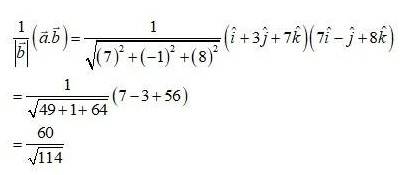
Let,
The projection of vector on is given by,

The projection of vector on is 0.
 Upvote


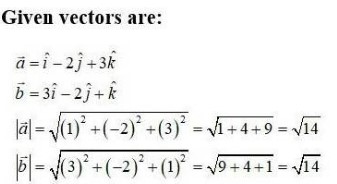

24. Find the angle between two vectors and with magnitude √3 and 2 respectively having . = √6
24. Find the angle between two vectors and with magnitude √3 and 2 respectively having . = √6

23. If and are two collinear vectors, then which of the following are incorrect:
(A) = λ for some scalar λ
(B) = ±
(C) The respective components of and are proportional.
(D) Both the vectors and have same direction, but different magnitudes.
23. If and are two collinear vectors, then which of the following are incorrect:
(A) = λ for some scalar λ
(B) = ±
(C) The respective components of and are proportional.
(D) Both the vectors and have same direction, but different magnitudes.
We know,
If and are two collinear vector, they are parallel.
So,
Hence, the respective component are proportional but, vector and can have different direction.
Thus, the statement given in D is incorrect.
The correct answer is D.
Upvote 22. In triangle ABC (Fig. below), which of the following is not true:
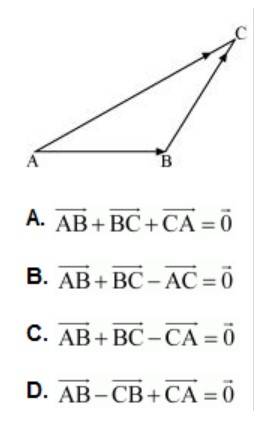
22. In triangle ABC (Fig. below), which of the following is not true:

(A)
By triangle law of addition in given triangle, we get:
So, (A) is true.
(B)
So, (B) is true.
(C)
The eQ.uation in alternative C , which is not true, is incorrect.
(D)
The, equation given is alternative is D is true.
The correct answer is C.
Upvote 21. Show that the points A, B and C with position vectors respectively form the vertices of a right angled triangle.
21. Show that the points A, B and C with position vectors respectively form the vertices of a right angled triangle.
We have,
Now,

Hence,
Hence, given points from the vertices of a right angled triangle.
Upvote 20. Find the position vector of the mid-point of the vector joining the points P (2, 3, 4) and Q. (4, 1, – 2).
20. Find the position vector of the mid-point of the vector joining the points P (2, 3, 4) and Q. (4, 1, – 2).
The Position vector of mid-point R of the vector joining point P (2,3,4) and Q (4,1, -2) is given by;
Upvote 19. Find the position vector of a point R which divides the line joining two points P and Q. whose position vectors are and - respectively, in the ratio 2 : 1
(i) Internally
(ii) Externally
19. Find the position vector of a point R which divides the line joining two points P and Q. whose position vectors are and - respectively, in the ratio 2 : 1
(i) Internally
(ii) Externally
(i) The position vector of point R dividing the join of P and Q. internally in
the ratio 2:1 is,
(ii) The position vector of the point k dividing the join of P and Q. externally in the ratio 2:1
A15. (ii)
Upvote 18. Show that the vector is equally inclined to the axes OX, OY and OZ.
18. Show that the vector is equally inclined to the axes OX, OY and OZ.
