
Ncert Solutions Maths class 12th
Get insights from 2.5k questions on Ncert Solutions Maths class 12th, answered by students, alumni, and experts. You may also ask and answer any question you like about Ncert Solutions Maths class 12th
- 2.5k
Questions
- 0
Discussions
- 1
Active Users
- 65
Followers
Have a question about Ncert Solutions Maths class 12th? Ask our experts
Keep it short & simple. Type complete word. Avoid abusive language.
44. If a unit vector makes an angle π/3 with and an acute angle θ with then find θ and hence, the components of .
44. If a unit vector makes an angle π/3 with and an acute angle θ with then find θ and hence, the components of .
Let as component
We know,
is a unit vector,
Given that,
marks angles with , with and with acute angle.
Now,
We know,

 Upvote

43. Find a unit vector perpendicular to each of the vectors
43. Find a unit vector perpendicular to each of the vectors
Given,
A vector which is perpendicular to both and is given by

Say

Therefore, the unit vector is
Upvote 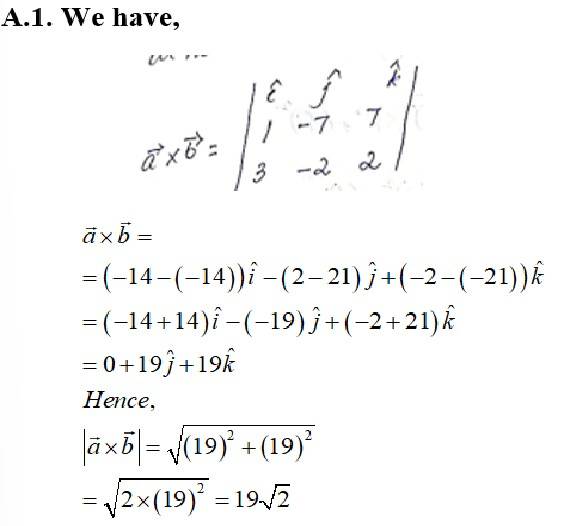
41. If is a nonzero vector of magnitude ‘a’ and λ a nonzero scalar, then λ is unit vector if
(A) λ = 1
(B) λ = –1
(C) a = | λ
|(D) a = 1/|λ|
41. If is a nonzero vector of magnitude ‘a’ and λ a nonzero scalar, then λ is unit vector if
(A) λ = 1
(B) λ = –1
(C) a = | λ
|(D) a = 1/|λ|
Vector is a unit vector if
Now,
Therefore, vectar is a unit vector if a= .
Option (D)is correct.
Upvote 40. Show that the vectors form the vertices of a right angled triangle.
40. Show that the vectors form the vertices of a right angled triangle.
Let vector and be position vector of point A, B, C respectively.
So,
Now, vectors and represents the sides of .
Hence,
 Upvote
39. Show that the points A (1, 2, 7), B (2, 6, 3) and C (3, 10, –1) are collinear.
39. Show that the points A (1, 2, 7), B (2, 6, 3) and C (3, 10, –1) are collinear.

38. If the vertices A, B, C of a triangle ABC are (1, 2, 3), (–1, 0, 0), (0, 1, 2), respectively, then find ∠ABC. [∠ABC is the angle between the vectors and ]
38. If the vertices A, B, C of a triangle ABC are (1, 2, 3), (–1, 0, 0), (0, 1, 2), respectively, then find ∠ABC. [∠ABC is the angle between the vectors and ]
Vertices of are given as
is the angle between the vectors and
 Upvote
37. If either vector . But the converse need not be true. Justify your answer with an example.
37. If either vector . But the converse need not be true. Justify your answer with an example.
Consider
and
Then,

Therefore, the converse of the given statement need not be true.
Upvote <p><strong>3. Examine the following functions for continuity.</strong></p>
36. If and are unit vectors such that = 0 find the value of
36. If and are unit vectors such that = 0 find the value of