
Ncert Solutions Maths class 12th
Get insights from 2.5k questions on Ncert Solutions Maths class 12th, answered by students, alumni, and experts. You may also ask and answer any question you like about Ncert Solutions Maths class 12th
- 2.5k
Questions
- 0
Discussions
- 1
Active Users
- 65
Followers
Have a question about Ncert Solutions Maths class 12th? Ask our experts
Keep it short & simple. Type complete word. Avoid abusive language.
72. If θ be the angle between any two vectors and , then when θ is equal to:
(A) 0
(B)
(C)
(D) π
72. If θ be the angle between any two vectors and , then when θ is equal to:
(A) 0
(B)
(C)
(D) π
Let, be angle between two vector . Then, without loss of generality, are non-zero vectors, so that are positive. Therefore, the correct answer is B. |
 Upvote

71. Choose the correct answer:
The value of is:
(A) 0
(B) -1
(C) 1
(D) 3
71. Choose the correct answer:
The value of is:
(A) 0
(B) -1
(C) 1
(D) 3
Therefore, the correct answer is (C)
Upvote 70. Choose the correct answer:
Let and be two unit vectors andθ is the angle between them. Then is a unit vector if
(A) θ =
(B) θ =
(C) θ =
(D) θ =
70. Choose the correct answer:
Let and be two unit vectors andθ is the angle between them. Then is a unit vector if
(A) θ =
(B) θ =
(C) θ =
(D) θ =
Let, be two unit vectors and be the angle between them.
Then,
Now, is a unit vector if
[ is unit vector.]
Therefore, the correct answer is (D)
Upvote 69. Choose the correct answer:
If θ is the angle between two vectors and then only when:
(A)
(B)
(C)
(D)
69. Choose the correct answer:
If θ is the angle between two vectors and then only when:
(A)
(B)
(C)
(D)
Let, in triangle between two vector
Then, without loss of generality, are non-zero vector so that
are positive.
We know,
So,
Therefore, , when
Hence, the correct answer is B.
Upvote 68. Prove that if and only if are perpendicular given .
68. Prove that if and only if are perpendicular given .
( Distributive of scalar product over addition )
( Scalar product is commutative , )
Therefore, are perpendicular.
Upvote 67. If are mutually perpendicular vectors of equal magnitudes, show that the vector -is equally inclined to and .
67. If are mutually perpendicular vectors of equal magnitudes, show that the vector -is equally inclined to and .
Given that are mutually perpendicular vectors, we have
Let, vector be inclined to at angles, respectively.
Therefore, the vector are equally inclined to
Upvote 66. The scalar product of the vector with a unit vector along the sum of vectors is equal to one. Find the value of λ.
66. The scalar product of the vector with a unit vector along the sum of vectors is equal to one. Find the value of λ.
The unit vector along is given as;

By Q.uestion, scalar product of with this unit vector is 1.
 Upvote
65. Let Find a vector which is perpendicular to both and and = 15
65. Let Find a vector which is perpendicular to both and and = 15
Given,
Let,
Since, is perpendicular to both
We know,
Putting this value in (3) we get
Putting value in (2), we get
The reQ.uired vector is
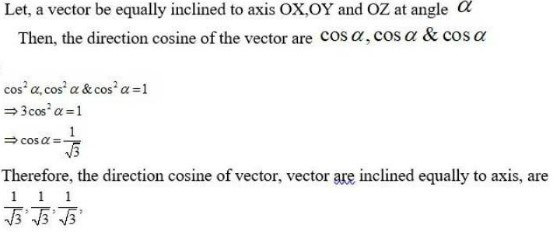
Upvote 64. Show that the direction cosines of a vector equally inclined to the axes OX,Oy and OZ 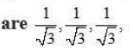
64. Show that the direction cosines of a vector equally inclined to the axes OX,Oy and OZ
63. Two adjacent sides of a parallelogram are . Find the unit vector parallel to its diagonal. Also, find its area.
63. Two adjacent sides of a parallelogram are . Find the unit vector parallel to its diagonal. Also, find its area.
Given,
Adjacent sides of parallelogram are
Diagonal of parallelogram =
Thus, the unit vector parallel to diagonal
 Upvote