Ncert Solutions Maths class 12th
Get insights from 2.5k questions on Ncert Solutions Maths class 12th, answered by students, alumni, and experts. You may also ask and answer any question you like about Ncert Solutions Maths class 12th
- 2.5k
Questions
- 0
Discussions
- 1
Active Users
- 65
Followers
Have a question about Ncert Solutions Maths class 12th? Ask our experts
Keep it short & simple. Type complete word. Avoid abusive language.
<p><strong>8. Write two different vectors having same direction.</strong></p>
7. Write two different vectors having same magnitude.
7. Write two different vectors having same magnitude.
Two different vectors having same magnitude: -
(i)
(ii)
 Upvote


5. Answer the following as true or false:
(i) and - are collinear.
(ii) Two collinear vectors are always equal in magnitude.
(iii) Two vectors having same magnitude are collinear.
(iv) Two collinear vectors having the same magnitude are equal.
5. Answer the following as true or false:
(i) and - are collinear.
(ii) Two collinear vectors are always equal in magnitude.
(iii) Two vectors having same magnitude are collinear.
(iv) Two collinear vectors having the same magnitude are equal.
(i) True, as vector quantity and - are parallel to same line.
(ii) False, as collinear vector are those vectors that are parallel to same line, but it is not necessary that they are equal also.
(iii) False, as two vectors having same magnitude may have different direction
Upvote 4. In the adjoining figure, (a square) identify the following vectors:
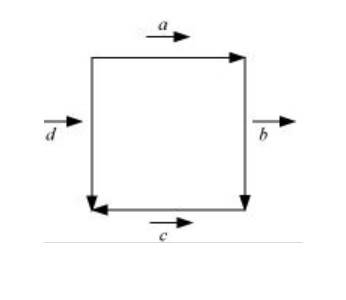
(ii) Equal
(iii) Collinear but not equal.
4. In the adjoining figure, (a square) identify the following vectors:

(ii) Equal
(iii) Collinear but not equal.
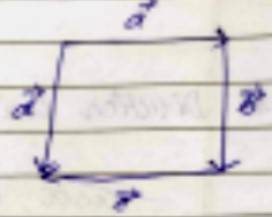
(a) Vector and are co initial same initial point.
(b) and same magnitude & direction.
(c) and are collinear but not equal they are parallels their direction are not same.
Upvote 95. If A and B are any two events such that P (A) + P (B) – P (A and B) = P (A), then
(A) P (B|A) = 1
(B) P (A|B) = 1
(C) P (B|A) = 0
(D) P (A|B) = 0
95. If A and B are any two events such that P (A) + P (B) – P (A and B) = P (A), then
(A) P (B|A) = 1
(B) P (A|B) = 1
(C) P (B|A) = 0
(D) P (A|B) = 0
95.
Therefore, option (B) is correct.
Upvote 3. Classify the following as scalar and vector quantities:
(i) Time period
(ii) Distance
(iii) Force
(iv) Velocity
(v) Work done
3. Classify the following as scalar and vector quantities:
(i) Time period
(ii) Distance
(iii) Force
(iv) Velocity
(v) Work done
(i) Time period involves only magnitude. So, it is scalar quantity.
(ii) Distance involves only magnitude. So, it is scalar quantity.
(iii) Force involves both magnitude and direction. So, it is vector quantity.
(iv) Velocity involves both magnitude and direction. So, it is vector quantity.
(v) Wor
Upvote
2. Check the following measures as scalars and vectors:
(i) 10 kg
(ii) 2 meters north-west
(iii) 40°
(iv) 40 Watt
(v) 10–19 coulomb
(vi) 20 m/sec2
(i) 10 kg
(ii) 2 meters north-west
(iii) 40°
(iv) 40 Watt
(v) 10–19 coulomb
(vi) 20 m/sec2
(i) 10kg involves only magnitude. So, it is scalar quantity.
(ii) 2 meters north-west involves both magnitude and direction. So, it is vector quantity.
(iii) 400 involves only magnitude. So, it is scalar quantity.
(iv) 400 watts involves only magnitude. So, it is scalar quantity.
(v)
Upvote 94. If P (A|B) > P (A), then which of the following is correct:
(A) P (B|A) < P (B)
(B) P (A ∩ B) < P (A).P (B)
(C) P (B|A) > P (B)
(D) P (B|A) = P (B)
94. If P (A|B) > P (A), then which of the following is correct:
(A) P (B|A) < P (B)
(B) P (A ∩ B) < P (A).P (B)
(C) P (B|A) > P (B)
(D) P (B|A) = P (B)
94.
Therefore, option (C) is correct.
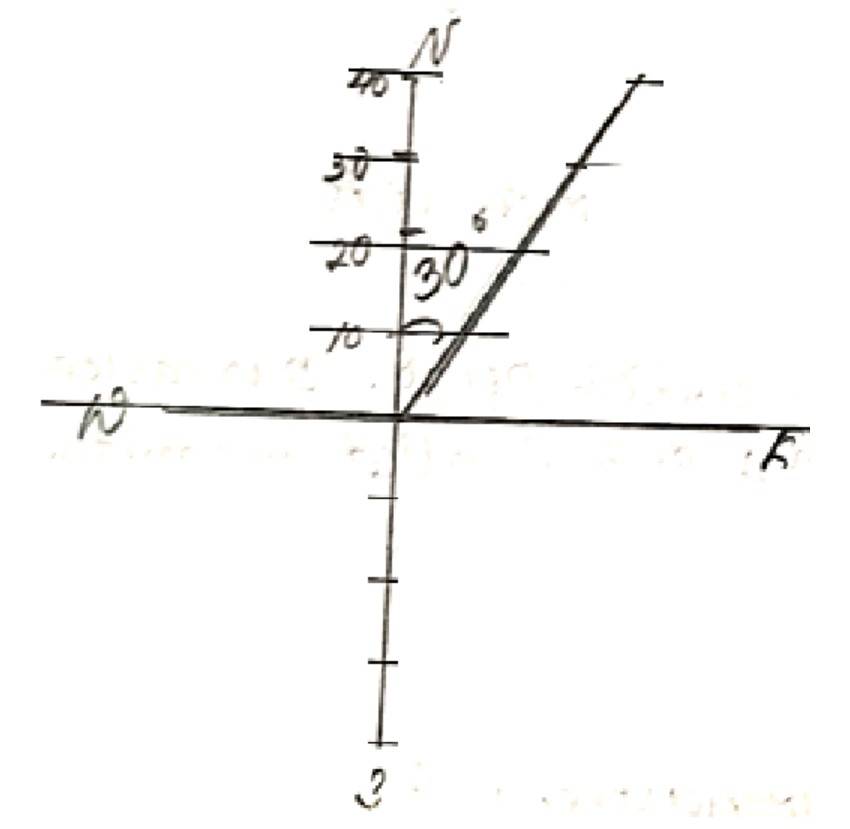
Upvote 1. Represent graphically a displacement of 40 km, 30° east of north.
1. Represent graphically a displacement of 40 km, 30° east of north.