
Overview
Get insights from 89 questions on Overview, answered by students, alumni, and experts. You may also ask and answer any question you like about Overview
- 89
Questions
- 0
Discussions
- 0
Active Users
- 0
Followers
Have a question about Overview? Ask our experts
Keep it short & simple. Type complete word. Avoid abusive language.
A satellite is moving around a planet of radius R in a circular orbit of radius r. The speed of the satellite is v. Find the acceleration due to gravity on the surface of the planet.
<!-- [if !supportLineBreakNewLine]-->
<!--[endif]-->
A satellite is moving around a planet of radius R in a circular orbit of radius r. The speed of the satellite is v. Find the acceleration due to gravity on the surface of the planet.
<!-- [if !supportLineBreakNewLine]-->
<!--[endif]-->
v = √ (GM/r) (orbital speed)
⇒ GM = v²r ⇒ (GM/R²) = (v²r/R²) ⇒ g = (v²r/R²)
 Upvote

In free space, two particles of mass m each are initially both at rest at a distance a from each other. They start moving towards each other due to their mutual gravitational attraction. The time after which the distance between them has reduced to a/2 is
In free space, two particles of mass m each are initially both at rest at a distance a from each other. They start moving towards each other due to their mutual gravitational attraction. The time after which the distance between them has reduced to a/2 is
Let the origin be at the CM of the particles, let the initial positions of the particles be x = a/2 and x = -a/2 and let the instantaneous positions of the particles be x = r and x = -r
Let the instantaneous velocity of each particle be v
Let the time after which the distance between the particles has
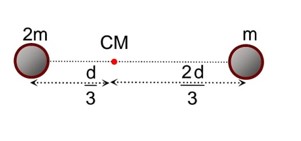
Upvote Two stars of masses m and 2m at a distance d rotate about their common centre of mass in free space. The
Two stars of masses m and 2m at a distance d rotate about their common centre of mass in free space. The
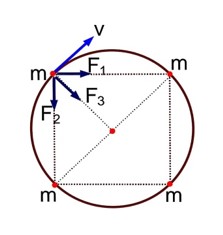
Four identical particles of equal masses 1kg made to move along the circumference of a circle of radius 1m under the actin of their own mutual gravitational attraction. The speed of each particle will be:
Four identical particles of equal masses 1kg made to move along the circumference of a circle of radius 1m under the actin of their own mutual gravitational attraction. The speed of each particle will be:
Putting m = 1 kg and r = 1 m,
Upvote A particle of mass ' m ' is projected with a velocity v = kVe(k < 1) from the surface of the earth.
(Ve = escape velocity)
The maximum height above the surface reached by the particle is:
<!-- [if !supportLineBreakNewLine]-->
<!--[endif]-->
A particle of mass ' m ' is projected with a velocity v = kVe(k < 1) from the surface of the earth.
(Ve = escape velocity)
The maximum height above the surface reached by the particle is:
<!-- [if !supportLineBreakNewLine]-->
<!--[endif]-->
h = R / [ (2gR/V? ²) - 1] = R / [ (V²/K²V? ²) ] = KK² / (1 - K²)
Upvote A planet is revolving around the sun in an elliptical orbit. The mass of planet is m, angular momentum of planet about sun is L, and length of semi major axis is a and eccentricity is e. Time period of revolution of planet is given by
A planet is revolving around the sun in an elliptical orbit. The mass of planet is m, angular momentum of planet about sun is L, and length of semi major axis is a and eccentricity is e. Time period of revolution of planet is given by
b = a√1 - e²
dA/dt = L/2m
T = A / (L/2m)
T = 2mA/L = 2mπab/L = 2mπa²√1 - e²/L
Upvote