
Overview
Get insights from 89 questions on Overview, answered by students, alumni, and experts. You may also ask and answer any question you like about Overview
- 89
Questions
- 0
Discussions
- 0
Active Users
- 0
Followers
Have a question about Overview? Ask our experts
Keep it short & simple. Type complete word. Avoid abusive language.
If the angular velocity of earth's spin is increased such that the bodies at the equator start floating, the duration of the day would be approximately :
[Take g = 10 ms⁻², the radius of earth, R = 6400×10³ m, Take π = 3.14]
If the angular velocity of earth's spin is increased such that the bodies at the equator start floating, the duration of the day would be approximately :
[Take g = 10 ms⁻², the radius of earth, R = 6400×10³ m, Take π = 3.14]
g? = g - ω²R ⇒ 0 = g - ω²R ⇒ ω = √ (g/R)
⇒ T = 2π/ω = 2π√ (R/g) = 2 × 3.14 × √ (6400 × 10³)/10)
 Upvote

The angular momentum of a planet of mass M moving around the sun in an elliptical orbit is L. The magnitude of the areal velocity of the planet is:
<!-- [if !supportLineBreakNewLine]-->
<!--[endif]-->
The angular momentum of a planet of mass M moving around the sun in an elliptical orbit is L. The magnitude of the areal velocity of the planet is:
<!-- [if !supportLineBreakNewLine]-->
<!--[endif]-->
A = Area swept ⇒ dA/dt = (1/2)r² (dθ/dt) = (1/2) (Mr²ω)/M = L / (2M)
Upvote A particle of mass m moves in a circular orbit under the central potential field, V(r) = -C/r, where C is a constant. The correct radius-velocity graph of the particle's motion is;
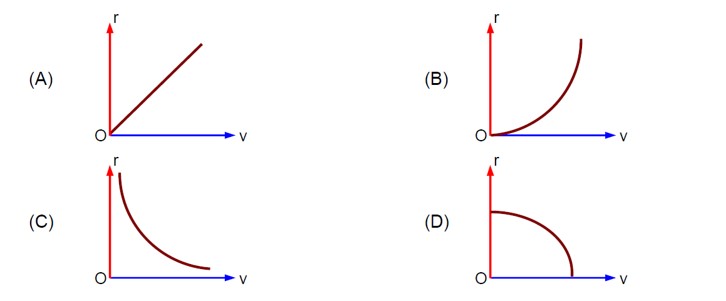
A particle of mass m moves in a circular orbit under the central potential field, V(r) = -C/r, where C is a constant. The correct radius-velocity graph of the particle's motion is;
U = mV (r) = -Cm/r
F = -dU/dr = -Cm/r² ⇒ The force which provides required centripetal force
⇒ mv²/r = Cm/r² ⇒ r = C/v²
Upvote A geostationary satellite is orbiting around an arbitrary planet 'P' at a height of 11R above the surface of 'P', R being the radius of 'P'. The time period of another satellite in hours at a height of 2R from the surface of 'P' is ---------. 'P' has the time period of 24 hours.
A geostationary satellite is orbiting around an arbitrary planet 'P' at a height of 11R above the surface of 'P', R being the radius of 'P'. The time period of another satellite in hours at a height of 2R from the surface of 'P' is ---------. 'P' has the time period of 24 hours.
(T / 24) = (3/12)^ (3/2) ⇒ T = 3 hours
Upvote The radius in kilometre to which the radius of earth (R = 6400 km) to be compressed so that the escape velocity is increased 10 times is .
The radius in kilometre to which the radius of earth (R = 6400 km) to be compressed so that the escape velocity is increased 10 times is .
The formula for escape velocity (v_e) is v_e = √ (2GM/R).
According to the question, the new escape velocity (v_e') from a new radius R' is related to the original escape velocity by 10v_e' = v_e.
10 * √ (2GM/R') = √ (2GM/R)
Squaring both sides:
100 * (2GM/R') = (2GM/R)
100/R' = 1/R
R' = R/100
If R is the
Upvote The value of the acceleration due to gravity is g₁ at a height h = R/2 (R = radius of the earth) from the surface of the earth. It is again equal to g₁ at a depth d below the surface of the earth. The ratio (d/R) equals:
The value of the acceleration due to gravity is g₁ at a height h = R/2 (R = radius of the earth) from the surface of the earth. It is again equal to g₁ at a depth d below the surface of the earth. The ratio (d/R) equals:
dW? = Eqdx
∫ dU? = ∫ kQ/x² dxq
W? = kQq (-1/x)|? ^ (R+y)
W? = kQq (y)/ (R) (R + y)
W? + W? = 1/2 mv²
V² = 2/m (kQqy/ (R) (R+y) + mgy)
V² = 2y (kQq/ (m (R) (R+y) + g) ; k = 1/ (4πε? )
Upvote A body is moving in a low circular orbit about a planet of mass M and radius R. The radius of the orbit can be taken to be R itself. Then the ratio of the speed of this body in the orbit to the escape velocity from the planet is :
A body is moving in a low circular orbit about a planet of mass M and radius R. The radius of the orbit can be taken to be R itself. Then the ratio of the speed of this body in the orbit to the escape velocity from the planet is :
Escape velocity = √ (2GM/R) = v? f
Orbital speed = √ (GM/R) = V?
V? /V? = 1/√2
Upvote Two planets have masses M and 16M and their radii are a and 2a, respectively. The separation between the centres of the planets is 10a. A body of mass m is fired from the surface of the larger planet towards the smaller planet along the line joining their centres. For the body to be able to reach at the surface of smaller planet, the minimum firings speed needed is:
<!-- [if !supportLineBreakNewLine]-->
<!--[endif]-->
Two planets have masses M and 16M and their radii are a and 2a, respectively. The separation between the centres of the planets is 10a. A body of mass m is fired from the surface of the larger planet towards the smaller planet along the line joining their centres. For the body to be able to reach at the surface of smaller planet, the minimum firings speed needed is:
<!-- [if !supportLineBreakNewLine]-->
<!--[endif]-->

On the x-axis and at a distance x from the origin, the gravitational field due to a mass distribution is given by Ax/(x²+a²)³/² in the x-direction. The magnitude of gravitational potential on the x-axis at a distance x, taking its value to be zero at infinity is:
<!-- [if !supportLineBreakNewLine]-->
<!--[endif]-->
g = Ax / (x² + a²)³?²
⇒ ∫? dV = -∫?^∞ gdx
⇒ 0 - V = -∫?^∞ [Ax / (a² + x²)³?²] dx
Let, a² + x² = t²
⇒ 2xdx = 2tdt
⇒ xdx = tdt
⇒ V = ∫?^∞ (Atdt / t³) ⇒ [-A / t]?^∞ ⇒ [-A / √(a² + x²)]?^∞
⇒ V = A / √(a² + x²)
Upvote