

Physics
Get insights from 5.6k questions on Physics, answered by students, alumni, and experts. You may also ask and answer any question you like about Physics
Follow Ask QuestionQuestions
Discussions
Active Users
Followers
New answer posted
a year agoContributor-Level 10
Using Bernoulli's equation
P? + (1/2)ρv? ² + ρgh? = P? + (1/2)ρv? ² + ρgh?
For horizontal tube h? = h?
P + (1/2)ρv² = P/2 + (1/2)ρV²
(1/2)ρV² = P/2 + (1/2)ρv²
V = √ (P/ρ + v²)
New answer posted
a year agoContributor-Level 10
Escape velocity = √ (2GM/R) = v? f
Orbital speed = √ (GM/R) = V?
V? /V? = 1/√2
New answer posted
a year agoContributor-Level 10
From aerie's law x = c/r
I = xH
I? = x? H?
I? = x? H?
I? /I? = x? H? /x? H?
I? /I? = T? H? /T? H? = (4 x 0.3)/ (24 x 0.4) = 1/8
I? = T? /8 = 6/8 = 0.75
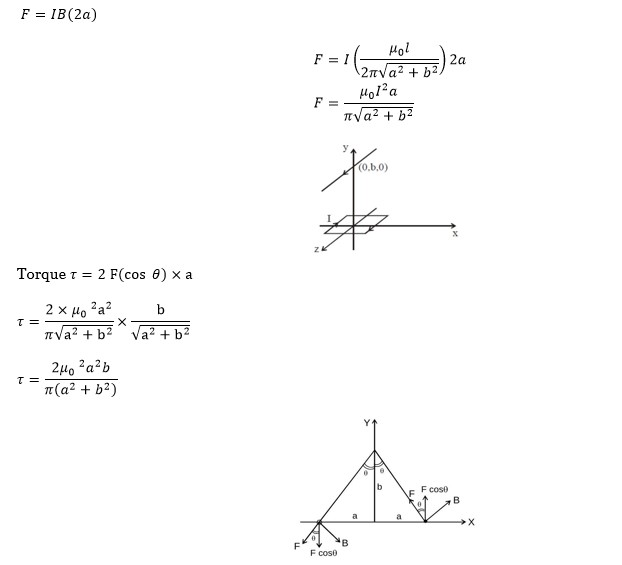
New answer posted
a year agoContributor-Level 10
Network done is equal to area under F-x curve
= 200 x 15 + ½ x 100 x 15 + 100 * 15
= 4500 + 750
= 5250
New answer posted
a year agoContributor-Level 10
P = (μ – 1) (1/R – 1/ (-R)
P = 2 (μ – 1)/R
1.5P = (μ – 1)/R') * 1.5 = 1/2R'
R' = R/3
New answer posted
a year agoContributor-Level 10
Since significant figures show the degree of correctness of any measurement, so in any mathematical calculation we cannot increase the number of significant digits. Because the four reading has 3 significant digits so the answer should also have 3 significant digits only.
New answer posted
a year agoContributor-Level 10
i = V/r {1 - e? /? }
i? = V/r
U = ½Li²
½ L (V²/r²) {1 - e? /? } = (1/n) x (LV²/2r²)
1 - e? /? = 1/√n ; e? /? = 1 - 1/√n = (√n - 1)/√n
e? /? = √n/ (√n - 1) ; rt/L = ln (√n/ (√n - 1)
T = L/r ln (√n/ (√n - 1)
New answer posted
a year agoContributor-Level 10
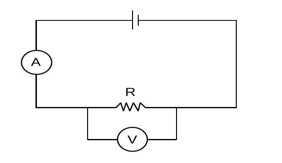
In Ohm's law experiment, ammeter is used in series because in series same current will flow through it. But voltmeter is used in parallel to resistor to measure the potential difference across it.
New answer posted
a year agoContributor-Level 10
f? = 420 Hz
f? = (V? + V)/ (V? - V) f? = 490
(330 + V)/ (300 - V) 420 = 490
(330 + V)6 = 7 (330 – V)
13 V = 330
V = 33/13 (m/s)
= 91 (km/hr)
Taking an Exam? Selecting a College?
Get authentic answers from experts, students and alumni that you won't find anywhere else
Sign Up on ShikshaOn Shiksha, get access to
- 67k Colleges
- 1.2k Exams
- 718k Reviews
- 1850k Answers