Physics

Get insights from 5.6k questions on Physics, answered by students, alumni, and experts. You may also ask and answer any question you like about Physics

Follow Ask Question
5.6k

Questions

0

Discussions

29

Active Users

0

Followers

New answer posted

6 months ago

0 Follower 2 Views

V
Vishal Baghel

Contributor-Level 10

A/c to question

f + 76 = 2f

f = 76

last frequency

= f + 76 = 2 * 76

= 152 H2

New answer posted

6 months ago

0 Follower 4 Views

P
Payal Gupta

Contributor-Level 10

Let 'h' be the height at which velocity becomes equal to magnitude of Acceleration

v = g = 10

v = u + at

10 = 0 + 10t

t = 1 sec

h=ut+12at2

=0*1+12*10*1*1

= 5m

New answer posted

6 months ago

0 Follower 4 Views

V
Vishal Baghel

Contributor-Level 10

Heat given to water by geyser

H=moωCΔT

=2*103grammin*4.2Jg1c1* (7030)°C

=2*42*4*103J/min - (1)

heat provided by combustion of fuel

H=mofCf

mof=2*42*48=42

New answer posted

6 months ago

0 Follower 13 Views

V
Vishal Baghel

Contributor-Level 10

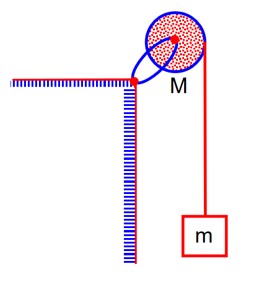
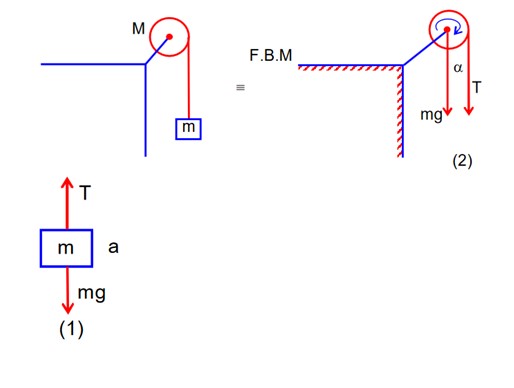
12 g – T = 12 a- (1)

T – T' = 2a- (2)

T' = 6a- (3)

From (1) & (2)

12g – 12a – T' = 2a- (4)

From (4) & (3)

12g – 12a – T' = 14

12g=103T'T'=120*310=36

New answer posted

6 months ago

0 Follower 2 Views

P
Payal Gupta

Contributor-Level 10

B fighter jet

A anti-Air craft gun

Draw velocity diagram of A w.r.t. B

If A hits B

Then Relative velocity perpendicular to the line joining A to B will be zero.

That means 400 cos = 200

cosθ=12θ=60°

New question posted

6 months ago

0 Follower 3 Views

New answer posted

6 months ago

0 Follower 3 Views

V
Vishal Baghel

Contributor-Level 10

Impulse = change in momentum

ΔP=2mv

= 2 * 15 * 0.4

= 12 N sec

New answer posted

6 months ago

0 Follower 3 Views

V
Vishal Baghel

Contributor-Level 10

 h=50t12? *10t2=80m

Now velocity B with respect to A

VBA=VBVA

= 50 – 30

= 20 m/sec

Now ABA=aBaA

10 (j^) (10j^)

= 0

Time taken to collide.

h=VBAt

80 = 20t

t = 4 sec

Total time = 4 + 2

= 6 sec

New answer posted

6 months ago

0 Follower 1 View

P
Payal Gupta

Contributor-Level 10

In amplitude modulation, the amplitude of the career signal is varied in according with the modulating signal.

New answer posted

6 months ago

0 Follower 2 Views

V
Vishal Baghel

Contributor-Level 10

 Cm (t)=ACsinωCt+μAC2 [cos (ωCωm)tcos (ωC+ωm)t]

μ=AmAC

AC=40

μ=12

So amplitude of minimum frequency = μAC2

= 10

Get authentic answers from experts, students and alumni that you won't find anywhere else

Sign Up on Shiksha

On Shiksha, get access to

  • 66k Colleges
  • 1.2k Exams
  • 681k Reviews
  • 1800k Answers

Share Your College Life Experience

×
×

This website uses Cookies and related technologies for the site to function correctly and securely, improve & personalise your browsing experience, analyse traffic, and support our marketing efforts and serve the Core Purpose. By continuing to browse the site, you agree to Privacy Policy and Cookie Policy.