

Physics
Get insights from 5.6k questions on Physics, answered by students, alumni, and experts. You may also ask and answer any question you like about Physics
Follow Ask QuestionQuestions
Discussions
Active Users
Followers
New answer posted
a year agoContributor-Level 10
This is a long answer type question as classified in NCERT Exemplar
(i) UE=
UB=
So total energy density = UE+ UB= +
E= Eo/ and B=Bo/
Uav= +
(ii) We know Eo=cBo and c = 1/
= 1/4 2
UE= UB
New answer posted
a year ago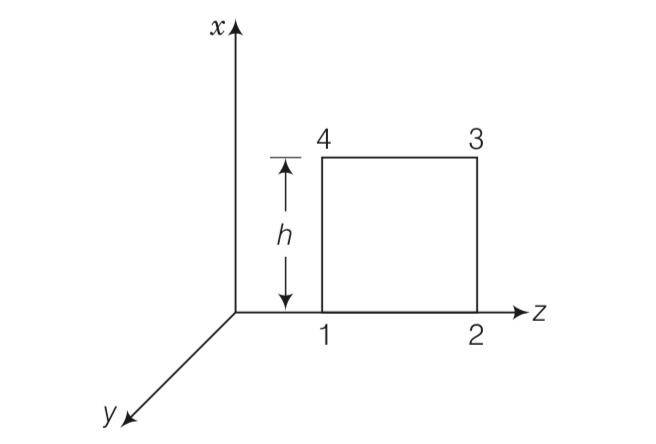
Contributor-Level 10
This is a long answer type question as classified in NCERT Exemplar
(i) =
= Eoh[sin(kz2-wt)-sin(kz1-gwt)]

(ii)
=

(iv) =-
=Eoh[sin(kz2-wt)-sin(kz1-wt)]
=-
Eo=Bow/k=Byc
Eo/Bo=c
New question posted
a year agoNew answer posted
a year agoContributor-Level 10
This is a long answer type question as classified in NCERT Exemplar
E(s,t)=
Now displacement current Jd=eo
=
=
= ina/s sin2
Id=
=( )2
=
After solving this we get
Id=
Id=
Iod= (
New answer posted
a year agoContributor-Level 10
This is a long answer type question as classified in NCERT Exemplar
Suppose the distance between the plates is d and applied voltage is Vt= V02
Then electric field is E= sin(2 )
Jc=
=
=
Jd= =
= cos(2 )
= J0d cos 2
J0d=
= 2 = 2 v 0.25 = 4 v =4/9
New answer posted
a year ago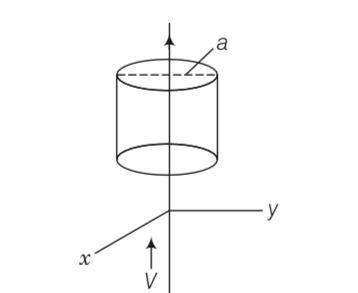
Contributor-Level 10
This is a long answer type question as classified in NCERT Exemplar
E=
And B= i= i
Then S= {E }=
=
New answer posted
a year agoContributor-Level 10
This is a Multiple Choice Questions as classified in NCERT Exemplar
Answer- (b)
Explanation-as we know that
so inversely proportional to
so from the above conclusion we can say that alpha p n e
New answer posted
a year agoContributor-Level 10
This is a Multiple Choice Questions as classified in NCERT Exemplar
Answer- (c)
Explanation- In Davisson-Germer experiment, the de-Broglie wavelength associated with electron is
λ = 12.27/
Å . (i)where V is the applied voltage.
If there is a maxima of the diffracted electrons at an angle θ, then
2dsinθ = λ … (ii)
From Eq. (i), we note that if V is inversely proportional to the wavelength λ.
i.e., V will increase with the decrease in the λ.
From Eq. (ii), we note that wavelength λ is directly proportional to sinθ and hence θ.
So, with the decrease in λ, θ will also decrease.
Thus, when the voltage applied to A is increased. The dif
New answer posted
a year agoContributor-Level 10
This is a Multiple Choice Questions as classified in NCERT Exemplar
Answer- (d)
explanation- When a beam of electrons of energy E0 is incident on a metal surface kept in an
evacuated chamber electrons can be emitted with maximum energy E0 (due to elastic
collision) and with any energy less than E0, when part of incident energy of electron is
used in liberating the electrons from the surface of metal.
New answer posted
a year agoContributor-Level 10
This is a Multiple Choice Questions as classified in NCERT Exemplar
Answer – (b)
Explanation- E=hc/
And l = hc/E= 1240/106= 1.24 10-3nm
Taking an Exam? Selecting a College?
Get authentic answers from experts, students and alumni that you won't find anywhere else
Sign Up on ShikshaOn Shiksha, get access to
- 67k Colleges
- 1.2k Exams
- 718k Reviews
- 1850k Answers