

Physics
Get insights from 5.6k questions on Physics, answered by students, alumni, and experts. You may also ask and answer any question you like about Physics
Follow Ask QuestionQuestions
Discussions
Active Users
Followers
New answer posted
a year agoContributor-Level 10
This is a Short Answer Type Questions as classified in NCERT Exemplar
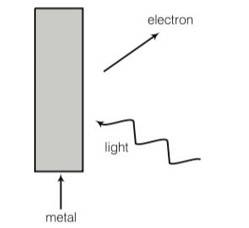
Explanation- During photoelectric emission, the momentum of incident photon is transferred to the metal. At microscopic level, atoms of a metal absorb the photon and its momentum is transferred mainly to the nucleus and electrons.
The excited electron is emitted. Therefore, the conservation of momentum is to be Considered as the momentum of incident photon transferred to the nucleus and electrons.
New answer posted
a year agoContributor-Level 10
This is a Short Answer Type Questions as classified in NCERT Exemplar
Explanation- during photoelectric emission the momentum is transferred to metal. metal absorbs absorb the photon and its momentum is transferred, and excited electron emitted.
New answer posted
a year agoContributor-Level 10
This is a Multiple Choice Questions as classified in NCERT Exemplar
Explanation- the debroglie wavelength of the particle can be varying cyclically between two values and , if particle is moving in an elliptical orbit with origin as its focus.

Let v1, v2, be the speed of particle at A and B respectively and origin is at focus O. If and are the de-Broglie wavelengths associated with particle while moving at A and B
respectively. Then,
=h/mv1
=h/mv2
>
So v2>v1
By law of conservation of angular momentum, the particle moves faster when it is closer to
focus.
From figure, we note that origin O is closed to P than A
New answer posted
a year agoContributor-Level 10
This is a Multiple Choice Questions as classified in NCERT Exemplar
Explanation- energy spent to convert into water = mass latent heat
= mL= 1000g 80cal/g
= 80000cal
Energy of phtons used= nT E=nT
So nTh =mL
T= mL/nhv
T 1/n where v is constant
T when n is fixed
T 1/nv
New answer posted
a year agoContributor-Level 10
This is a Multiple Choice Questions as classified in NCERT Exemplar
Explanation- =
Ee=1/2meve2
Meve=
Ee= h2/2 e2me
For photon
Ep= hc/ = hc/2
= 100
Pe=meve= me
New answer posted
a year agoContributor-Level 10
This is a long answer type question as classified in NCERT Exemplar
Any ray entering at an angle I shall be guided along AC if the angle ray makes with the face AC (φ) is greater than the critical angle as per the principle of total internal reflection φ +r =900, therefore sinφ = cosr
Sinφ>
Cosr>

1-cos2r<1-1/
Sin2r<1-1/
Sin2r<1-1/
Sini = sinr
I=
If that is greater than the critical then all other angle of incidence shall be more than the critical angle.
1< -1
>
New answer posted
a year agoContributor-Level 10
This is a long answer type question as classified in NCERT Exemplar
(i) As we know that power Pf=1/f=1/0.1+1/0.02=60D
By corrective lens the object distance at far pointP'f=1/f'=1/1/0.02=50D
Total power P'f=Pf+Pg
Pg=-10D
(ii) This power of accommodation is 4D for the normal eye then
4=Pn-Pf where Pn power of near point
So Pn= 64D
1/xn+1/0.002=64 then xn= 1/14=0.07m
(iii) Pn'=Pf'+4=54
After solving xn'=4=0.25m
New answer posted
a year ago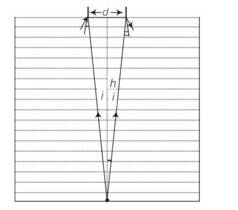
Contributor-Level 10
This is a long answer type question as classified in NCERT Exemplar
Let d be the diameter of the disc. The spot shall be invisible if the incident rays from the dot at O to the surface at d / 2 at the critical angle.
Let I be the angle of incidence. Using relationship between refractive index and critical angle,
SinC= 1/
= tani
D=
New answer posted
a year agoContributor-Level 10
This is a Multiple Choice Questions as classified in NCERT Exemplar
Explanation- as debroglie wavelength is
P=h/
P1/p2=
If wavelength are equal then ratio is 1:1 so P1=P2
E= 1/2mv2= p2/2m
E inversely proportional to m
So = <1
E1
New answer posted
a year agoContributor-Level 10
This is a multiple choice answer as classied in NCERT Exemplar
momentum per unit time per unit area = intensity/ speed of wave
= I/c= radiation pressure (p)
Momentum is always double when a light gets reflected back as in that case the momentum which is positive to one side added to momentum which is negative to other side so momentum is always double
So it becomes 2I/c
Taking an Exam? Selecting a College?
Get authentic answers from experts, students and alumni that you won't find anywhere else
Sign Up on ShikshaOn Shiksha, get access to
- 67k Colleges
- 1.2k Exams
- 718k Reviews
- 1850k Answers