
Physics Wave Optics
Get insights from 101 questions on Physics Wave Optics, answered by students, alumni, and experts. You may also ask and answer any question you like about Physics Wave Optics
- 101
Questions
- 0
Discussions
- 0
Active Users
- 0
Followers
Have a question about Physics Wave Optics? Ask our experts
Keep it short & simple. Type complete word. Avoid abusive language.
A beam of plane polarized light of large cross-sectional area and uniform intensity of falls normally on a polarizer (cross sectional area ) which rotates about its axis with an angular speed of . The energy of light passing through the polariser per revolution, is close to:
A beam of plane polarized light of large cross-sectional area and uniform intensity of falls normally on a polarizer (cross sectional area ) which rotates about its axis with an angular speed of . The energy of light passing through the polariser per revolution, is close to:
Two light waves having the same wavelength in vacuum are in phase initially. Then the first wave travels path <!-- [if gte msEquation 12]>L n L n
<!-- [if !supportLineBreakNewLine]-->
<!--[endif]-->
Two light waves having the same wavelength in vacuum are in phase initially. Then the first wave travels path <!-- [if gte msEquation 12]>
<!-- [if !supportLineBreakNewLine]-->
<!--[endif]-->
An inductance coil has a reactance of 100Ω. When an AC signal of frequency 1000 Hz is applied to the coil, the applied voltage leads the current by 45°. The self-inductance of the coil is:
<!-- [if !supportLineBreakNewLine]-->
<!--[endif]-->
An inductance coil has a reactance of 100Ω. When an AC signal of frequency 1000 Hz is applied to the coil, the applied voltage leads the current by 45°. The self-inductance of the coil is:
<!-- [if !supportLineBreakNewLine]-->
<!--[endif]-->
R = 100Ω. tanφ = (X_L-X_C)/R. tan45° = X_L/R (since it's an inductor). X_L=R=100Ω.
Lω=100 ⇒ L (2πf)=100 ⇒ L = 100/ (2π1000) ≈ 1.59 × 10? ² H. The closest option is (A).
 Upvote

In a Young's double slit experiment, light of 500 nm is used to produce an interference pattern. When the distance between the slits is 0.05 mm, the angular width (in degree) of the fringes formed on the distance screen is close to:
<!-- [if !supportLineBreakNewLine]-->
<!--[endif]-->
In a Young's double slit experiment, light of 500 nm is used to produce an interference pattern. When the distance between the slits is 0.05 mm, the angular width (in degree) of the fringes formed on the distance screen is close to:
<!-- [if !supportLineBreakNewLine]-->
<!--[endif]-->
Angular width of a fringe is YDSE

Upvote Interference fringes are observed on a screen by illuminating two thin slits 1 mm apart with a light source (λ = 632.8 nm). The distance between the screen and the slits is 100 cm. If a bright fringe is observed on a screen at distance of 1.27 mm from the central bright fringe, then the path difference between the waves, which are reaching this point from the slits is close to:
<!-- [if !supportLineBreakNewLine]-->
<!--[endif]-->
Interference fringes are observed on a screen by illuminating two thin slits 1 mm apart with a light source (λ = 632.8 nm). The distance between the screen and the slits is 100 cm. If a bright fringe is observed on a screen at distance of 1.27 mm from the central bright fringe, then the path difference between the waves, which are reaching this point from the slits is close to:
<!-- [if !supportLineBreakNewLine]-->
<!--[endif]-->
ΔP = dsinθ = dθ
dy/D = (10? ³ × 1.270mm)/1m = 1.27µm
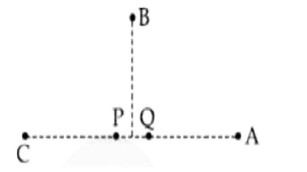
Upvote In the figure below, P and Q are two equally intense coherent sources emitting radiation of wavelength 20 m. The separation between P and Q is 5 m and the phase of P is ahead of that of Q by 90°. A, B and C are three distinct points of observation, each equidistant from the midpoint of PQ. The intensities of radiation at A, B, C will be in the ratio:
<!-- [if !supportLineBreakNewLine]-->
<!--[endif]-->
In the figure below, P and Q are two equally intense coherent sources emitting radiation of wavelength 20 m. The separation between P and Q is 5 m and the phase of P is ahead of that of Q by 90°. A, B and C are three distinct points of observation, each equidistant from the midpoint of PQ. The intensities of radiation at A, B, C will be in the ratio:
<!-- [if !supportLineBreakNewLine]-->
<!--[endif]-->
Φ? = π/2 - (2π/λ)x = π/2 - (2π/20)5 = 0
Φ_B = π/2
Φ_C = π/2 + (2π/λ)x = π/2 + π/2 = π
I_A = 4I? ; I_B = 2I? ; I_C = 0
Upvote