
Physics Wave Optics
Get insights from 101 questions on Physics Wave Optics, answered by students, alumni, and experts. You may also ask and answer any question you like about Physics Wave Optics
- 101
Questions
- 0
Discussions
- 0
Active Users
- 0
Followers
Have a question about Physics Wave Optics? Ask our experts
Keep it short & simple. Type complete word. Avoid abusive language.
Consider the given arrangement. The two slits S1 and S2 are illuminated by monochromatic light of wavelength λ. Slits S3 and S4 are at separation d1 = λD/(3d), then ratio of maximum and minimum intensity on the screen will be
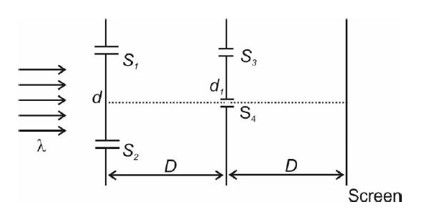
Consider the given arrangement. The two slits S1 and S2 are illuminated by monochromatic light of wavelength λ. Slits S3 and S4 are at separation d1 = λD/(3d), then ratio of maximum and minimum intensity on the screen will be
Is? = 4I?
Is? = I?
∴ I_max/I_min = (√Is? + √Is? )² / (√Is? - √Is? )² = (2+1)²/ (2-1)² = 9/1
 Upvote

For Young's double slit experiment, two statements are given below:
Statement I: If screen is moved away from the plane of slits, angular separation of the fringes remains constant.
Statement II: If the monochromatic source is replaced by another monochromatic source of larger wavelength, the angular separation of fringes decreases.
In the light of the above statements, choose the correct answer from the options given below:
is proportional to but independent of
Upvote For Young's double slit experiment, two statements are given below:
Statement I: If screen is moved away from the plane of slits, angular separation of the fringes remains constant.
Statement II: If the monochromatic source is replaced by another monochromatic source of larger wavelength, the angular separation of fringes decreases.
In the light of the above statements, choose the correct answer from the options given below:
For Young's double slit experiment, two statements are given below:
Statement I: If screen is moved away from the plane of slits, angular separation of the fringes remains constant.
Statement II: If the monochromatic source is replaced by another monochromatic source of larger wavelength, the angular separation of fringes decreases.
In the light of the above statements, choose the correct answer from the options given below:
Factual (theory based)
Capacitor in parallel removes the AC ripple from the rectified output.
Upvote In a Young's double slit experiment, a student observes 8 fringes in a certain segment of screen when a monochromatic light of 600nm wavelength is used. If the wavelength of light is changed to 400nm, then the number of fringes he would observe in the same region of the screen is:
In a Young's double slit experiment, a student observes 8 fringes in a certain segment of screen when a monochromatic light of 600nm wavelength is used. If the wavelength of light is changed to 400nm, then the number of fringes he would observe in the same region of the screen is:
In Young's double slit arrangement, slits are separated by a gap of 0.5 mm, and the screen is placed at a distance of 0.5 m from them. The distance between the first and the third bright fringe formed when the slits are illuminated by a monochromatic light of 5890 Å is:
In Young's double slit arrangement, slits are separated by a gap of 0.5 mm, and the screen is placed at a distance of 0.5 m from them. The distance between the first and the third bright fringe formed when the slits are illuminated by a monochromatic light of 5890 Å is:
Fringe width, β = (λD) / d = (5890 × 10? ¹? × 0.5) / (0.5 × 10? ³) = 589 × 10? m
Distance between first and third bright fringe = 2β = 1178 × 10? m.
Upvote A beam of electrons of energy E scatters from a target having atomic spacing of IÅ °. The first maximum intensity occurs at θ = 60°. Then E (in eV) is (Planck constant h = electron mass m = 9.1 × 10?³¹ kg )
<!-- [if !supportLineBreakNewLine]-->
<!--[endif]-->
A beam of electrons of energy E scatters from a target having atomic spacing of IÅ °. The first maximum intensity occurs at θ = 60°. Then E (in eV) is (Planck constant h = electron mass m = 9.1 × 10?³¹ kg )
<!-- [if !supportLineBreakNewLine]-->
<!--[endif]-->
We know, P = √2Em and λ = h/√2Em
For 1st maxima, 2nd sinθ = λ
Put (1) and get the answer
E = 50.47eV.
B = µ? I (200)/2R? R? = 20 cm; R? = 1 cm
e = -dΦ/dt = π (R? )² (500) dB/dt
= π (R? )² (500) (µ? I/2R? ²) (200) (10t-2)
= π (1/10000) (500) (200) (µ? ) (8) (5)/ (2)
= 16π² x 10 x 5 x 10?
= 800π² x 10?
e = 0
Upvote A Young's double-slit experiment is performed using monochromatic light of wavelength λ. The intensity of light at a point on the screen, where the path difference is λ, is K units. The intensity of the light at a point where the path difference is λ/6 is given by nK/12, where ' n ' is an integer. The value of ' n ' is
A Young's double-slit experiment is performed using monochromatic light of wavelength λ. The intensity of light at a point on the screen, where the path difference is λ, is K units. The intensity of the light at a point where the path difference is λ/6 is given by nK/12, where ' n ' is an integer. The value of ' n ' is
We know I = 4I? cos² (φ/2) but φ = 2πx/λ
I = 4I? cos² (πx/λ)
(i) when x = λ, I = k
i.e. k = 4I? cos²π
k = 4I?
(ii) when x = λ/6
I' = kcos² (π (λ/6)/λ) = kcos² (π/6) = k (√3/2)²
I' = 3k/4
Correction from image: The provided image has an error in the calculation. I' = k ( (√3/2)² ) = 3k/4. The image shows
Upvote Orange light of wavelength 6000 × 10-10 m illuminates a single slit of width 0.6 × 10⁻⁴ m. the maximum possible number of diffraction minima produced on both sides of the central maximum is
<!-- [if !supportLineBreakNewLine]-->
<!--[endif]-->
Orange light of wavelength 6000 × 10-10 m illuminates a single slit of width 0.6 × 10⁻⁴ m. the maximum possible number of diffraction minima produced on both sides of the central maximum is
<!-- [if !supportLineBreakNewLine]-->
<!--[endif]-->
λ = 6 × 10? M
d = 6 x 10? M
I = I? [ (sin (β)²/β²] ; β = (πdsinθ)/λ
θ = π/2 ; β = πd/λ
= (π (6 × 10? )/ (6 x 10? ) = 100π
So at ∞ also minima will form total number of minima = 2 × 100 = 200
Upvote A beam of plane polarized light of large cross-sectional area and uniform intensity of 3.3Wm⁻² falls normally on a polarizer (cross sectional area 3 × 10⁻⁴ m² ) which rotates about its axis with an angular speed of 31.4rad/s. The energy of light passing through the polariser per revolution, is close to:
A beam of plane polarized light of large cross-sectional area and uniform intensity of 3.3Wm⁻² falls normally on a polarizer (cross sectional area 3 × 10⁻⁴ m² ) which rotates about its axis with an angular speed of 31.4rad/s. The energy of light passing through the polariser per revolution, is close to:
E = (I)(t)(A)(cos²θ)
⇒ (3.3) (2π / [31.4]) [3 × 10?] × 1/2
⇒ 0.99 × 10?
Upvote