
Physics Wave Optics
Get insights from 101 questions on Physics Wave Optics, answered by students, alumni, and experts. You may also ask and answer any question you like about Physics Wave Optics
- 101
Questions
- 0
Discussions
- 0
Active Users
- 0
Followers
Have a question about Physics Wave Optics? Ask our experts
Keep it short & simple. Type complete word. Avoid abusive language.
In Young’s double slit experiment the two slits are 0.6mm distance apart. Interference pattern is observed on a screen at a distance 80cm from the slits. The first dark fringe is observed on the screen directly opposite to one of the slits. The wavelength of light will be__________nm.
In Young’s double slit experiment the two slits are 0.6mm distance apart. Interference pattern is observed on a screen at a distance 80cm from the slits. The first dark fringe is observed on the screen directly opposite to one of the slits. The wavelength of light will be__________nm.
3d = 0.6mm
D = 80cm
= 800mm
Path difference is given by
BP – Andhra Pradesh = Dx
[for Dark fringe at P]
n = 0, for first dark fringe
first dark fringe is observed on the screen directly opposite to one of the slits]
 Upvote

An observer moves towards stationary source of sound with a velocity equal to one-fifth of the velocity of sound. The percentage change in the frequency will be:
An observer moves towards stationary source of sound with a velocity equal to one-fifth of the velocity of sound. The percentage change in the frequency will be:
V0 observer velocity
C sound velocity
Vs source velocity
% change in frequency = 20%
Upvote In a Young's double slit experiment, the separation between the slits is . In the experiment, a source of light of wavelength is used and the interference pattern is observed on a screen kept away. The separation between the successive bright fringes on the screen is:
<!-- [if !supportLineBreakNewLine]-->
<!--[endif]-->
In a Young's double slit experiment, the separation between the slits is . In the experiment, a source of light of wavelength is used and the interference pattern is observed on a screen kept away. The separation between the successive bright fringes on the screen is:
<!-- [if !supportLineBreakNewLine]-->
<!--[endif]-->
The distance between two successive bright fringes is fringe width .
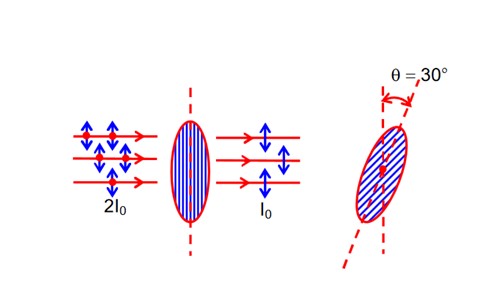
Upvote An unpolarised light beam of intensity 2l0 is passed through a polaroid P and then through another polaroid Q which is oriented is such a way that its passing axis makes an angle of 30° relative to that of P. The intensity of the emergent light is
<!-- [if !supportLineBreakNewLine]-->
<!--[endif]-->
An unpolarised light beam of intensity 2l0 is passed through a polaroid P and then through another polaroid Q which is oriented is such a way that its passing axis makes an angle of 30° relative to that of P. The intensity of the emergent light is
<!-- [if !supportLineBreakNewLine]-->
<!--[endif]-->
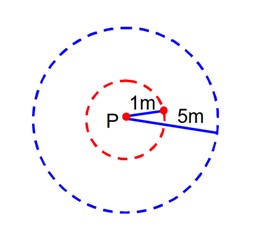
Nearly 10% of the power of a 110 W light bulb is converted to visible radiation. The change in average intensities of visible radiation, at a distance of 1 m from the bulb to a distance of 5 m is a × 10‑2 W/m2. The value of ‘a’ will be________.
Nearly 10% of the power of a 110 W light bulb is converted to visible radiation. The change in average intensities of visible radiation, at a distance of 1 m from the bulb to a distance of 5 m is a × 10‑2 W/m2. The value of ‘a’ will be________.
P = 10% of 110W = 11W
(Visible)
=84 × 10-2 = a × 10-2 = a = 84
Upvote Two beams of light having intensities I and 4I interfere to produce a fringe pattern on a screen. The phase difference between the two beams are p/2 and p/3 at points A and B respectively. The difference between the resultant intensities at the two points is xI. The value of x will be________.
Two beams of light having intensities I and 4I interfere to produce a fringe pattern on a screen. The phase difference between the two beams are p/2 and p/3 at points A and B respectively. The difference between the resultant intensities at the two points is xI. The value of x will be________.
Nearly 10% of the power of a 110 W light bulb is converted to visible radiation. The change in average intensities of visible radiation, at a distance of 1 m from the bulb to a distance of 5 m is a × 10?2 W/m2. The value of ‘a’ will be________.
Nearly 10% of the power of a 110 W light bulb is converted to visible radiation. The change in average intensities of visible radiation, at a distance of 1 m from the bulb to a distance of 5 m is a × 10?2 W/m2. The value of ‘a’ will be________.
P = 10% of 110W = 11W
(Visible)
⇒ 84 × 10-2 = a × 10-2 ⇒ a = 84
 Upvote
In a Young’s double slit experiment, a laser light of 560 nm produces an interference pattern with consecutive bright fringes’ separation of 7.2 mm. Now another light is used to produce an interference pattern with consecutive bright fringes’ separation of 8.1 mm. The wavelength of second light is__________nm.
In a Young’s double slit experiment, a laser light of 560 nm produces an interference pattern with consecutive bright fringes’ separation of 7.2 mm. Now another light is used to produce an interference pattern with consecutive bright fringes’ separation of 8.1 mm. The wavelength of second light is__________nm.
fringe width, B = 7.2 mm
For
= 630 nm
Upvote