Straight Lines
Get insights from 177 questions on Straight Lines, answered by students, alumni, and experts. You may also ask and answer any question you like about Straight Lines
- 177
Questions
- 0
Discussions
- 0
Active Users
- 0
Followers
Have a question about Straight Lines? Ask our experts
Keep it short & simple. Type complete word. Avoid abusive language.
11. The slope of a line is double of the slope of another line. If tangent of the angle between them is , find the slopes of the lines.
11. The slope of a line is double of the slope of another line. If tangent of the angle between them is , find the slopes of the lines.
11.
Let the two slopes be m and 2m. And if θ is the angle between the two lines.
Case I. When
Case II. When
Hence,
The possible slopes of the two lines (m, 2m) are (1, 2), and
 Upvote

10. Find the angle between the x-axis and the line joining the points (3,–1) and (4,–2).
10. Find the angle between the x-axis and the line joining the points (3,–1) and (4,–2).
10.
Slope of line joining points A (3, –1) and B (4, –2) is
As slope of AB is the angle made by the line-segment AB w.r.t. x-axis, the angle between them is and is given by
Upvote 9. Without using distance formula, show that points (– 2, – 1), (4, 0), (3, 3) and (–3, 2) are the vertices of a parallelogram.
9. Without using distance formula, show that points (– 2, – 1), (4, 0), (3, 3) and (–3, 2) are the vertices of a parallelogram.
9.
Let A (–2, –1), B (4, 0), C (3, 3) and D (–3, 2) be the given points.


Slope of DC =
As slope of AB = slope of DC
We conclude that AB | | DC.
Similarly, slope of BC =
Slope of AD =
As slope of BC = slope of AD we conclude that BC | | AD.
Hence, as the pair of opposite sides of ABCD a
Upvote 8. Find the value of x for which the points (x, – 1), (2,1) and (4, 5) are collinear.
8. Find the value of x for which the points (x, – 1), (2,1) and (4, 5) are collinear.
8. Let P (x, –1), Q (2, 1) and R (4, 5) be the collinear points. Then,
Slope of PQ = Slope of QR
Upvote 7. Find the slope of the line, which makes an angle of 30°with the positive direction of y-axis measured anticlockwise.
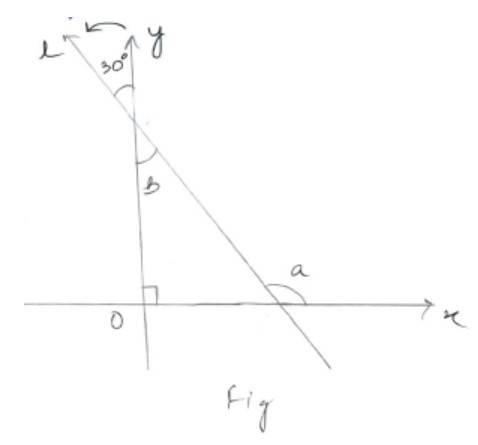
7. Find the slope of the line, which makes an angle of 30°with the positive direction of y-axis measured anticlockwise.
7.
Let l be the line making 30° with y-axis as shown in figure. Then,
Angle a = + 90° (Sum of exterior angle of a triangle)
( vertically opposite angle)
So, slope of line l = tan a
= m = tan 120°
= tan (180° – 60°)
= –tan 60°
Upvote 6. Without using the Pythagoras theorem, show that the points (4, 4), (3, 5) and (–1, –1) are the vertices of a right angled triangle.
6. Without using the Pythagoras theorem, show that the points (4, 4), (3, 5) and (–1, –1) are the vertices of a right angled triangle.
6.
. Let the given point be A (4, 4), B (3, 5) and C (–1, –1)
Then, slope of AB, m1 =
Slope of AC, m2 =
And slope of BC, m3 =
As m1 – m2 = –1 × 1 = –1
We conclude that AB and AC are perpendicular to each other.
Hence, ABC is a right-angle triangle right-angled at A
Upvote 5. Find the slope of a line, which passes through the origin, and the mid-point of the line segment joining the points P (0, – 4) and B (8, 0).
5. Find the slope of a line, which passes through the origin, and the mid-point of the line segment joining the points P (0, – 4) and B (8, 0).
5.
Let 0 (0, 0) be the origin and A be the mid-point of line joining P (0, –4) and B (8, 0)
Then, co-ordinate of A =
Slope of OA, m =
Upvote 4. Find a point on the x-axis, which is equidistant from the points (7, 6) and (3, 4).
4. Find a point on the x-axis, which is equidistant from the points (7, 6) and (3, 4).
4.
Let A (x, 0) be the point on x-axis when is equidistant from P (7, 6) and Q (3, 4)
Then, PA = QA

Squaring both sides, we get,
The required point on x-axis is
Upvote