
Straight Lines
Get insights from 177 questions on Straight Lines, answered by students, alumni, and experts. You may also ask and answer any question you like about Straight Lines
- 177
Questions
- 0
Discussions
- 0
Active Users
- 0
Followers
Have a question about Straight Lines? Ask our experts
Keep it short & simple. Type complete word. Avoid abusive language.
Let two points be and . If a point be such that the area of sq. units and it lies on the line, , then a value of is:
Let two points be and . If a point be such that the area of sq. units and it lies on the line, , then a value of is:
Let the equation of the pair of lines, y = px and y = qx, can be written as (y - px)(y - qx) = 0. Then the equation of the pair of the angle bisectors of the lines x² - 4xy – 5y² = 0 is:
<!-- [if !supportLineBreakNewLine]-->
<!--[endif]-->
Let the equation of the pair of lines, y = px and y = qx, can be written as (y - px)(y - qx) = 0. Then the equation of the pair of the angle bisectors of the lines x² - 4xy – 5y² = 0 is:
<!-- [if !supportLineBreakNewLine]-->
<!--[endif]-->
x² - 4xy – 5y² = 0
Equation of pair of straight line bisectors is (x²-y²)/ (a-b) = xy/h
(x²-y²)/ (1- (-5) = xy/ (-2)
(x²-y²)/6 = xy/ (-2)
x²-y² = -3xy
x² + 3xy - y² = 0
 Upvote
If the locus of the mid-point of the line segment from the point (3, 2) to a point on the circle, x2 + y2 = 1 is a circle of radius r, then r is equal to:
If the locus of the mid-point of the line segment from the point (3, 2) to a point on the circle, x2 + y2 = 1 is a circle of radius r, then r is equal to:
=>
=>
circle of radius r =
Upvote A man is walking on a straight line. The arithmetic mean of the reciprocals of the intercepts of the line on the coordinate axes is <!-- [if gte mso 9]><xml>
A man is walking on a straight line. The arithmetic mean of the reciprocals of the intercepts of the line on the coordinate axes is <!-- [if gte mso 9]><xml>
According to question,
Equation of required line is
Obviously B (2, 2) satisfying condition (i)
Upvote If the area of the triangle formed by the positive x-axis, the normal and the tangent to the circle (x - 2)2 + (y – 3)2 = 25 at the point (5, 7) is A, then 24A is equal to………………
If the area of the triangle formed by the positive x-axis, the normal and the tangent to the circle (x - 2)2 + (y – 3)2 = 25 at the point (5, 7) is A, then 24A is equal to………………
Equation of normal is 4x – 3y + 1 = 0
Equation of tangent is 3x + 4y – 43 = 0
Area of triangle =
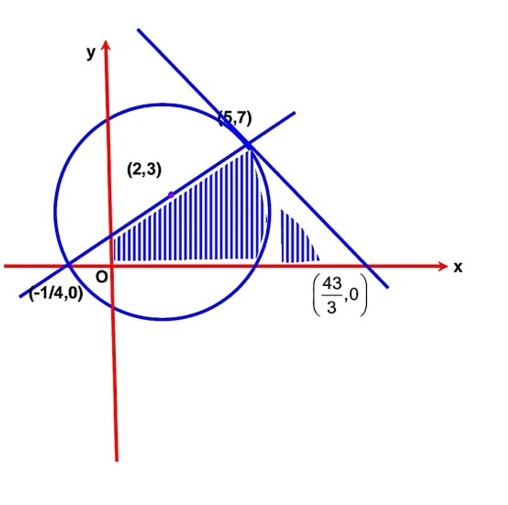
Upvote If the curve y = ax2 + bx + c, <!-- [if gte mso 9]><xml>
If the curve y = ax2 + bx + c, <!-- [if gte mso 9]><xml>
y = ax2 + bx + c
a + b + c = 2
It passes through (0, 0)
0 = 0 + 0 + c -> c = 0
a = 1
Upvote If the curves x = y4 and xy = k cut at right angles, then (4k)6 equal to………….
If the curves x = y4 and xy = k cut at right angles, then (4k)6 equal to………….
Let a, b, c be in arithmetic progression. Let the centroid of the triangle with vertices (a, c), (2, b) and (a, b) be <!-- [if gte mso 9]><xml>
Let a, b, c be in arithmetic progression. Let the centroid of the triangle with vertices (a, c), (2, b) and (a, b) be <!-- [if gte mso 9]><xml>
2a + 2 = 0
2a = 8 -> a = 4 .(i)
and
2b + c = 7 .(ii)
Since a, b, c are in A.P.
2b = a + c
From (i) 2b = 4 + c .(iii)
Solving (ii) and (iii)
4 + c + c = 7
2
Upvote The locus of the point of intersection of the lines <!-- [if gte mso 9]><xml>
The locus of the point of intersection of the lines <!-- [if gte mso 9]><xml>
K
K =
48 = 16 (e2 – 1)
Upvote