
Straight Lines
Get insights from 177 questions on Straight Lines, answered by students, alumni, and experts. You may also ask and answer any question you like about Straight Lines
- 177
Questions
- 0
Discussions
- 0
Active Users
- 0
Followers
Have a question about Straight Lines? Ask our experts
Keep it short & simple. Type complete word. Avoid abusive language.
Let ABC be a triangle with A (-3, 1) and <!-- [if gte mso 9]><xml>
Let ABC be a triangle with A (-3, 1) and <!-- [if gte mso 9]><xml>
Line BM : 2x + y = 3 Þ M (0, 3)
Line CD : 7x – 4y = 1 Þ C (3, 5)
Mirror image of A (-3, 1) in the line CD is
Slope of AC is 2/3
Slope of BC is 18.
where θ =
 Upvote

A 10 inches long pencil AB with mid point C and a small eraser P are placed on the horizontal top of a table such that PC = <!-- [if gte mso 9]><xml>
The acute angle through which the pencil must be rotated about C so that the perpendicular distance between eraser and pencil becomes exactly 1 inch is:
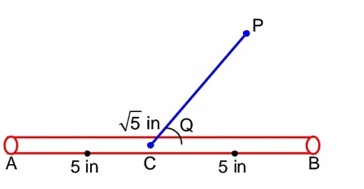
A 10 inches long pencil AB with mid point C and a small eraser P are placed on the horizontal top of a table such that PC = <!-- [if gte mso 9]><xml>
The acute angle through which the pencil must be rotated about C so that the perpendicular distance between eraser and pencil becomes exactly 1 inch is:
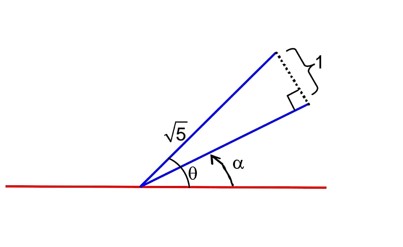
->tan q = 2
->4 – 2 tanq = 1 + 2 tan a tan a =
Upvote Let A(, 2), B(, 6) and be vertices of a If is the circumcentre of then which of the following is NOT correct about
Let A(, 2), B(, 6) and be vertices of a If is the circumcentre of then which of the following is NOT correct about
Circumcentre (D)
(i)
(ii) 9 + 16 = 9 + 16
ar
2S = 24
R = 5, r =
Upvote Let m1, m2 be the slopes of two adjacent sides of a square of side a such that a2 + 11a + If one vertex of the square is where and the equation of one diagonal is then is equal to
Let m1, m2 be the slopes of two adjacent sides of a square of side a such that a2 + 11a + If one vertex of the square is where and the equation of one diagonal is then is equal to
for square a,b,c,d let
Diagonal : (cosα - sinα)x + (sinα + cosα)y = 10
BD (diagonal)
Dist. Of BD from A is
Also, a2 + 11a + 3
210 + 3
Also, m1 m2 = -1
m2 +
or
m =
m =
Diagonal AC:
=10 cos2α - 10cos2α = 0
Slope of AC =
FIGURE
? =
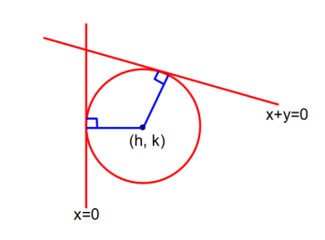
Upvote A circle touches both the y-axis and the line x + y = 0. Then the locus of its center is:
A circle touches both the y-axis and the line x + y = 0. Then the locus of its center is:
Let A(1, 1) B(-4, 3), C(-2, -5) be vertices of a triangle ABC, P be a point on side BC, and be the area of triangles APB and ABC, respectively. If <!-- [if gte mso 9]><xml>
Let A(1, 1) B(-4, 3), C(-2, -5) be vertices of a triangle ABC, P be a point on side BC, and be the area of triangles APB and ABC, respectively. If <!-- [if gte mso 9]><xml>
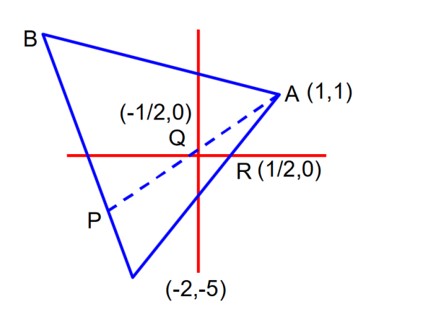
->14 x – 35 y = -95 …. (ii)
Solve (i) & (ii), x =
Upvote Let
A1 = <!-- [if gte mso 9]><xml>
A2 = <!-- [if gte mso 9]><xml>
Let
A1 = <!-- [if gte mso 9]><xml>
A2 = <!-- [if gte mso 9]><xml>
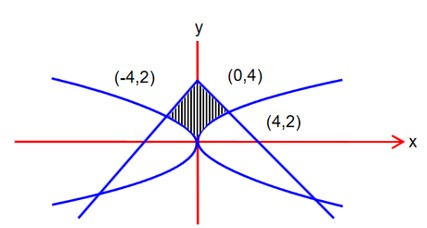
Required area (above x-axis)
and
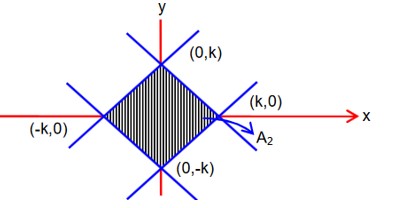
-> k = 6
for above x-axis.
Upvote Let <!-- [if gte mso 9]><xml>
Let <!-- [if gte mso 9]><xml>
Short distance of (11,6)
=
= 13 – 5
= 8
Upvote Let A(a, -2), B(a, 6) and be vertices of a <!-- [if gte mso 9]><xml>
Let A(a, -2), B(a, 6) and be vertices of a <!-- [if gte mso 9]><xml>
Circumcentre (D)
(i) ->
(ii) -> 9 + 16 = 9 + 16
ar
2S = 24
R = 5, r =
Upvote Let m1, m2 be the slopes of two adjacent sides of a square of side a such that a2 + 11a + <!-- [if gte mso 9]><xml>
Let m1, m2 be the slopes of two adjacent sides of a square of side a such that a2 + 11a + <!-- [if gte mso 9]><xml>
for square a,b,c,d let
Diagonal : (cos a - sina)x + (sina + cosa)y = 10
BD (diagonal)
Dist. Of BD from A is
Also, a2 + 11a + 3
Upvote