
Straight Lines
Get insights from 177 questions on Straight Lines, answered by students, alumni, and experts. You may also ask and answer any question you like about Straight Lines
- 177
Questions
- 0
Discussions
- 0
Active Users
- 0
Followers
Have a question about Straight Lines? Ask our experts
Keep it short & simple. Type complete word. Avoid abusive language.
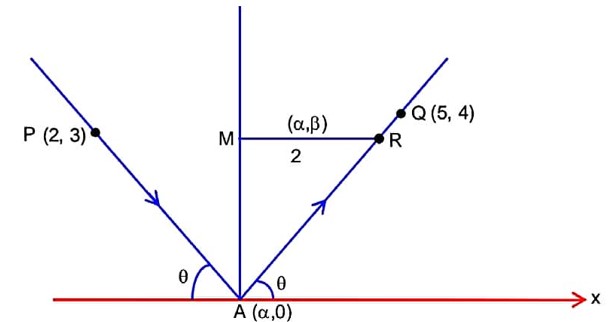
A ray of light passing through the point P(2, 3) reflects on the x-axis at point A and the reflected ray passes through the point Q(5, 4). Let R be the point that divides the line segment AQ internally into the ration 2 : 1. Let the co-ordinates of the foot of the perpendicular M from R on the bisector of the angle PAQ be (a, β)). Then the value of 7a + 3β) is equal to……….
A ray of light passing through the point P(2, 3) reflects on the x-axis at point A and the reflected ray passes through the point Q(5, 4). Let R be the point that divides the line segment AQ internally into the ration 2 : 1. Let the co-ordinates of the foot of the perpendicular M from R on the bisector of the angle PAQ be (a, β)). Then the value of 7a + 3β) is equal to……….
The equations of the sides AB, BC and CA of a triangle ABC are 2x + y = 0, x + py = 15a and x – y = 3 respectively. If its orthocenter is (2, a), then p is equal to…………
The equations of the sides AB, BC and CA of a triangle ABC are 2x + y = 0, x + py = 15a and x – y = 3 respectively. If its orthocenter is (2, a), then p is equal to…………
Slope of AH = slope of BC =
slope of HC =
slope of BC × slope of HC = -1 Þ p = 3 or 5
hence p = 3 is only possible value.
 Upvote

A point P moves so that the sum of squares of its distances from the points (1, 2) and (-2, 1) is 14. Let f(x, y) = 0 be the locus of P, which intersects the x-axis at the points A , B and the y-axis at the points C, D. Then the area of the quadrilateral ACBD is equal to:
A point P moves so that the sum of squares of its distances from the points (1, 2) and (-2, 1) is 14. Let f(x, y) = 0 be the locus of P, which intersects the x-axis at the points A , B and the y-axis at the points C, D. Then the area of the quadrilateral ACBD is equal to:
Let point P : (h, k)
Therefore according to question,
locus of P(h, k) is
Now intersection with x – axis are
Now intersection with y – axis are
Therefore are of the quadrilateral ABCD is =
Upvote Consider pair of straight lines ax2 + 3xy – 2y2 – 5x + 5y + c = 0 representing perpendicular lines. Value of equals
Consider pair of straight lines ax2 + 3xy – 2y2 – 5x + 5y + c = 0 representing perpendicular lines. Value of equals
If the two lines are perpendicular then a = 2
D = 0
(D = abc + 2fgh - af2 – bg2 - ch2)
Upvote 
The combined equation of 2 altitudes of an equilateral triangle is x2 – 3y2 – 4x + <!-- [if gte mso 9]><xml>
The combined equation of 2 altitudes of an equilateral triangle is x2 – 3y2 – 4x + <!-- [if gte mso 9]><xml>
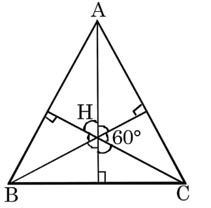
The two altitudes are
Point of int. of the 2 altitudes is
Let slope of 3rd altitude be ‘m’
then
The third altitude is x = 2
Upvote A variable line passing through the point P(2, 3/2) meets co-ordinate axes at points A and B, then locus of the foot of perpendicular from origin on the line is:
<!-- [if !supportLineBreakNewLine]-->
<!--[endif]-->
A variable line passing through the point P(2, 3/2) meets co-ordinate axes at points A and B, then locus of the foot of perpendicular from origin on the line is:
<!-- [if !supportLineBreakNewLine]-->
<!--[endif]-->
(k-3)/ (h-2) × (k-0)/ (h-0) = -1
⇒ k (2k – 3) = -2 (h – 2)h
⇒ 2h² + 2k² – 4h – 3k = 0
2x² + 2y² – 4x – 3y = 0
(0,0)
Upvote Let the abscissae of the two points P and Q be the roots of 2x2 – rx + p = 0 and the ordinates of P and Q be the roots of x2 – sx – q = 0. If the equation of the circle described on PQ as diameter is 2(x2 + y2) – 11x – 14y – 22 = 0, then 2r + s – 2q + is equal to….
Let the abscissae of the two points P and Q be the roots of 2x2 – rx + p = 0 and the ordinates of P and Q be the roots of x2 – sx – q = 0. If the equation of the circle described on PQ as diameter is 2(x2 + y2) – 11x – 14y – 22 = 0, then 2r + s – 2q + is equal to….
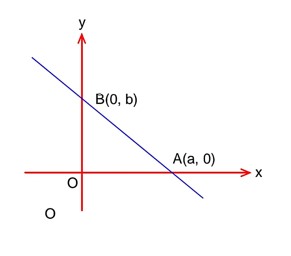
A man is walking on a straight line. The arithmetic mean of the reciprocals of the intercepts of the line on the coordinate axes is <!-- [if gte mso 9]><xml>
A man is walking on a straight line. The arithmetic mean of the reciprocals of the intercepts of the line on the coordinate axes is <!-- [if gte mso 9]><xml>
According to question,
Equation of required line is
Obviously B (2, 2) satisfying condition (i)
Upvote If two of the straight lines given by 3x3 + 3x2y – 3xy2 + dy3 = 0, are at right angles, then d is equal to __________
If two of the straight lines given by 3x3 + 3x2y – 3xy2 + dy3 = 0, are at right angles, then d is equal to __________
3x² + 3x²y - 3xy² + dy³ = 0
3x² (x + y) – 3y² (x - dy/3) = 0
x - dy/3 = x + y for getting two perpendicular straight lines
d = -3
Upvote