
Thermodynamics
Get insights from 325 questions on Thermodynamics, answered by students, alumni, and experts. You may also ask and answer any question you like about Thermodynamics
- 325
Questions
- 0
Discussions
- 0
Active Users
- 0
Followers
Have a question about Thermodynamics? Ask our experts
Keep it short & simple. Type complete word. Avoid abusive language.
Three copper blocks of masses M1, M2 and M3 kg respectively are brought into thermal contact till they reach equilibrium. Before contact, they were at T1, T2, T3 (T1 > T2 > T3 ). Assuming there is no heat loss to the surroundings, the equilibrium temperature T is (s is specific heat of copper)
(a) T=
(b) T=
(c) T=
(d) T=
This is a multiple choice answer as classified in NCERT Exemplar
(b) Let us assume that T1, T2T3
According to questions there is no loss of heat in the surroundings
Heat lost by M3 = heat gained by M1+ heat gained by M2
M3s (T3-T)= M1s (T-T1)+M2s (T-T2)
T [M1+M2+M3]= M3T3+M1T1+M2T2
T =
 Upvote

Consider two containers A and B containing identical gases at the same pressure, volume and temperature. The gas in container A is compressed to half of its original volume isothermally while the gas in container B is compressed to half of its original value adiabatically. The ratio of final pressure of gas in B to that of gas in A is
(a)
(b)
(c)
(d)
This is a multiple choice answer as classified in NCERT Exemplar
(a) Container A is isothermal and container B is adiabatic

For isothermal process P1V1=P2V2
Po (2Vo)= P2 (Vo)
P2= 2Po
for adiabatic process
P1V1y= P2V2y
Po (2Vo)y=P2 (Vo)y
P2= ( )yPo= 2yPo
Hence ratio of final pressure =
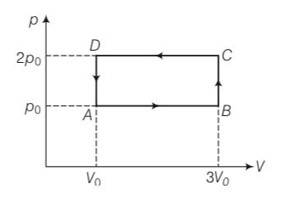
Upvote An ideal gas undergoes cyclic process ABCDA as shown in given P-V diagram (Fig. 12.4). The amount of work done by the gas is
(a) 6 PoVo
(b) –2 PoVo
(c) + 2 PoVo
(d) + 4 PoVo
An ideal gas undergoes cyclic process ABCDA as shown in given P-V diagram (Fig. 12.4). The amount of work done by the gas is

(a) 6 PoVo
(b) –2 PoVo
(c) + 2 PoVo
(d) + 4 PoVo
This is a multiple choice answer as classified in NCERT Exemplar
(b) Work done ABCD = area of rectangle ABCDA
= AB = (3Vo-Vo) (2po-po)
= 2V0 Po= 2poVo
And work done by the gas =- 2poVo
Upvote Consider P-V diagram for an ideal gas shown in Out of the following diagrams , which represents the T-P diagram?
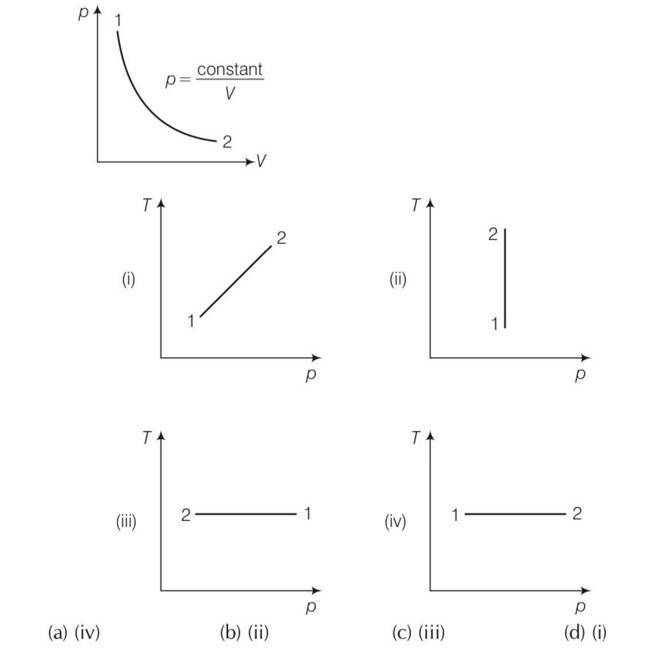
Consider P-V diagram for an ideal gas shown in Out of the following diagrams , which represents the T-P diagram?

This is a multiple choice answer as classified in NCERT Exemplar
(c) As we know PV =constant
Hence we can say that gas is going through an isothermal process.
Clearly from the graph that between process 1 and 2 temperature is constant and the gas expands and pressure decreases. So density of 2 is less
Upvote If an average person jogs, he produces 14.5 × 10³ cal/min. This is removed by the evaporation of sweat. The amount of sweat evaporated per minute (assuming 1 kg requires 580 × 103 cal for evaporation) is
(a) 0.25 kg
(b) 2.25 kg
(c) 0.05 kg
(d) 0.20 kg
If an average person jogs, he produces 14.5 × 10³ cal/min. This is removed by the evaporation of sweat. The amount of sweat evaporated per minute (assuming 1 kg requires 580 × 103 cal for evaporation) is
(a) 0.25 kg
(b) 2.25 kg
(c) 0.05 kg
(d) 0.20 kg
This is a multiple choice answer as classified in NCERT Exemplar
(a) Amount of sweat evaporated /minute =
=
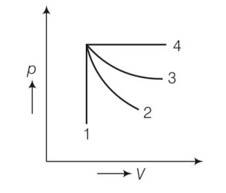
Upvote An ideal gas undergoes four different processes from the same initial state (Fig. 12.1). Four processes are adiabatic, isothermal, isobaric and isochoric. Out of 1, 2, 3 and 4 which one is adiabatic.
(a) 4
(b) 3
(c) 2
(d) 1
An ideal gas undergoes four different processes from the same initial state (Fig. 12.1). Four processes are adiabatic, isothermal, isobaric and isochoric. Out of 1, 2, 3 and 4 which one is adiabatic.

(a) 4
(b) 3
(c) 2
(d) 1
This is a multiple choice answer as classified in NCERT Exemplar
(c) For the curve 1 volume is constant so it is isochoric process. But in curve 2 and 3 curve 2 is steeper so 2 is adiabatic and 3 is isothermal.
Upvote The initial state of a certain gas is (Pi , Vi , Ti ). It undergoes expansion till its volume becomes Vf . Consider the following two cases:
(a) The expansion takes place at constant temperature.
(b) The expansion takes place at constant pressure. Plot the P-V diagram for each case. In which of the two cases, is the work done by the gas more?
The initial state of a certain gas is (Pi , Vi , Ti ). It undergoes expansion till its volume becomes Vf . Consider the following two cases:
(a) The expansion takes place at constant temperature.
(b) The expansion takes place at constant pressure. Plot the P-V diagram for each case. In which of the two cases, is the work done by the gas more?
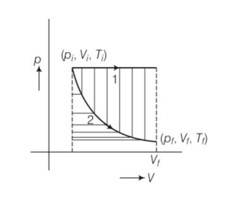
process 1 isochoric and process 2 is isothermal .
Since, work done = area under P-V curve . here area under the pV curve 1 is more . so work done is more when the gas expands in isochoric process.
Upvote If the co-efficient of performance of a refrigerator is 5 and operates at the room temperature (27 °C), find the temperature inside the refrigerator.
If the co-efficient of performance of a refrigerator is 5 and operates at the room temperature (27 °C), find the temperature inside the refrigerator.
This is a short answer type question as classified in NCERT Exemplar
Coefficient of
T1= 27+273=300K
Coefficient of performance
1500-5T2=T2
6T2=1500
T2= 250K
T2= 250-273=-23oC
Upvote In a refrigerator one removes heat from a lower temperature and deposits to the surroundings at a higher temperature. In this process, mechanical work has to be done, which is provided by an electric motor. If the motor is of 1kW power, and heat is transferred from –3°C to 27°C, find the heat taken out of the refrigerator per second assuming its efficiency is 50% of a perfect engine.
In a refrigerator one removes heat from a lower temperature and deposits to the surroundings at a higher temperature. In this process, mechanical work has to be done, which is provided by an electric motor. If the motor is of 1kW power, and heat is transferred from –3°C to 27°C, find the heat taken out of the refrigerator per second assuming its efficiency is 50% of a perfect engine.
This is a short answer type question as classified in NCERT Exemplar
Temperature of the source is 270C
T1= 27+273= 300K
T2= -3+273= 270K
Efficiency of heat engine = 1-T2/T1= 1-270/300=1/10
Efficiency of refrigerator is 50% of a perfect engine
= 0.5 = 1/20
Coefficient of performance of the refrigerat
Upvote Consider a cycle tyre being filled with air by a pump. Let V be the volume of the tyre (fixed) and at each stroke of the pump ?V V ( ) of air is transferred to the tube adiabatically. What is the work done when the pressure in the tube is increased from P1 to P2?
Consider a cycle tyre being filled with air by a pump. Let V be the volume of the tyre (fixed) and at each stroke of the pump ?V V ( ) of air is transferred to the tube adiabatically. What is the work done when the pressure in the tube is increased from P1 to P2?
This is a short answer type question as classified in NCERT Exemplar
For adiabatic change process we know
P1V1y= P2V2y
P (V+ )y = (P+ )Vy
PVy (1+ ) y=p (1+ )Vy
PVy (1+ ) PVy (1+ )
Y
dV=
hence work done increasing the pressure from P1 to P2
W=
=
W=
Upvote