Thermodynamics
Get insights from 325 questions on Thermodynamics, answered by students, alumni, and experts. You may also ask and answer any question you like about Thermodynamics
- 325
Questions
- 0
Discussions
- 0
Active Users
- 0
Followers
Have a question about Thermodynamics? Ask our experts
Keep it short & simple. Type complete word. Avoid abusive language.
Two moles of helium gas are taken over the cycle ABCDA as shown below in P-T diagram. Assuming the gas to be ideal, the work done on the gas in taking from A to B is
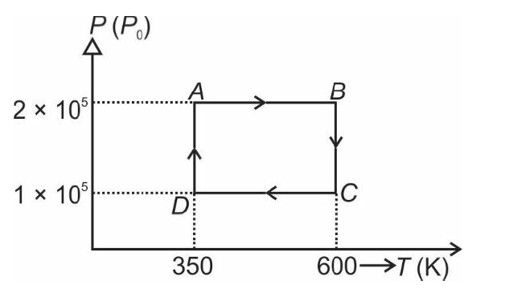
Two moles of helium gas are taken over the cycle ABCDA as shown below in P-T diagram. Assuming the gas to be ideal, the work done on the gas in taking from A to B is
From A to B the process is isobaric
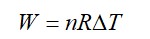
= W = 2 × R (600 - 350)
= 500 R
 Upvote

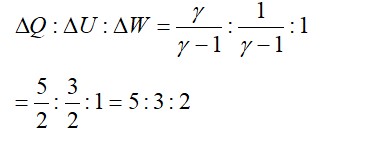
Heat is supplied to an ideal monoatomic gas at constant pressure. The ratio of 
Heat is supplied to an ideal monoatomic gas at constant pressure. The ratio of
Which of the following complex is paramagnetic, inner orbital complex and coloured :-
Which of the following complex is paramagnetic, inner orbital complex and coloured :-
(1) [Ni (NH3)6]+2 → Ni+2 → d8, C. No. = 6,
SP3d2, Para
(2) [Co (H2O)6]+2 → Co+2 → d6, C. No. = 6
d2sp3, Dia
(3) [Ti (H2O)6]+3 → Ti+3 → d1, C. No. = 6
d2SP3, Para
(4) [Co (NH3)6]+3 → Co+3 → d5, C. No. = 6
d2sp3, Para
Upvote 

Heat is path dependent so path function but internal energy does not depend on path chosen.
Upvote 
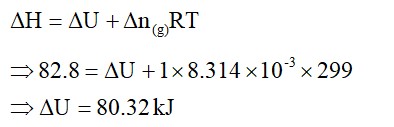
For the reaction, CaCO3(s) → CaO(s) + CO2(g) △H = 82.8 kJ at 25°C, △U at 25°C is
For the reaction, CaCO3(s) → CaO(s) + CO2(g) △H = 82.8 kJ at 25°C, △U at 25°C is
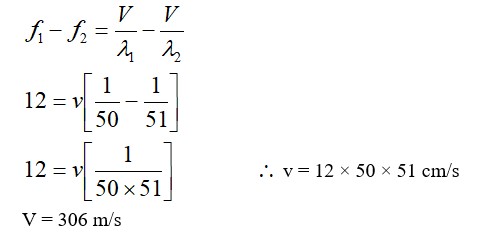
Two waves of wavelength 50 cm and 51 cm produced 12 beats per second. The velocity of sound is
Two waves of wavelength 50 cm and 51 cm produced 12 beats per second. The velocity of sound is