Chemistry

Get insights from 6.9k questions on Chemistry, answered by students, alumni, and experts. You may also ask and answer any question you like about Chemistry

Follow Ask Question
6.9k

Questions

0

Discussions

22

Active Users

0

Followers

New answer posted

a year ago

0 Follower 3 Views

V
Vishal Baghel

Contributor-Level 10

Mass of C15H30 = volume * Density

= 1000 m l  * 0.756 gm/ m l  

C15H30 + 22.5 O2   → 15CO2 + 15H2O

No. of moles of C15H30 = 7 5 6 2 1 0 moles

No. of moles of O2 required =   ( 2 2 . 5 * 7 5 6 2 1 0 ) m o l e s

Mass of O2 required = 22.5 *   7 5 6 2 1 0 * 3 2 = 2 5 9 2     g m

No. of moles of CO2 liberated = 15 *   ( 7 5 6 2 1 0 ) moles

Mass of O2 liberated =   1 5 * 7 5 6 2 1 0 * 4 4 = 2 3 7 6 g m

New answer posted

a year ago

0 Follower 9 Views

A
alok kumar singh

Contributor-Level 10

n-factor of KMnO4 in acidic medium = 5

n-factor of Mohr's salt = 1

meq of KMnO4 = meq of Mohr's salt

0.01 * 5 * V = 0.05 * 1 * 20

Volume of KMnO4 used, V = 20 mL

So; Volume of KMnO4 left in burette = 50 -20mL

= 30 mL

New answer posted

a year ago

0 Follower 8 Views

A
alok kumar singh

Contributor-Level 10

Moles of C = moles of CO2

=  0 . 7 9 3 4 4 m o l

Mass of C =  0 . 7 9 3 4 4 * 1 2 g

= 0.261g

Moles of H = 2 *  0 . 4 4 2 1 8 m o l

Mass of H =  2 * 0 . 4 4 2 1 8 * 1 g

Total mass of compound = 0.492g (given)

So; mass of O = (0.492 – 0.216 – 0.049) g

= 0.227g

% of O = 0 . 2 2 7 0 . 4 9 2 * 1 0 0  

= 46.14%

the nearest integer = 46

New answer posted

a year ago
0 Follower 45 Views

A
alok kumar singh

Contributor-Level 10

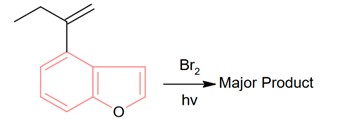
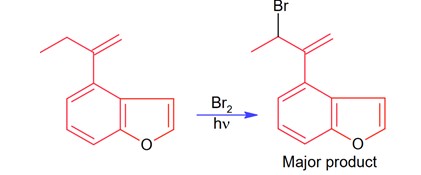
Bromination through free radical mechanism occurs at allylic carbon.
 

New answer posted

a year ago

0 Follower 19 Views

A
alok kumar singh

Contributor-Level 10

(a) C o C l 3 . 4 N H 3     i s [ C o C l 2 ( N H 3 ) 4 ] C l will show cis- trans isomerism as;

(b) C o C l 3 . 5 N H 3     i s [ C o ( N H 3 ) 5 C l ] C l 2 will not show cis- trans isomerism.

(c) C o C l 3 . 6 N H 3     i s [ C o ( N H 3 ) 6 ] C l 3 will not show cis- trans isomerism.

(d) C o C l ( N O 3 ) 2 . 5 N H 3     i s [ C o ( N H 3 ) 6 C l ] ( N O 3 ) 2  will not show cis-trans isomerism.

New answer posted

a year ago

0 Follower 3 Views

A
alok kumar singh

Contributor-Level 10

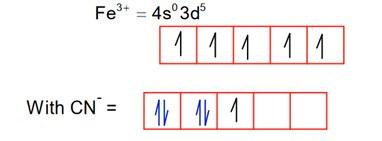
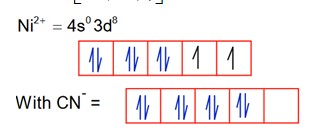
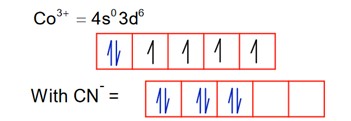
CN is a strong field ligand, so pairing occurs.

1. [ F e ( C N ) 6 ] 4 −
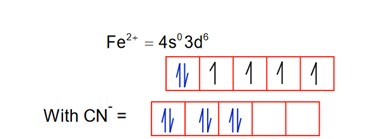
So; it is diamagnetic

2. [ F e ( C N ) 6 ] 3 −

So; it is paramagnetic.

3. [ T i ( C N ) 6 ] 3 −

Ti3+ = 4s03d1

 It is paramagnetic

4. [ N i ( C N ) 4 ] 2 −

It is diamagnetic

5. [ C o ( C n ) 6 ] 3 −

Hence,  [ F e ( C N ) 6 ] 3 − a n d     [ T i ( C N ) 6 ] 3 −  are paramagnetic.

New answer posted

a year ago

0 Follower 8 Views

A
alok kumar singh

Contributor-Level 10

t 1 / 2 = 2 0 0     d a y s = 0 . 6 9 3 k

t = 2 . 3 0 3 k l o g 1 0 N 0 N

83 =  2 . 3 0 3 0 . 6 9 3 * 2 0 0 l o g N 0 N

8 3 = 2 0 0 0 . 3 0 1 0 l o g N 0 N

0.125 = l o g N 0 N

N 0 N = a n t i l o g ( 0 . 1 2 5 )

= 1.333

Activating remaining = N N 0 * 1 0 0

= N 0 1 . 3 3 3 N 0 * 1 0 0

= 75%


New answer posted

a year ago

0 Follower 5 Views

A
alok kumar singh

Contributor-Level 10

π = n v R T

π = W M * v R T

5 . 0 3 * 1 0 − 3 = 2 . 5 M * 0 . 5 * 0 . 0 8 3 * 3 0 0

M = 2 . 5 * 0 . 0 8 3 * 3 0 0 5 . 0 3 * 0 . 5 * 1 0 3 g / m o l

Molar mass of protein, M = 24751 g/mol

 Molar mass of glycine = 75 g/mol

So; number of glycine units =   2 4 7 5 1 7 5 = 3 3 0

New answer posted

a year ago

0 Follower 14 Views

A
alok kumar singh

Contributor-Level 10

E S n 2 + / S n 0 = − 0 . 1 4 0 V = E 2 0

E S n 4 + / S n 0 = + 0 . 0 1 0 V = E 3 0

Here, Δ G 3 0 = Δ G 1 0 + Δ G 2 0

− 4 F E 3 0 = − 2 F E 1 0 − 2 F E 2 0

E 3 0 = E 1 0 + E 2 0 2

+ 0 . 0 1 0 = E 1 0 + ( − 0 . 1 4 0 ) 2

E 1 0 = E S n 4 + / S n 2 + 0 = + 0 . 1 6

= 16 * 10-2 V


New answer posted

a year ago

0 Follower 3 Views

A
alok kumar singh

Contributor-Level 10

For combustion of Mg:

Mg (s) + 1 2 O 2 ( g ) → M g O ( s )

Here,   Δ n g = − 1 2

Now using

Δ H = Δ U + Δ n g R T

-601.7 =   Δ U + ( − 1 2 ) * 8 . 3 * 1 0 − 3 * 3 0 0

Δ U = − 6 0 0 . 4 5 k J

So; magnitude of   Δ U is 600 kJ (the nearest integer).

Get authentic answers from experts, students and alumni that you won't find anywhere else

Sign Up on Shiksha

On Shiksha, get access to

  • 67k Colleges
  • 1.2k Exams
  • 717k Reviews
  • 1850k Answers

Share Your College Life Experience

×

This website uses Cookies and related technologies for the site to function correctly and securely, improve & personalise your browsing experience, analyse traffic, and support our marketing efforts and serve the Core Purpose. By continuing to browse the site, you agree to Privacy Policy and Cookie Policy.