

Class 11th
Get insights from 8k questions on Class 11th, answered by students, alumni, and experts. You may also ask and answer any question you like about Class 11th
Follow Ask QuestionQuestions
Discussions
Active Users
Followers
New answer posted
a year agoContributor-Level 10
g_h = g (1-2h/R). g_d = g (1-d/R). Given h=d.
g_h = g (R/ (R+h)² ≈ g (1-2h/R). This differs from the image.
The image has g/ (1+h/R)² = g (1-h/R). This leads to h² + hR - R²=0. h = R (√5-1)/2.
New answer posted
a year agoContributor-Level 9

S = x (x? -1)/ (x-1)+9ka+a (9*8/2)=x (x? -1)/ (x-1)+9ka+72a.
S= (x¹? -x+ (9k+72)a (x-1)/ (x-1).
Comparing with given S, 9k+72=45 ⇒ k=-3.
New answer posted
a year agoContributor-Level 10
ΔE = have = 13.6Z² (1/n? ² - 1/n? ²)eV.
hv = 13.6 (1²) (1/n² - 1/ (n+1)²) = 13.6 (n+1)²-n²)/ (n² (n+1)²)
v = (13.6/h) * (2n+1)/ (n² (n+1)²). For n>>1, v ≈ (13.6/h) (2n/n? ) ∝ 1/n³.
New answer posted
a year ago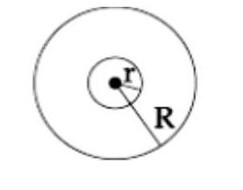
Contributor-Level 10
σ4πr² + σ4πR² = Q ⇒ σ = Q/ (4π (R²+r²)
V_c = kq? /r + kq? /R = k (σ4πr²)/r + k (σ4πR²)/R = kσ4π (r+R)
= K (Q/ (R²+r²) (R+r)
New answer posted
a year agoContributor-Level 10
On increasing the temperature, random velocity of molecules increases, therefore mean collision time between the molecules decreases. But the mean free path remains constant as it is product of velocity and time.? (b) and (c) are correct.
New answer posted
a year agoContributor-Level 10
λ = h/p = h/mv
λp/λe = (m? v? )/ (m? v? ) ⇒ 1.878 * 10? = (9.1*10? ³¹)/ (m? * 5)
m? = 9.1*10? ³¹ / (5 * 1.878 * 10? ) = 0.97 * 10? ²? kg
Taking an Exam? Selecting a College?
Get authentic answers from experts, students and alumni that you won't find anywhere else
Sign Up on ShikshaOn Shiksha, get access to
- 67k Colleges
- 1.2k Exams
- 716k Reviews
- 1850k Answers