Class 11th

Get insights from 8k questions on Class 11th, answered by students, alumni, and experts. You may also ask and answer any question you like about Class 11th

Follow Ask Question
8k

Questions

0

Discussions

4

Active Users

0

Followers

New answer posted

8 months ago

0 Follower 3 Views

A
alok kumar singh

Contributor-Level 10

geff = g –   ( ρ w ρ b ) g

T = 2 π l g

T ' = 2 π l g e f f

T ' = 5 4 T

  5 4 * 1 0

  5 5 s e c

So, x = 5

New answer posted

8 months ago

0 Follower 7 Views

V
Vishal Baghel

Contributor-Level 10

.From conservation of energy

mgh = 1 2 m v 2 + 1 2 l ω 2

m g h = 1 2 m v 2 + 1 2 m R 2 2

10 h = 1 6 2 + 1 6 4

h = 1.2 m = 120 cm

New answer posted

8 months ago

0 Follower 2 Views

V
Vishal Baghel

Contributor-Level 10

P 2 P 0 6 = 4 T 6 & P 1 P 2 = 4 T 3

P 1 P 0 = 4 T 2 = 4 T r

r = 2cm

New answer posted

8 months ago

0 Follower 3 Views

A
alok kumar singh

Contributor-Level 10

m = 10g                                                                       

l = 5 0 c m

A = 2mm2

Y = 1.2 * 1011N/m2

Δ x = x * 1 0 5 m  

As, T A = Y Δ x l  


Δ x = T l A Y


T l = V 2 m

V 2 m A Y  

= 3 6 0 0 * 1 0 * 1 0 3 2 * 1 0 6 * 1 . 2 * 1 0 1 1 = 1 8 0 0 * 1 0 3 * 1 0 6 1 . 2

= 1 8 1 2 * 1 0 4 = 3 2 * 1 0 4 = 1 5 * 1 0 5 m

So, x = 15


New answer posted

8 months ago

0 Follower 11 Views

V
Vishal Baghel

Contributor-Level 10

n v 0 . 6 = 4 0 0 & ( n + 1 ) v 0 . 6 = 4 5 0

[ 0 . 6 * 4 5 0 v + 1 ] v 0 . 6 = 4 5 0

v = 30

T μ = 3 0

2 7 0 0 μ = 9 0 0

μ = 3

New answer posted

8 months ago

0 Follower 4 Views

A
alok kumar singh

Contributor-Level 10

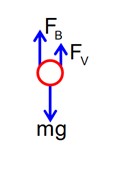
m = 0.3g density,   ρ ( b a l l ) = 8 g / c c V = m ρ = 0 . 3 8 c c                                        

ρ g l y c e r e n e = 1 . 3 g / c c = 1 . 3 * 1 0 3 k g / m 3      

Fv + FB = mg.

=Fv = mg – FB = .3 * 10-3 * 10 – 1.3 *   0 . 3 8 * 1 0 6 * 1 0 * 1 0 3


= 3 * 1 0 3 . 3 9 8 * 1 0 2 = 3 * 1 0 3 . 5 * 1 0 3    

= 2.5 * 10-3N                       

= 25 * 10-4N

 x = 25


New answer posted

8 months ago

0 Follower 16 Views

V
Vishal Baghel

Contributor-Level 10

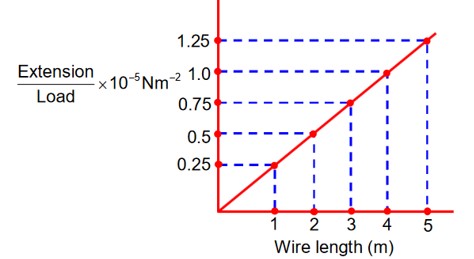
Slope = Δ L / W L = Δ L / L W = 1 Y A

Y = 1 ( S l o p e ) A

Y = 1 ( 2 * 1 0 6 ) ( 0 . 2 5 * 1 0 5 )

Y = 2 * 1 0 1 1 N / m 2

New answer posted

8 months ago

0 Follower 2 Views

A
alok kumar singh

Contributor-Level 10

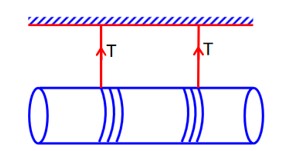
  l = 0 . 5 m

= 1 0 4 m 2

Breaking stress, F A = 5 * 1 0 8 N / m 2

F = 5 * 1 0 8 * 1 0 4 N

F = 5 * 104N

T = m V 2 l V ( m a x ) 2 = = T l m

V m 2 = 2 . 5 * 1 0 3


Vmax = 50m/s


New answer posted

8 months ago

0 Follower 8 Views

A
alok kumar singh

Contributor-Level 10

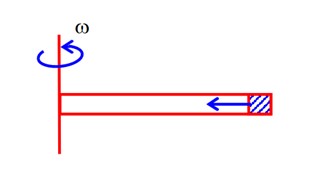
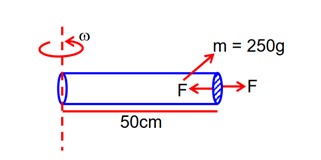
ω = x F r a d / 5

As, F = m ω 2 L 2

F = m L 2 ( x 2 F ) x 2 = 2 m L = 2 1 4 * 1 2 = 1 6

x = 4


New answer posted

8 months ago

0 Follower 3 Views

N
nitesh singh

Contributor-Level 10

Higher melting point means more energy is required to break the ionic bond. Since the ionic bonds in MgO are stronger than in NaCl due to various reasons, It have higher melting and even boiling point. Reasons are listed below:

  • In MgO, Magnesium and oxygen ions carry a +2 and -2 charge while sodium and in NaCl, chlorine ions carry a +1 and -1 charge. Due to higher charges more electrostatic attraction is involved.
  • The smaller ionic radius of Mg2+ are smaller compared to Na+, makes the bond stronger in MgO.
  • Due to larger elctrostatic force and smaller ionic radius, ionic bond in MgO are stronger, resulting in higher lattice energy.
  • The stro
...more

Get authentic answers from experts, students and alumni that you won't find anywhere else

Sign Up on Shiksha

On Shiksha, get access to

  • 66k Colleges
  • 1.2k Exams
  • 687k Reviews
  • 1800k Answers

Share Your College Life Experience

×
×

This website uses Cookies and related technologies for the site to function correctly and securely, improve & personalise your browsing experience, analyse traffic, and support our marketing efforts and serve the Core Purpose. By continuing to browse the site, you agree to Privacy Policy and Cookie Policy.