Class 11th

Get insights from 8k questions on Class 11th, answered by students, alumni, and experts. You may also ask and answer any question you like about Class 11th

Follow Ask Question
8k

Questions

0

Discussions

0

Active Users

0

Followers

New answer posted

a year ago

0 Follower 6 Views

V
Vishal Baghel

Contributor-Level 10

This is a Short Answer Type Questions as classified in NCERT Exemplar

Sol:

(a)Given

  that:      2x+y=5                             …(i)                               x+3y+8=0                             …(ii)                                   3x+4y=7                             …(iii)Equation  of  any  line    through  the    of    of  eqn.(i)  and  eqn.(ii)  is       (2x+y−5)+λ(x+3y+8)=0                 …(iv)        [λ=]⇒    2x+y−5+λx+3λy+8λ=0⇒(2+λ)x+(1+3λ)y−5+8λ=0        Slope  of  line  m1(say)=−(2+λ)1+3λ      [?m=−ab]        Slope  of  line  3x+4y=7  is                                     m2(say)=−34       If  eqn.(iii)  is  parallel  to  eqn.(iv)  then                           m1=m2∴          −(2+λ)1+3λ=−34⇒             2+λ1+3λ=34       ⇒8+4λ=3+9λ⇒         9λ−4λ=5        ⇒5λ=5     ⇒λ=1On  putting  the  value  of  λ  in  eqn.(iv)  we  get            (2x+y−5)+1(x+3y+8)=0⇒                 2x+y−5+x+3y+8=0⇒                                       3x+4y+3=0Hence,  the  required  equation  is  3x+4y+3=0.

New answer posted

a year ago

0 Follower 3 Views

V
Vishal Baghel

Contributor-Level 10

This is a Short Answer Type Questions as classified in NCERT Exemplar

Sol:

Given  that  the  line  makes  angle  300  with  yaxis∴  Angle  made  by  the  line  with   xaxis  is  600∴  Slope  of  the  line           m=tan600⇒      m=3So,  the  equation  of  the  line    through  the    (1,2)  and  slope  3  is             y−y1=m(x−x1)⇒          y−2=3(x−1)⇒          y−2=3x−3⇒          y−3x−3−2=0Hence,  the  required  equation  of  line  is  y−3x−3−2=0.

New answer posted

a year ago

0 Follower 6 Views

V
Vishal Baghel

Contributor-Level 10

This is a Short Answer Type Questions as classified in NCERT Exemplar

Sol:

Given  that:           xa+yb=1                           …(i)and                           xa−yb=1                           …(ii)           Slope  of  the  eqn.(i)  m1  (say)=−baand  slope  of  the  eqn.(ii)  m2  (say)=baLet  θ  be  the  angle  betqween  the  two  given  lines∴  tanθ=|m1−m21+m1m2|=|−ba−ba1+(−ba)(ba)|=|−2ba1−b2a2|=|−2aba2−b2|⇒    tanθ=2aba2−b2.  Hence  proved.

New answer posted

a year ago

0 Follower 3 Views

V
Vishal Baghel

Contributor-Level 10

This is a Short Answer Type Questions as classified in NCERT Exemplar

Sol:

Let  (x1,y1)  be  any    lying  in  the  equation  x+y=4∴                 x1+y1=4                                               …(i)  of  the    (x1,y1)  from  the  equation  4x+3y=10                  4x1+3y1−10(4)2+(3)2=1                |4x1+3y1−105|=1                   4x1+3y1−10=±5Taking  (+)  sign           4x1+3y1−10=5⇒                                         4x1+3y1=15                         …(ii)From  eqn.(i)  we  get  y1=4−x1Putting  the  value  of  y1  in  eqn.(ii)  we  get            4x1+3(4−x1)=15⇒         4x1+12−3x1=15⇒                       x1+12=15⇒                      x1=3  and  y1=4−3=1So,  the  required    is  (3,1)Now  taking  (−)  sign,           4x1+3y1−10=−5⇒                                         4x1+3y1=5                         …(iii)From  eqn.(i)  we  get  y1=4−x1            4x1+3(4−x1)=5⇒         4x1+12−3x1=5⇒                       x1+12=5⇒                      x1=−7  and  y1=4−(−7)=11So,  the  required    is  (−7,11)Hence,  the   required    on  the  given  line  are  (3,1)  and  (−7,11).

New answer posted

a year ago

0 Follower 3 Views

V
Vishal Baghel

Contributor-Level 10

This is a Short Answer Type Questions as classified in NCERT Exemplar

Sol:

Equation  of  line  having  a  and  b    on  the  axis  is                       xa+yb=1                                           …(i)Given  that  a+b=14     ⇒b=14−a⇒                       xa+y14−a=1                                     …(ii)If  eqn.(ii)  passes  through  the    (3,4)  then                         3a+414−a=1⇒            3(14−a)+4aa(14−a)=1⇒                             42+a=14a−a2⇒       a2+a−14a+42=0⇒               a2−13a+42=0⇒       a2−7a−6a+42=0⇒   a(a−7)−6(a−7)=0⇒              (a−6)(a−7)=0         ⇒a=6,7∴                b=14−6=8,  b=14−7=7Hence,  the  required  equation  of  lines  are               x6+y8=1       ⇒4x+3y=24and       x7+y7=1       ⇒x+y=7

New answer posted

a year ago

0 Follower 4 Views

P
Payal Gupta

Contributor-Level 10

This is a short answer type question as classified in NCERT Exemplar
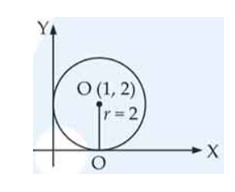
Since  the  circle  whose  centre  is  (1,2)  touch  x-axis ∴     r = 2 S o ,     t h e     e q u a t i o n     o f     t h e     c i r c l e     i s                                   ( x − h ) 2 + ( y − k ) 2 = r 2 ⇒                             ( x − 1 ) 2 + ( y − 2 ) 2 = ( 2 ) 2 ⇒ x 2 − 2 x + 1 + y 2 − 4 y + 4 = 4 ⇒                   x 2 + y 2 − 2 x − 4 y + 1 = 0 H e n c e ,     t h e     r e q u i r e d     e q u a t i o n     i s     x 2 + y 2 − 2 x − 4 y + 1 = 0 .

New answer posted

a year ago

0 Follower 5 Views

V
Vishal Baghel

Contributor-Level 10

This is a Short Answer Type Questions as classified in NCERT Exemplar

Sol:

The  given  equations  are  y=(2−3)(x+5)                        …(i)                and                              y=(2+3)(x−7)                        …(ii)           Slope  of  the  eqn.(i)  m1  (say)=(2−3)and  slope  of  the  eqn.(ii)  m2  (say)=(2+3)Let  θ  be  the  angle  betqween  the  two  given  lines∴  tanθ=|m1−m21+m1m2|=|2−3−2−31+(2−3)(2+3)|=|−232|=|−3|⇒    tanθ=3  or  −3∴              θ=600  or  1200Hence,  the  required  angle  is  600  or  1200.

New answer posted

a year ago

0 Follower 2 Views

P
Payal Gupta

Contributor-Level 10

This is a short answer type question as classified in NCERT Exemplar

Given  points  are  (0,0),(a,0)  and  (0,b) G e n e r a l     e q u a t i o n     o f     t h e     c i r c l e     i s                     x 2 + y 2 + 2 g x + 2 f y + c = 0     w h e r e     t h e     c e n t r e     i s ( − g , − f )     a n d     r a d i u s = g 2 + f 2 − c I f     i t     p a s s e s     t h r o u g h ( 0 , 0 ) ∴     c = 0 I f     i t     p a s s e s     t h r o u g h ( a , 0 )     a n d     ( 0 , b )     t h e n                 a 2 + 2 g a + c = 0           ⇒ a 2 + 2 g a = 0                                             [ ? c = 0 ] ∴               g = − a 2 a n d       0 + b 2 + 0 + 2 f b + c = 0         ⇒ b 2 + 2 f b = 0                 [ ? c = 0 ] ⇒       f = − b 2 H e n c e ,     t h e     c o o r d i n a t e s     o f     c e n t r e     o f     t h e     c i r c l e     a r e     ( − g , − f ) = ( a 2 , b 2 )

New answer posted

a year ago

0 Follower 4 Views

V
Vishal Baghel

Contributor-Level 10

This is a Short Answer Type Questions as classified in NCERT Exemplar

Sol:

Slope  of  the  line  joining  through  the    (2,3)  and  (3,−1)  is              −1−33−2=−4Slope  of  the  required  line  which  is  perpendicular  to  it            =−1−4=14                          [
m1m2=−1]Equation  of  the  line    through  the    (5,2)  is            y−2=14(x−5)             [
y−y1=m(x−x1)]⇒     4y−8=x−5⇒    x−4y+3=0Hence,  the  required  equation  is  x−4y+3=0.

New answer posted

a year ago

0 Follower 5 Views

P
Payal Gupta

Contributor-Level 10

This is a short answer type question as classified in NCERT Exemplar

G i v e n     t h a t :     x = 2 a t 1 + t 2     a n d     y = a ( 1 − t 2 ) 1 + t 2 ⇒         x 2 + y 2 = ( 2 a t 1 + t 2 ) 2 + ( a ( 1 − t 2 ) 1 + t 2 ) 2                                                 = 4 a 2 t 2 ( 1 + t 2 ) 2 + a 2 ( 1 − t 2 ) 2 ( 1 + t 2 ) 2 = 4 a 2 t 2 + a 2 ( 1 + t 4 − 2 t 2 ) ( 1 + t 2 ) 2                                                 = 4 a 2 t 2 + a 2 + a 2 t 4 − 2 a 2 t 2 ( 1 + t 2 ) 2 = a 2 + a 2 t 4 + 2 a 2 t 2 ( 1 + t 2 ) 2                                                 = a 2 ( 1 + t 4 + 2 t 2 ) ( 1 + t 2 ) 2 = a 2 ( 1 + t 2 ) 2 ( 1 + t 2 ) 2 = a 2 ∴           x 2 + y 2 = a 2     w h i c h     i s     t h e     e q u a t i o n     o f     a     c i r c l e . Hence,  the  given  points  lie  on  a  circle.

Get authentic answers from experts, students and alumni that you won't find anywhere else

Sign Up on Shiksha

On Shiksha, get access to

  • 67k Colleges
  • 1.2k Exams
  • 718k Reviews
  • 1850k Answers

Share Your College Life Experience

×
×

This website uses Cookies and related technologies for the site to function correctly and securely, improve & personalise your browsing experience, analyse traffic, and support our marketing efforts and serve the Core Purpose. By continuing to browse the site, you agree to Privacy Policy and Cookie Policy.