

Class 12th
Get insights from 12k questions on Class 12th, answered by students, alumni, and experts. You may also ask and answer any question you like about Class 12th
Follow Ask QuestionQuestions
Discussions
Active Users
Followers
New answer posted
a year agoContributor-Level 9
For an acidic buffer solution, pH = pKa + log ( [Base]/ [Acid]).
Given pH = 5.74 and pKa = 4.74.
5.74 = 4.74 + log ( [Base]/1).
1 = log ( [Base]).
[Base] = 10M.
New answer posted
a year agoContributor-Level 9
For the reaction C? H? → C? H? + H? , calculate the enthalpy change (ΔH).

ΔH = [Bond energy (C-C) + 6 * Bond energy (C-H)] - [Bond energy (C=C) + 4 * Bond energy (C-H) + Bond energy (H-H)]
ΔH = 347 + 2 (414) - 611 - 436 = 128 kJ/mol.
New answer posted
a year agoContributor-Level 9
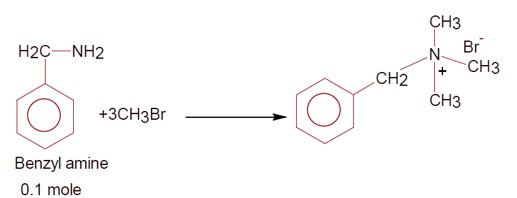
Benzyl amine (0.1 mole) reacts with 3 equivalents of CH? Br to form Benzyl trimethyl ammonium bromide.
Given 23g of Benzyl trimethyl ammonium bromide (molar mass 230 g/mol ), which is 0.1 mol.
Therefore, moles of CH? Br = 0.3 = 3 x 10? ¹. The value of n is 3.
New answer posted
a year agoContributor-Level 10
When white light passes through a cool gas, atoms absorb specific wavelengths. This produces a continuous background with dark lines at those absorbed wavelengths. This is atomic absorption spectra. But when atoms are excited, they release photons at specific wavelengths, producing a dark background with bright lines. That is emission spectra.
New answer posted
a year agoContributor-Level 9
CH? (methane) is produced / generated from paddy fields. And methane leads to both global warming and photochemical smog.
CO? is used in photosynthesis, acid rain etc. but methane is not consumed.
So methane is a stronger global warming gas than CO?
New answer posted
a year agoContributor-Level 10
Every element has a unique set of spectral lines as its electrons occupy specific energy levels. What scientists know for certain is that these unique patterns act like fingerprints. It helps in identifying elements in stars, flames, or unknown samples. For instance, Helium was discovered in the Sun's spectrum before it was found on Earth.
New answer posted
a year agoContributor-Level 10
We see a discrete emission spectrum when electrons inside excited atoms or ions in gases fall back from higher energy levels to lower ones. Every transition releases a photon of a specific wavelength. Usually the spectrum appears as sharp, bright lines. Dark gaps separate them. These lines are unique to each element.
On the other hand, a continuous emission spectrum is produced when hot solids, liquids, or dense gases emit radiation. This happens because of the collective motion of their atoms and electrons. We don't see sharp lines. Instead the spectrum shows a smooth and unbroken spread of all wavelengths.
New answer posted
a year agoContributor-Level 10
The truth table for the logical expression (p ∧ q) → (p → q) is as follows:
p | q | p ∧ q | p → q | (p ∧ q) → (p → q) |
T | T | T | T | T |
T | F | F | F | T |
F | T | F | T | T |
F | F | F | T | T |
The final column shows that the expression is a tautology, meaning it is always true regardless of the truth values of p and q.
Taking an Exam? Selecting a College?
Get authentic answers from experts, students and alumni that you won't find anywhere else
Sign Up on ShikshaOn Shiksha, get access to
- 67k Colleges
- 1.2k Exams
- 716k Reviews
- 1850k Answers