

Class 12th
Get insights from 12k questions on Class 12th, answered by students, alumni, and experts. You may also ask and answer any question you like about Class 12th
Follow Ask QuestionQuestions
Discussions
Active Users
Followers
New answer posted
a year agoContributor-Level 9
o Let the number of atoms of element A be N.
o Tetrahedral voids = 2N.
o Atoms of element M = (2/3) * 2N = 4/3 N.
o The ratio M : A is (4/3 N) : N, which simplifies to 4:3.
o So, the formula of the compound is M? A?
New answer posted
a year agoContributor-Level 10
The equation of a plane parallel to x - 2y + 2z - 3 = 0 is x - 2y + 2z + λ = 0.
The distance from the point (1, 2, 3) to this plane is 1.
|1 - 2 (2) + 2 (3) + λ| / √ (1² + (-2)² + 2²) = 1
|1 - 4 + 6 + λ| / √9 = 1
|3 + λ| / 3 = 1
|3 + λ| = 3
3 + λ = 3 or 3 + λ = -3
λ = 0 or λ = -6.
New answer posted
a year ago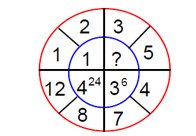
Contributor-Level 10
1 = (2-1)¹ (The n is likely 1).
3? = (7-4)³ (This seems to be a pattern matching (a-b)^c).
4²? = (12-8)? ! = 4²?
The blank space must be (5-3)² = 2² = 4.
New question posted
a year agoNew answer posted
a year agoContributor-Level 10
Circle 1: x² + y² - 10x - 10y + 41 = 0
Center C? = (5,5).
Radius r? = √ (5² + 5² - 41) = √ (25+25-41) = √9 = 3.
Circle 2: x² + y² - 22x - 10y + 137 = 0
Center C? = (11,5).
Radius r? = √ (11² + 5² - 137) = √ (121+25-137) = √9 = 3.
Distance between centers d (C? , C? ) = √ (11-5)² + (5-5)²) = √ (6²) = 6.
Sum of radii r? + r? = 3 + 3 = 6.
Since the distance between the centers is equal to the sum of their radii, the circles touch externally at one point.
New answer posted
a year agoContributor-Level 10
Linear: N? (azide ion)
Bent-shape: O? (ozone), NO? (nitrite ion), Cl? O (dichlorine monoxide)
New answer posted
a year agoContributor-Level 10
1° amine: Forms a precipitate that is soluble in NaOH.
2° amine: Forms a precipitate that is insoluble in NaOH.
3° amine: No reaction.
New answer posted
a year agoContributor-Level 10
A function f (x) is continuous at x=1, so lim (x→1? ) f (x) = lim (x→1? ) f (x) = f (1).
Assuming a piecewise function like f (x) = { -x, x<1; ax+b, x1 } (structure inferred from derivative).
Continuity at x=1: f (1) = 1. a (1)+b = 1 => a+b=1.
The function is differentiable at x=1. The derivative of f (x) at x=1 from the left is -1. The derivative from the right is a.
So, a = -1. (The image has 2a = -1, which would imply a function like -x and ax²+b). Let's assume f' (x) = 2a for x>1.
2a = -1 => a = -1/2.
From a+b=1, b = 1 - a = 1 - (-1/2) = 3/2.
So, a = -1/2 and b = 3/2.
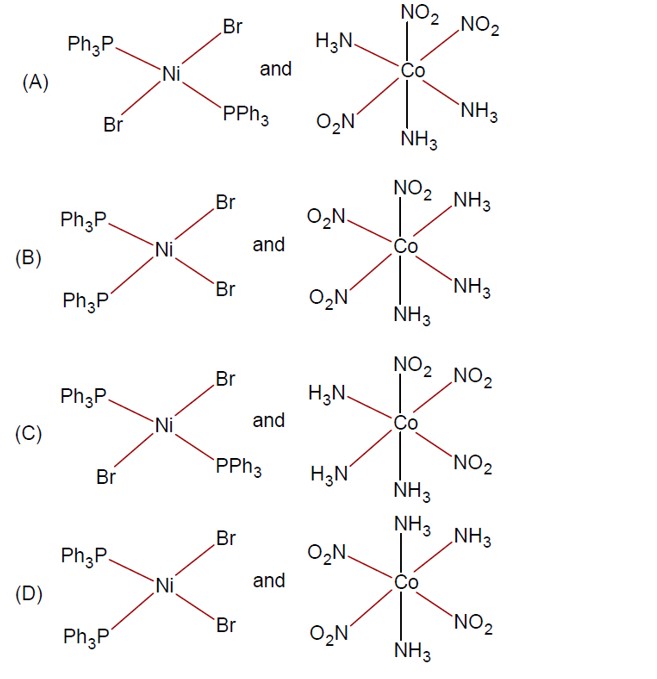
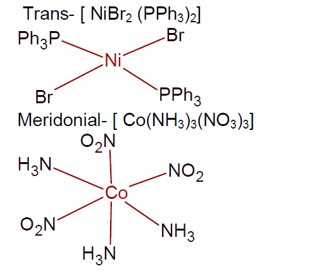
New answer posted
a year agoContributor-Level 10
Inversion of Sucrose:
C? H? O? (Sucrose) + H? O - (Invertase)-> C? H? O? (Glucose) + C? H? O? (Fructose)
Fermentation of Glucose:
C? H? O? (Glucose) - (Zymase)-> 2C? H? OH (Ethanol) + 2CO?
Taking an Exam? Selecting a College?
Get authentic answers from experts, students and alumni that you won't find anywhere else
Sign Up on ShikshaOn Shiksha, get access to
- 67k Colleges
- 1.2k Exams
- 716k Reviews
- 1850k Answers