

Class 12th
Get insights from 12k questions on Class 12th, answered by students, alumni, and experts. You may also ask and answer any question you like about Class 12th
Follow Ask QuestionQuestions
Discussions
Active Users
Followers
New answer posted
a year agoContributor-Level 10
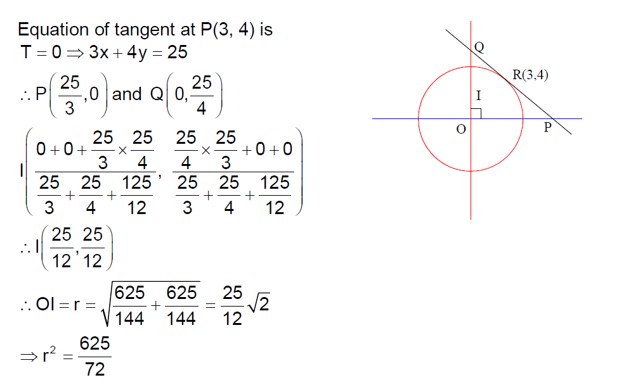
Find the number of solutions for 2tan(x) = π/2 - x in [0, 2π].
This is equivalent to finding the number of intersection points of the graphs y = tan(x) and y = (π/4) - x/2.
Let's sketch the graphs:
y = tan(x) has vertical asymptotes at x = π/2, 3π/2.
y = (π/4) - x/2 is a straight line with a negative slope.
At x=0, y=π/4.
At x=π/2, y=0.
At x=π, y=-π/4.
At x=2π, y=-3π/4.
By observing the graphs, there will be one intersection in (0, π/2), one in (π/2, 3π/2), and one in (3π/2, 2π].
Total number of solutions is 3.
New answer posted
a year ago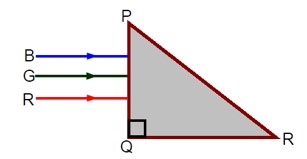
Contributor-Level 10
θ? > I = θ ⇒ sinθ? > sinθ ⇒ 1/μ > sinθ
⇒ μ < 1/sin
Note: If we assume θ = 45° ⇒ μ < 1.414, then red colour light ray will come out from face PR of prism.
New answer posted
a year agoContributor-Level 10
Given that x, y, z are in A.P., so 2y = x + z.
The determinant is:
| 3 4√2 x |
| 4 5√2 y | = 0
| 5 k z |
Apply the operation R? → R? + R? - 2R?:
The first row becomes:
(3 + 5 - 24) (4√2 + k - 25√2) (x + z - 2y)
= 0 (k - 6√2) (0)
So the determinant becomes:
| 0 k-6√2 0 |
| 4 5√2 y | = 0
| 5 k z |
Expanding along the first row:
-(k - 6√2)(4z - 5y) = 0.
This implies k - 6√2 = 0 or 4z - 5y = 0.
k = 6√2 or y = 4z/5.
The condition y = 4z/5 is stated as not possible.
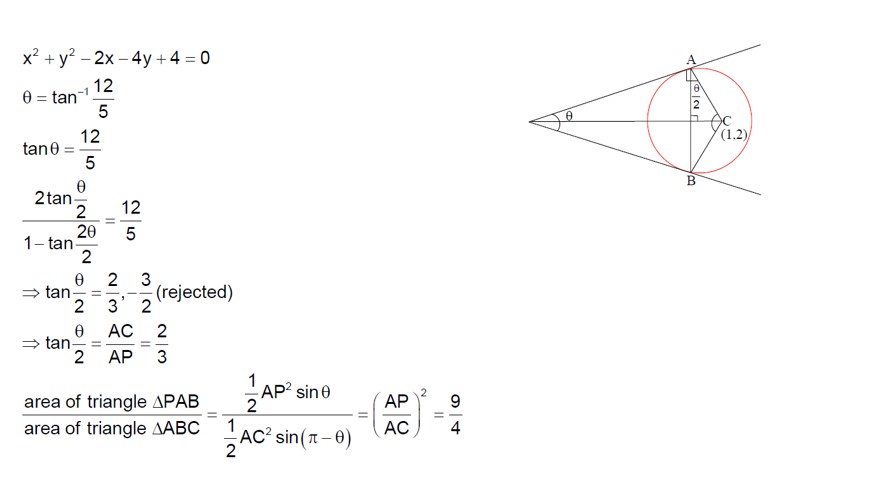
Therefore, k = 6√2, which means k² = (6√2)² = 36 * 2 = 72.
New answer posted
a year agoContributor-Level 10
I = (V/R) (1 - e^ (-t/τ) where τ = L/R
E = (1/2)LI² = (1/2)L (V²/R²) (1 - e^ (-t/τ)² ⇒ Energy stored in inductor
According to Question, we can write
(1/4) * (1/2) (LV²/R²) = (1/2) (LV²/R²) (1 - e^ (-t/τ)²
⇒ 1/4 = (1 - e^ (-t/τ)² ⇒ 1/2 = 1 - e^ (-t/τ) ⇒ e^ (-t/τ) = 1/2
⇒ t/τ = ln (2) ⇒ t = τln (2) = (L/R)ln (2)
New answer posted
a year agoContributor-Level 10
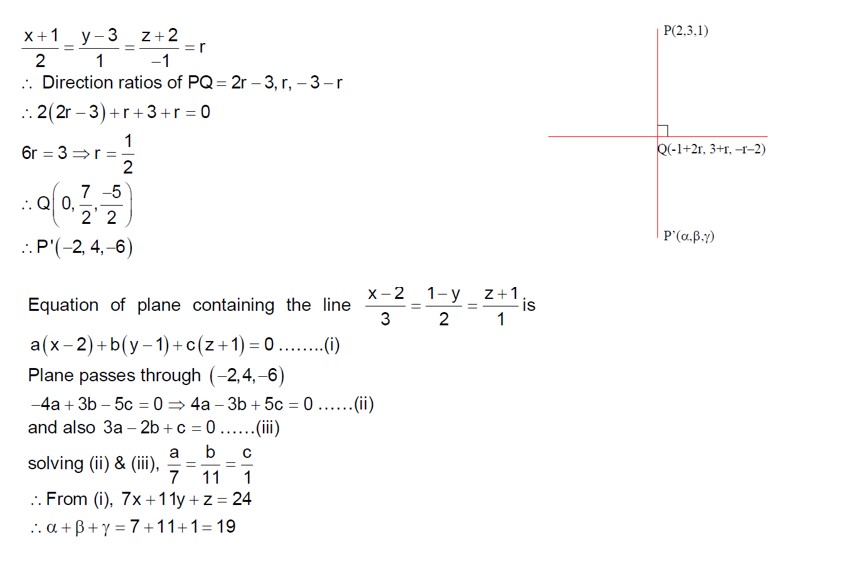
R = mv / (qB) = √ (2mK) / (qB) ⇒ K = (R²q²B²) / (2m)
⇒ K? /Kα = (R? ²q? ²B² / 2m? ) * (2mα / (Rα²qα²B²) = (mα/m? ) * (R? /Rα)² * (q? /qα)²
⇒ K? /Kα = (4) * (2)² * (1/2)² = 4:1
New answer posted
a year agoContributor-Level 10
R = (2μ sinθ) / (1.22λ) . (1)
According to de-Broglie's hypothesis, we can write
λ = h / (mv) . (2)
With the help of equations (1) and (2), we can write
R = (2μmv sinθ) / (1.22h) ⇒ R? /R? = m? /m? = 1837 ⇒ R? = 1837R?
- Concept involved: Resolving Power of Microscope
- Topic: Optics
- Difficulty level: Moderate
- Point of Error: Formula
Taking an Exam? Selecting a College?
Get authentic answers from experts, students and alumni that you won't find anywhere else
Sign Up on ShikshaOn Shiksha, get access to
- 67k Colleges
- 1.2k Exams
- 716k Reviews
- 1850k Answers