Class 12th
Get insights from 12k questions on Class 12th, answered by students, alumni, and experts. You may also ask and answer any question you like about Class 12th
Follow Ask QuestionQuestions
Discussions
Active Users
Followers
New answer posted
4 months agoContributor-Level 10
|a|=|b|=|c|=1
|a-b|²+|a-c|²=8
⇒|a|²+|b|²-2a.b+|a|²+|c|²-2a.c=8
⇒4-2 (a.b+a.c)=8
⇒a.b+a.c=-2
|a+2b|²+|a+2c|²
=|a|²+4|b|²+4a.b+|a|²+4|c|²+4a.c
=10+4 (a.b+a.c)
=10-8=2
New answer posted
4 months agoContributor-Level 9
With weak field ligands Mn (II) will be of high spin and with strong field ligands it will be of low spin.
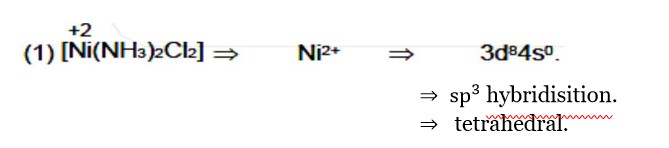
Ni (II) tetrahedral complexes will be generally of high spin due to sp³ hybridisation. Mn (II) is of light pink color in aqueous solution.
New answer posted
4 months agoContributor-Level 10
Let B? be the event where Box-I is selected and B? →where box-II selected
P (B? )=P (B? )=1/2
Let E be the event where selected card is non prime.
For B? : Prime numbers: {2,3,5,7,11,13,17,19,23,29}
For B? : Prime numbers: {31,37,41,43,47}
P (E)=P (B? )*P (E/B? )+P (B? )P (E/B? )
= 1/2*20/30+1/2*15/20
Required probability:
P (B? /E) = (P (E/B? )P (B? )/P (E) = (1/2*20/30)/ (1/2*20/30+1/2*15/20) = (2/3)/ (2/3+3/4) = 8/17
New answer posted
4 months agoContributor-Level 10
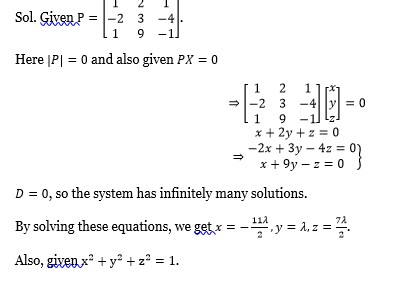
2x-y+2z=2
x-2y+λz=-4
x+λy+z=4
For no solution:
D=|2, -1,2; 1, -2, λ 1,1,1|=0
⇒ 2 (-2-λ²)+1 (1-λ)+2 (λ+2)=0
⇒ -2λ²+λ+1=0
⇒ λ=1, -1/2
D? =|2, -1,2; -4, -2, λ 4,1,1|
=2 (-2-λ)+1 (-4-4λ)+2 (-4+8)
=2 (1+λ) which is not equal to zero for λ=1, -1/2
New answer posted
4 months agoContributor-Level 9
The vapour pressure of solution will be less than vapour pressure of pure solvent, so some vapour molecules will get condensed to maintain new equilibrium.
New answer posted
4 months agoContributor-Level 10
Energy Density = 1/2 B²/µ?
B = √ (2 * µ? * Energy density)
B = √ (2 * 4π * 10? * 1.02 * 10? ) = 160 * 10? = 160nT
New answer posted
4 months agoContributor-Level 10
f (x) = {ae? +be? , -1
Lim (x→1? )f (x) = Lim (x→1? )f (x)
⇒ ae+be? ¹=c ⇒ b=ce-ae²
For continuity at x=3
Lim (x→3? )f (x) = Lim (x→3? )f (x)
⇒ 9c=9a+6c ⇒ c=3a
f' (0)+f' (2)=e
(ae? -be? ) at x=0 + (2cx) at x=2 = e
⇒ a-b+4c=e
From (1), (2) and (3)
a-3ae+ae²+12a=e
⇒ a (e²+13-3e)=e
⇒ a=e/ (e²-3e+13)
New answer posted
4 months agoContributor-Level 10
Since p (x) has relative extreme at x=1 and 2
so p' (x)=0 at x=1 and 2
⇒ p' (x)=A (x-1) (x-2)
⇒ p (x)=∫A (x²-3x+2)dx
p (x)=A (x³/3 - 3x²/2 + 2x)+C
P (1)=8
From (1)
8=A (1/3-3/2+2)+C
⇒ 8=5A/6+C ⇒ 48=5A+6C
P (2)=4
⇒ 4=A (8/3-6+4)+C
⇒ 4=-2A/3+C ⇒ 12=-2A+3C
From 3 and 4, C=-12
So P (0)=C=-12
Taking an Exam? Selecting a College?
Get authentic answers from experts, students and alumni that you won't find anywhere else
Sign Up on ShikshaOn Shiksha, get access to
- 66k Colleges
- 1.2k Exams
- 681k Reviews
- 1800k Answers