Class 12th

Get insights from 12k questions on Class 12th, answered by students, alumni, and experts. You may also ask and answer any question you like about Class 12th

Follow Ask Question
12k

Questions

0

Discussions

63

Active Users

0

Followers

New answer posted

4 months ago

0 Follower 1 View

R
Raj Pandey

Contributor-Level 9

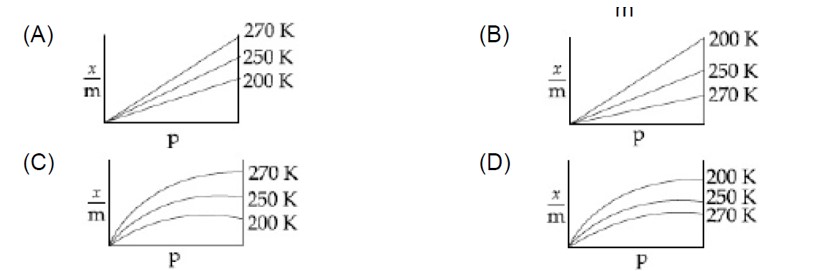
Kindly consider the following Image


New answer posted

4 months ago

0 Follower 5 Views

V
Vishal Baghel

Contributor-Level 10

ω = 2πf = 1/√ (LC)
L = 1/ (4π²f²C) = 1/ (4π² * 60² * 0.1*10? ) = 70.3 mH

New answer posted

4 months ago

0 Follower 10 Views

V
Vishal Baghel

Contributor-Level 10

E? (due to A and G) = 2 * (kq/l²)cos (45) = √2 kq/l² (downwards)
E? (due to B and F) = 2 * (kq/l²)cos (45) = √2 kq/l² (towards left)
E? (due to C and H) = 0
E? (due to D and E) = 0
Resultant E = √ (E? ²+E? ²) = √ (2 (kq/l²)²+2 (kq/l²)²) = 2kq/l²
(Solution in the image seems to be different.)

New answer posted

4 months ago

0 Follower 7 Views

V
Vishal Baghel

Contributor-Level 10

Energy of electron = 3 eV
It forms H atom in n=3 state. Energy released E = 3 - (-13.6/9) = 3 + 1.51 = 4.51 eV.
Photon Energy = 4.51 eV
Threshold energy = hc/λ = 12400eVÅ / 4000Å = 3.1 eV.
kE_max = 4.51 - 3.1 = 1.41 eV


New answer posted

4 months ago

0 Follower 2 Views

V
Vishal Baghel

Contributor-Level 10

Density of nucleus is constant.

New answer posted

4 months ago

0 Follower 8 Views

V
Vishal Baghel

Contributor-Level 10

R = R? [1 + α? T]
⇒ 16 = R? [1 + α (15 - T? )]
20 = R? [1 + α (100 - T? )]
Assuming T? = 0°C:
16 = R? (1 + 15α)
20 = R? (1 + 100α)
Dividing the equations:
16/20 = (1+15α)/ (1+100α)
16 + 1600α = 20 + 300α
1300α = 4
α = 4/1300 ≈ 0.003 °C? ¹

New answer posted

4 months ago

0 Follower 8 Views

V
Vishal Baghel

Contributor-Level 10

As b > a
The magnetic field inside the wire (rR) is B = µ? I/ (2πr).
For wire with radius a, B increases linearly to r=a, then decreases. For wire with radius b, B increases linearly to r=b, then decreases. Since a⇒ B? > B?
B? = µ? I / 2πa
B? = µ? I / 2πb
(Note: The question is likely asking for the graph representation, which is option A based on the formulas.)

New answer posted

4 months ago

0 Follower 7 Views

A
alok kumar singh

Contributor-Level 10

dy/dx = 2y/ (xlnx).
dy/y = 2dx/ (xlnx).
ln|y| = 2ln|lnx| + C.
ln|y| = ln (lnx)²) + C.
y = A (lnx)².
(ln2)² = A (ln2)². ⇒ A=1.
y = f (x) = (lnx)².
f (e) = (lne)² = 1² = 1.

New answer posted

4 months ago

0 Follower 8 Views

A
alok kumar singh

Contributor-Level 10

P (at least one head) = 1 - P (no heads) = 1 - (1/2)? ≥ 0.9.
0.1 ≥ (1/2)?
10 ≤ 2?
n=3, 2³=8. n=4, 2? =16.
Minimum value of n is 4.

New answer posted

4 months ago

0 Follower 9 Views

A
alok kumar singh

Contributor-Level 10

(a+3b). (7a-5b) = 7|a|² - 5ab + 21ab - 15|b|² = 7|a|²+16ab-15|b|²=0.
(a-4b). (7a-2b) = 7|a|² - 2ab - 28ab + 8|b|² = 7|a|²-30ab+8|b|²=0.
Subtracting: 46ab - 23|b|² = 0 ⇒ 2ab = |b|².
Substituting: 7|a|² + 8|b|² - 15|b|² = 0 ⇒ 7|a|² = 7|b|² ⇒ |a|=|b|.
cosθ = ab/ (|a|b|) = ab/|b|² = (1/2)|b|²/|b|² = 1/2.
θ = 60°.

Get authentic answers from experts, students and alumni that you won't find anywhere else

Sign Up on Shiksha

On Shiksha, get access to

  • 66k Colleges
  • 1.2k Exams
  • 681k Reviews
  • 1800k Answers

Share Your College Life Experience

×
×

This website uses Cookies and related technologies for the site to function correctly and securely, improve & personalise your browsing experience, analyse traffic, and support our marketing efforts and serve the Core Purpose. By continuing to browse the site, you agree to Privacy Policy and Cookie Policy.