

Class 12th
Get insights from 12k questions on Class 12th, answered by students, alumni, and experts. You may also ask and answer any question you like about Class 12th
Follow Ask QuestionQuestions
Discussions
Active Users
Followers
New answer posted
a year ago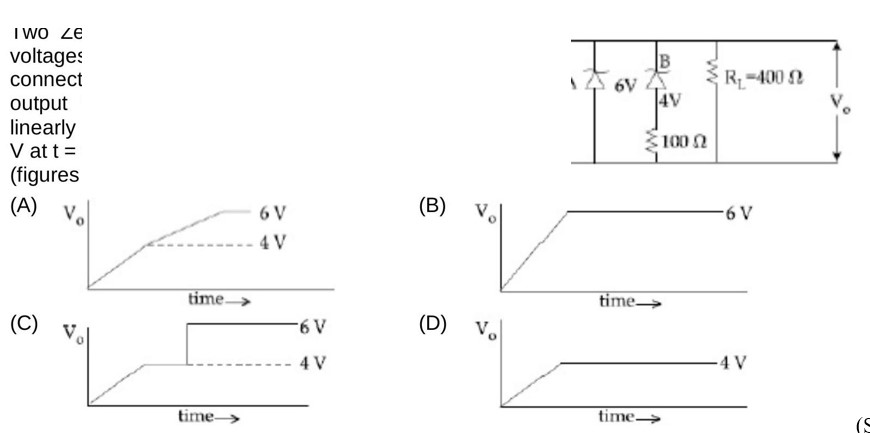
Contributor-Level 10
Till input voltage reaches 4 V. No zener is in breakdown region. So V? = V? then now hen V? changes between 4 V to 6 V one zener with 4 V will breakdown are P.D. across this zener will become constant and remaining potential will drop acro resistance in series with 4 V zener.
Now current in circuit increases Abruptly and source must have an internal resistance due to which. Some potential will get drop across the source also so correct graph between V? and t will be
We have to assume some resistance in series with source.
New answer posted
a year agoContributor-Level 9
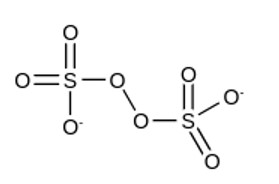
Number of bond between sulphur and oxygen
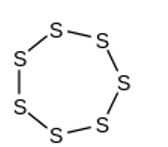
Number of bond between sulphur and sulphur
New answer posted
a year agoContributor-Level 10
Before inserting slab
C_i = ε? A/d
After inserting dielectric slab
C_i = ε? lw/d
C_f = C? + C?
C_f = (Kε? A? /d) + (ε? A? /d)
C_f = 2C_i ⇒ (Kε? wx/d) + (ε? w (l-x)/d) = 2ε? lw/d
4x + l - x = 2l
x = l/3
New answer posted
a year ago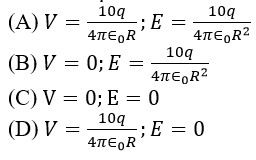
Contributor-Level 10
Potential of centre, = V =
Vc = K (Σq)/R
Vc = K (0)/R = 0
Electric field at centre E_B = E_B = ΣE
Let E be electric field produced by each
charge at the centre, then resultant electric field will be
Ec = 0, since equal electric field vectors are acting at equal angle so their resultant is equal to zero.
New answer posted
a year ago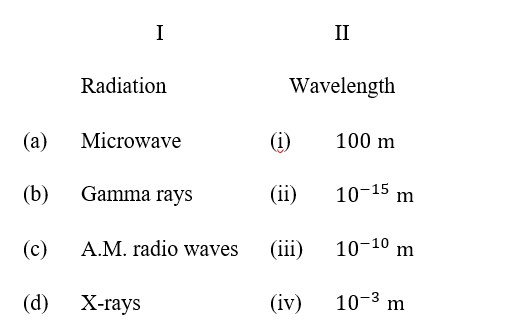
Contributor-Level 10
Energies of given Radiation can have
The following relation
Eγ-Rays > EX-Rays > Emicrowave > EAM Radiowaves
∴ λγ-Rays < X-Rays < microwave < AM Radiowaves
According to tres.
(a) Microwave → 10? ³ m
(b) Gamma Rays → 10? ¹? m (ii)
(c) AM Radio wve → 100 m (i)
(d) X-Rays → 10? ¹? m
New answer posted
a year agoContributor-Level 10
M = µ? NiA
Here
µ? = Relative permeability
N = Number of turns
i = Current
A = Area of cross section
M = µ? NiA = µ? nliA
M = µ? niV = 1000 (1000) (0.5) (10? ³) = 500 = 5 * 10²Am²
New answer posted
a year ago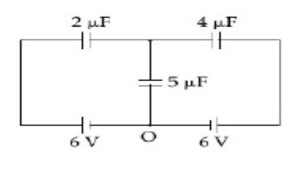
Contributor-Level 10
Now, using junction analysis
We can say, q? + q? + q? = 0
2 (x - 6) + 4 (x - 6) + 5 (x) = 0
x = 36/11, q? = 36 (5)/11 = 180/11
q? = 16.36µC
Taking an Exam? Selecting a College?
Get authentic answers from experts, students and alumni that you won't find anywhere else
Sign Up on ShikshaOn Shiksha, get access to
- 67k Colleges
- 1.2k Exams
- 717k Reviews
- 1850k Answers