Class 12th

Get insights from 12k questions on Class 12th, answered by students, alumni, and experts. You may also ask and answer any question you like about Class 12th

Follow Ask Question
12k

Questions

0

Discussions

25

Active Users

0

Followers

New answer posted

a year ago

0 Follower 7 Views

V
Vishal Baghel

Contributor-Level 10

This is a Short Answer Type Questions as classified in NCERT Exemplar
Sol:

H e r e ,                       A = [ 0 1 1 1 0 1 1 1 0 ]                                           | A | = 0 | 0 1 1 0 | − 1 | 1 1 1 0 | + 1 | 1 0 1 1 |                                                         = 0 − 1 ( 0 − 1 ) + 1 ( 1 − 0 )                                                         = 1 + 1 = 2 ≠ 0     ( non−singular  matrix ) N o w ,     c o − f a c t o r s ,     a 1 1 = + | 0 1 1 0 | = − 1 ,                 a 1 2 = − | 1 1 1 0 | = 1 ,                   a 1 3 = + | 1 0 1 1 | = 1     a 2 1 = − | 1 1 1 0 | = 1 ,                 a 2 2 = + | 0 1 1 0 | = − 1 ,                   a 2 3 = − | 0 1 1 1 | = 1     a 3 1 = + | 1 1 0 1 | = 1 ,                 a 3 2 = − | 0 1 1 1 | = 1 ,                   a 3 3 = + | 0 1 1 0 | = − 1 A d j ( A ) = [ − 1 1 1 1 − 1 1 1 1 − 1 ] ' = [ − 1 1 1 1 − 1 1 1 1 − 1 ] ∴                   A − 1 = 1 | A | A d j ( A ) = 1 2 [ − 1 1 1 1 − 1 1 1 1 − 1 ] N o w ,     A 2 = A . A = [ 0 1 1 1 0 1 1 1 0 ] [ 0 1 1 1 0 1 1 1 0 ]                                           = [ 0 + 1 + 1 0 + 0 + 1 0 + 1 + 0 0 + 0 + 1 1 + 0 + 1 1 + 0 + 0 0 + 1 + 0 1 + 0 + 0 1 + 1 + 0 ] = [ 2 1 1 1 2 1 1 1 2 ] H e n c e ,     A 2 = [ 2 1 1 1 2 1 1 1 2 ] N o w ,     w e     h a v e     t o     p r o v e     t h a t     A − 1 = A 2 − 3 I 2 R . H . S . = [ 2 1 1 1 2 1 1 1 2 ] − 3 [ 1 0 0 0 1 0 0 0 1 ] 2                                 = [ 2 1 1 1 2 1 1 1 2 ] − [ 3 0 0 0 3 0 0 0 3 ] 2 = 1 2 [ − 1 1 1 1 − 1 1 1 1 − 1 ]                                   = A − 1 = L . H . S . H e n c e ,     p r o v e d .

New answer posted

a year ago

0 Follower 7 Views

V
Vishal Baghel

Contributor-Level 10

This is a Short Answer Type Questions as classified in NCERT Exemplar
Sol:

| 1 1 1 1 + c o s A 1 + c o s B 1 + c o s C c o s 2 A + c o s A c o s 2 B + c o s B c o s 2 C + c o s C | = 0 C 1 → C 1 − C 2 ,   C 2 → C 2 − C 3 ⇒         | 0 0 1 c o s A − c o s B c o s B − c o s C 1 + c o s C c o s 2 A + c o s A − c o s 2 B − c o s B c o s 2 B + c o s B − c o s 2 C − c o s C c o s 2 C + c o s C | = 0 ⇒         | 0 0 1 c o s A − c o s B c o s B − c o s C 1 + c o s C c o s 2 A − c o s 2 B + c o s A − c o s B c o s 2 B − c o s 2 C + c o s B − c o s C c o s 2 C + c o s C | = 0 ⇒         | 0 0 1 c o s A − c o s B c o s B − c o s C 1 + c o s C ( c o s A + c o s B ) * ( c o s A − c o s B ) + ( c o s A − c o s B ) ( c o s B + c o s C ) * ( c o s B − c o s C ) + c o s B − c o s C c o s 2 C + c o s C | = 0 T a k i n g     ( c o s A − c o s B )     a n d     ( c o s B − c o s C )     c o m m o n     f r o m     C 1     a n d     C 2     r e s p e c t i v e l y . ⇒ ( c o s A − c o s B ) ( c o s B − c o s C ) | 0 0 1 1 1 1 + c o s C c o s A + c o s B + 1 c o s B + c o s C + 1 c o s 2 C + c o s C | = 0 E x p a n d i n g     a l o n g     R 1 ⇒ ( c o s A − c o s B ) ( c o s B − c o s C ) [ 1 | 1 1 c o s A + c o s B + 1 c o s B + c o s C + 1 | ] = 0 ⇒ ( c o s A − c o s B ) ( c o s B − c o s C ) [ ( c o s B + c o s C + 1 ) − ( c o s A + c o s B + 1 ) ] = 0 ⇒ ( c o s A − c o s B ) ( c o s B − c o s C ) [ c o s B + c o s C + 1 − c o s A − c o s B − 1 ] = 0 ⇒ ( c o s A − c o s B ) ( c o s B − c o s C ) ( c o s C − c o s A ) = 0 ⇒ c o s A − c o s B = 0         o r         c o s B − c o s C = 0         o r         c o s C − c o s A = 0 ⇒ c o s A = c o s B         o r         c o s B = c o s C         o r         c o s C = c o s A ⇒ ∠ A = ∠ C         o r         ∠ B = ∠ C         ⇒         ∠ A = ∠ B H e n c e ,     Δ A B C     i s     a n     i s o s c e l e s     t r i a n g l e .

New answer posted

a year ago

0 Follower 12 Views

V
Vishal Baghel

Contributor-Level 10

This is a Short Answer Type Questions as classified in NCERT Exemplar
Sol:

If  the  given  points  lie  on  a  straight  line,  then  the  area  of  the  triangle  formed  by  joining  the points  pairwise  is  zero. S 0 ,           | a + 5 a − 4 1 a − 2 a + 3 1 a a 1 | R 1 → R 1 − R 2 ,   R 2 → R 2 − R 3 ⇒                                                       | 7 − 7 0 − 2 3 0 a a 1 | E x p a n d i n g     a l o n g     C 3 ⇒                                                         1 . | 7 − 7 − 2 3 | = 2 1 − 1 4 = 7 u n i t s As  7≠0.  Hence,  the  three  points  do  not  lie  on  a  straight  line  for  any  value  of  a.

New answer posted

a year ago

0 Follower 10 Views

V
Vishal Baghel

Contributor-Level 10

This is a Short Answer Type Questions as classified in NCERT Exemplar
Sol:

I f     a 1 , a 2 , a 3 , … a r     b e     t h e     t e r m s     o f     G . P . ,     t h e n                                                                                       a n = A R n − 1 ( w h e r e     A     i s     t h e     f i r s t     t e r m     a n d     R     i s     t h e     c o m m o n     r a t i o     o f     t h e     G . P . ) ∴               a r + 1 = A R r + 1 − 1 = A R r ;     a r + 5 = A R r + 5 − 1 = A R r + 4                     a r + 9 = A R r + 9 − 1 = A R r + 8 ;     a r + 7 = A R r + 7 − 1 = A R r + 6                     a r + 1 1 = A R r + 1 1 − 1 = A R r + 1 0 ;     a r + 1 5 = A R r + 1 5 − 1 = A R r + 1 4                     a r + 1 7 = A R r + 1 7 − 1 = A R r + 1 6 ;     a r + 2 1 = A R r + 2 1 − 1 = A R r + 2 0 ∴  The  determinant  becomes                                                                       | A R r A R r + 4 A R r + 8 A R r + 6 A R r + 1 0 A R r + 1 4 A R r + 1 0 A R r + 1 6 A R r + 2 0 | T a k i n g     A R r ,   A R r + 6     a n d     A R r + 1 0     c o m m o n     f r o m     R 1 ,   R 2 ,       a n d     R 3       r e s p e c t i v e l y .                                                                       A R r . A R r + 6 . A R r + 1 0 | 1 R 4 R 8 1 R 4 R 8 1 R 6 R 1 0 |                                                                     = A R r . A R r + 6 . A R r + 1 0 | 0 |                   [ ?     R 1       a n d     R 2       a r e     i d e n t i c a l     r o w s ]                                                                     = 0 Hence,  the  given  determinant  is  independent  of  r.

New answer posted

a year ago

0 Follower 5 Views

V
Vishal Baghel

Contributor-Level 10

This is a Short Answer Type Questions as classified in NCERT Exemplar
Sol:

L e t                             A = [ 4 − x 4 + x 4 + x 4 + x 4 − x 4 + x 4 + x 4 + x 4 − x ] = 0                                         | A | = | 4 − x 4 + x 4 + x 4 + x 4 − x 4 + x 4 + x 4 + x 4 − x | = 0 R 1 → R 1 + R 2 + R 3 ⇒                                                       | 1 2 + x 1 2 + x 1 2 + x 4 + x 4 − x 4 + x 4 + x 4 + x 4 − x | = 0 T a k i n g     ( 1 2 + x ) c o m m o n     f r o m     R 1 ⇒                                                       ( 1 2 + x ) | 1 1 1 4 + x 4 − x 4 + x 4 + x 4 + x 4 − x | = 0 C 1 → C 1 − C 2 , C 2 → C 2 − C 3 ⇒                                                       ( 1 2 + x ) | 0 0 1 2 x − 2 x 4 + x 0 2 x 4 − x | = 0 E x p a n d i n g     a l o n g     R 1 ⇒                                                         ( 1 2 + x ) [ 1 . | 2 x − 2 x 0 2 x | ] = 0 ⇒                                                         ( 1 2 + x ) ( 4 x 2 − 0 ) = 0 ⇒ 1 2 + x = 0     o r     4 x 2 = 0 ⇒                                                         x = − 1 2         o r         x = 0

New answer posted

a year ago

0 Follower 9 Views

P
Payal Gupta

Contributor-Level 10

This is a short answer type question as classified in NCERT Exemplar

1/f=1/v-1/u

-u+V=D

U=-(D-v)

Putting 1 D - v + 1 v = 1 f

On solving v2-Dv+Dt=0

So v= D 2 ? D 2 - 4 D f 2

When the objects distance is D 2 + D 2 - 4 D t 2

The image forms at D 2 ? D 2 - 4 D f 2

Similarly when the objects distance is D 2 + D 2 - 4 D t 2

The image forms at D 2 + D 2 - 4 D t 2

The distance between the poles for these two objects distance is

D 2 + D 2 - 4 D t 2 -(  D 2 - D 2 - 4 D t 2 )= D 2 - 4 D t
Let d = D 2 - 4 D t

If u = D/2+d/2 then the image is at v=D/2-d/2

The magnification m1= D + d D - d

If u =D-d/2then v= D+d/2

The magnification m2= D + d D - d

m 2 m 1 = ( D + d ) 2 ( D - d ) 2

New answer posted

a year ago

0 Follower 7 Views

V
Vishal Baghel

Contributor-Level 10

This is a Short Answer Type Questions as classified in NCERT Exemplar
Sol:
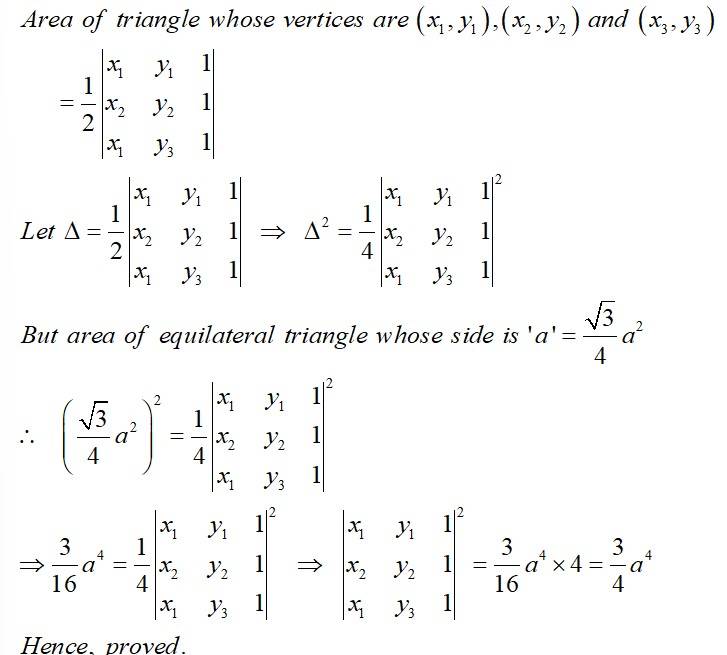
L e t                     A = [ 1 1 s i n 3 θ − 4 3 c o s 2 θ 7 − 7 − 2 ] = 0                                     | A | = | 1 1 s i n 3 θ − 4 3 c o s 2 θ 7 − 7 − 2 | = 0 C 1 → C 1 − C 2 ⇒                                       = | 0 1 s i n 3 θ − 7 3 c o s 2 θ 1 4 − 7 − 2 | = 0 T a k i n g     7     c o m m o n     f r o m     C 1 ⇒                                       = 7 | 0 1 s i n 3 θ − 1 3 c o s 2 θ 2 − 7 − 2 | = 0 ⇒                                       = | 0 1 s i n 3 θ − 1 3 c o s 2 θ 2 − 7 − 2 | = 0 E x p a n d i n g     a l o n g     C 1 ⇒                                         1 | 1 s i n 3 θ − 7 − 2 | + 2 | 1 s i n 3 θ 3 c o s 2 θ | = 0 ⇒               − 2 + 7 s i n 3 θ + 2 ( c o s 2 θ − 3 s i n 3 θ ) = 0 ⇒                       − 2 + 7 s i n 3 θ + 2 c o s 2 θ − 6 s i n 3 θ = 0 ⇒                                                                       − 2 + 2 c o s 2 θ + s i n 3 θ = 0 ⇒     − 2 + 2 ( 1 − 2 s i n 2 θ ) + 3 s i n θ − 4 s i n 3 θ = 0 ⇒                   − 2 + 2 − 4 s i n 2 θ + 3 s i n θ − 4 s i n 3 θ = 0 ⇒                                                 − 4 s i n 3 θ − 4 s i n 2 θ + 3 s i n θ = 0 ⇒                                               − s i n θ ( 4 s i n 2 θ + 4 s i n θ − 3 ) = 0                                     − s i n θ = 0     o r     4 s i n 2 θ + 4 s i n θ − 3 = 0 ∴         θ = n π         o r     4 s i n 2 θ + 6 s i n θ − 2 s i n θ − 3 = 0     w h e n     n ∈ I ⇒                                 2 s i n θ ( 2 s i n θ + 3 ) − 1 ( 2 s i n θ + 3 ) = 0 ⇒                                                                           ( 2 s i n θ + 3 ) ( 2 s i n θ − 1 ) = 0 ⇒                     &thinsp

New answer posted

a year ago

0 Follower 10 Views

V
Vishal Baghel

Contributor-Level 10

This is a Short Answer Type Questions as classified in NCERT Exemplar
Sol:

New answer posted

a year ago

0 Follower 6 Views

P
Payal Gupta

Contributor-Level 10

This is a short answer type question as classified in NCERT Exemplar

If there was no cut, then the object would have been at a height of 0.5 cm from the principal axis OO'.

Applying lens formula, we have

1/v-1/u=1/f 1 D - v + 1 v = 1 f Z

= 1 - 50 + 1 25

V= 50cm

Magnification m = v/u= 50/-50=-1

So coordinates of image are (50cm, -1cm)

New answer posted

a year ago

0 Follower 8 Views

V
Vishal Baghel

Contributor-Level 10

This is a Short Answer Type Questions as classified in NCERT Exemplar
Sol:

L . H . S . = | 1 c o s C c o s B c o s C 1 c o s A c o s B c o s A 1 | E x p a n d i n g     a l o n g     C 1                                   = 1 | 1 c o s A c o s A 1 | − c o s C | c o s C c o s B c o s A 1 | + c o s B | c o s C c o s B 1 c o s A |                                     = 1 ( 1 − c o s 2 A ) − c o s C ( c o s C − c o s A c o s B ) + c o s B ( c o s A c o s C − c o s B )                                     = s i n 2 A − c o s 2 C + c o s A c o s B c o s C + c o s A c o s B c o s C − c o s 2 B                                     = s i n 2 A − c o s 2 B − c o s 2 C + 2 c o s A c o s B c o s C                                     = − c o s ( A + B ) . c o s ( A − B ) − c o s 2 C + 2 c o s A c o s B c o s C [ ?     s i n 2 A − c o s 2 B = − c o s ( A + B ) . c o s ( A − B ) ]                                     = − c o s ( − C ) . c o s ( A − B ) + c o s C + ( 2 c o s A c o s B − c o s C ) [ ?     A + B + C = 0 ]                                     = − c o s C ( c o s A c o s B + s i n A s i n B ) + c o s C + ( 2 c o s A c o s B − c o s C )                                     = − c o s C ( c o s A c o s B + s i n A s i n B − 2 c o s A c o s B + c o s C )                                     = − c o s C ( − c o s A c o s B + s i n A s i n B + c o s C )                                     = c o s C ( c o s A c o s B − s i n A s i n B − c o s C )                                     = c o s C [ c o s ( A + B ) − c o s C ]                                     = c o s C [ c o s ( − C ) − c o s C ]                                           [ ?     A + B = − C ]                                     = c o s C [ c o s C − c o s C ] = c o s C . 0 = 0     R . H . S . L . H . S . = R . H . S .     H e n c e     p r o v e d .

Get authentic answers from experts, students and alumni that you won't find anywhere else

Sign Up on Shiksha

On Shiksha, get access to

  • 67k Colleges
  • 1.2k Exams
  • 718k Reviews
  • 1850k Answers

Share Your College Life Experience

×
×

This website uses Cookies and related technologies for the site to function correctly and securely, improve & personalise your browsing experience, analyse traffic, and support our marketing efforts and serve the Core Purpose. By continuing to browse the site, you agree to Privacy Policy and Cookie Policy.