

Class 12th
Get insights from 12k questions on Class 12th, answered by students, alumni, and experts. You may also ask and answer any question you like about Class 12th
Follow Ask QuestionQuestions
Discussions
Active Users
Followers
New answer posted
a year agoContributor-Level 10
This is a short answer type question as classified in NCERT Exemplar
(a) We know that P= VI

that is curve of power will be having maximum amplitude, equals to multiplication of amplitudes of voltage (V)and current (I) curve. So, the curve will be represented by A.
(b) As shown by shaded area in the diagram, the full cycle of the graph consists of one positive and one negative symmetrical area. Hence average power over a cycle is zero.

(c) As the average power is zero, hence the device may be inductor (L) or capacitor (C) or the series combination of L and C.
New answer posted
a year agoContributor-Level 10
This is a Multiple Choice Questions as classified in NCERT Exemplar
Answer- ( a)
Explanation- given width of slit is 10410-10m= 10-6
Wavelength of sunlight varies from 4000A0 to 8000A0
As the width of slit is comparable to that of wavelength, hence diffraction occurs with maxima at centre. So, at the centre all colours appear i.e., mixing of colours form white patch at the centre.
New answer posted
a year agoContributor-Level 10
This is a Multiple Choice Questions as classified in NCERT Exemplar
Answer- (c)
Explanation-Consider the diagram the light beam incident from air to the glass slab at Brewster's angle (ip ). The incident ray is unpolarised and is represented by dot (.).
The reflected light is plane polarised represented by arrows.
As the emergent ray is unpolarised, hence intensity cannot be zero when passes through polaroid.

New answer posted
a year agoContributor-Level 10
This is a short answer type question as classified in NCERT Exemplar
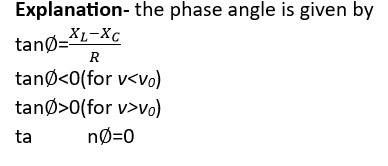
New answer posted
a year ago
Contributor-Level 10
This is a Short Answer Type Questions as classified in NCERT Exemplar
Explanation- T2P= T2O+OP= D+x
T1P= T1O-OP= D-x
S1P =
S2P=
The minima will occur when S2P- S1P= (2n-1)
- =
[D2+4D2]1/2-[D2+0]1/2=
[5D2]1/2- [D2]1/2=
D-D=
we get D= 0.404
New answer posted
a year ago
Contributor-Level 10
This is a short answer type question as classified in NCERT Exemplar
Irms= = = 1.58A = 1.6 approx
This value is indicating in graph

New answer posted
a year agoContributor-Level 10
This is a Short Answer Type Questions as classified in NCERT Exemplar
Explanation- resolving power =1/d = = dmin= where is the wavelength of light
So dmin=
= = 0.12 10-9m
= = 0.2 10-3
New answer posted
a year agoContributor-Level 10
This is a Short Answer Type Questions as classified in NCERT Exemplar
Explanation- When angle of incidence is equal to Brewster's angle, the transmitted light is unpolarised and reflected light is plane polarised.

Consider the diagram in which unpolarised light is represented by dot and plane polarised light is represented By arrows.
Polarisation by reflection occurs when the angle of incidence Is the Brewster's angle
So tanib = where 2< 1
When the light rays travels in such a medium, the critical angle is
Sinic=
Where 2< 1
As tanib > sinic for large angles ibc
Thus the polarisation by reflection occurs definitely.
New answer posted
a year ago
Contributor-Level 10
This is a short answer type question as classified in NCERT Exemplar
In the figure
Band width = w2-w1 where these two corresponds to frequencies at which magnitude of current is 1/ times of maximum value

Irms= = 1/ = 0.7A
From the diagram the corresponding frequencies are 0.8 and 1.2rad/s
New answer posted
a year agoContributor-Level 10
This is a Short Answer Type Questions as classified in NCERT Exemplar
Explanation- As per the given question, monochromatic light emerging from polaroid (I) is plane polarised. When polaroid (II) is placed infront of this polaroid (I), and rotated till no light passes through polaroid (II), then (I) and (II) are set in crossed positions, i.e., pass axes of I and II are at 90°.

Consider the above diagram where a third polaroid (III) is placed between polaroid (I) and polaroid II.

When a third polaroid (III) is placed in between (I) and (II), no light will emerge from (II), if pass axis of (III) is parallel to pass axis of (I) or (II). In
Taking an Exam? Selecting a College?
Get authentic answers from experts, students and alumni that you won't find anywhere else
Sign Up on ShikshaOn Shiksha, get access to
- 67k Colleges
- 1.2k Exams
- 718k Reviews
- 1850k Answers