

Class 12th
Get insights from 12k questions on Class 12th, answered by students, alumni, and experts. You may also ask and answer any question you like about Class 12th
Follow Ask QuestionQuestions
Discussions
Active Users
Followers
New answer posted
a year ago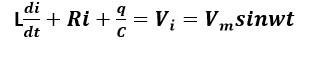

Contributor-Level 10
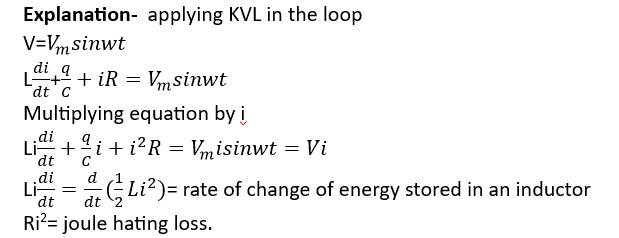
This is a long answer type question as classified in NCERT Exemplar
New answer posted
a year agoContributor-Level 10
This is a Multiple Choice Questions as classified in NCERT Exemplar
Answer- (b)
Explanation – because alpha and beta particle have some charge and mass so their energy level will change but in case of gamma particle it does not contain any charge.
New answer posted
a year ago
Contributor-Level 10
This is a Long Answer Type Questions as classified in NCERT Exemplar
Explanation- as the refractive index of the class , the path difference will be calculated as =2dsin +( )L
For principal maxima ,(path difference is zero)
2dsin 0+( )L=0
Sin 0= - =
Sin 0=-1/16
OP=Dtan 0= Dsin 0=-D/16
For pat h difference
2dsin 1+0.5L=
Sin 1= =
= = 1/4 -1/16
So two possible values and- =
New answer posted
a year agoContributor-Level 10
This is a long answer type question as classified in NCERT Exemplar
Total current i=i1+i2
Vmsinwt=Ri1
I1=
If q2 is charge on the capacitor at any time t then for series combination of C and L
Applying KVL in below circuit
So q2=qmsin(wt )……….1
qm[ sin(wt+ )]= Vmsinwt
if
qm=
from above equation i2=
i2= when
so total current I = i1+i2
I=
I= i1+i2= Ccos +Csin
I= Csin(wt+ )
C=
1/2
= tan-1
1/2
This is the expression for impedance.2
New answer posted
a year ago
Contributor-Level 10
This is a Long Answer Type Questions as classified in NCERT Exemplar
Explanation- when polariser is not used
A=Aperp+A
letA1= asinwt and A2=asin(wt+ )
now superposition principle for perpendicular polariser
AR= asinwt+ asin(wt+ )
AR=a(2cos sin(wt+ ))
AR=2acos sin(wt+ )
This eqn is also same for parallel polariser
AR=2acos sin(wt+ )
And we know that intensity is directly proportional to square of amplitude
(AR)2= (Aperp)2+(A)2
So resultant intensity is
I=4(a)2cos2 dt + 4(a)2cos2 dt
I= 8(a)2cos2 (1/2) &nb
New answer posted
a year agoContributor-Level 10
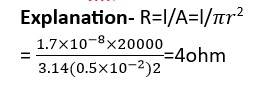
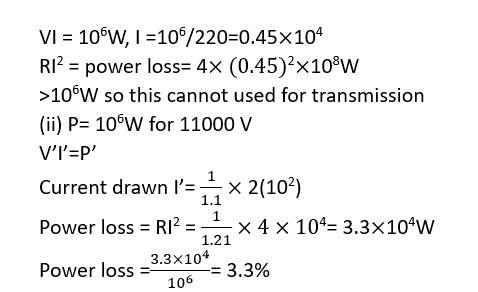
This is a long answer type question as classified in NCERT Exemplar
New answer posted
a year agoContributor-Level 10
This is a long answer type question as classified in NCERT Exemplar
Power drawn, p= 2KW= 2000W
tan =-3/4
P=V2/Z
Z=V2/P= =25
Z =
25=
625 = ………… (1)
tan = = ¾
XL-XC= 3R/4
Use this in eqn 1
625= R2+ (3R/4)2 = R2+9R2/16
625 = 25R2/16, R= 20ohm
XL-XC=15ohm
Im= I= = = 12.6A
If R, XL and Xc are all doubled, tan does not change . Z is doubled, current is halved. So power is also halved.
New answer posted
a year agoContributor-Level 10
This is a Multiple Choice Questions as classified in NCERT Exemplar
Answer- b
Explanation- F=GMm/r2
M=effective mass of hydrogen atom=mass of electron +mass of proton -B2/c
B.E of hydrogen atom = 13.6eV
New answer posted
a year agoContributor-Level 10
This is a Multiple Choice Questions as classified in NCERT Exemplar
Answer (c)
Explanation- it is a process in which metal decays spontaneously . so during a span of 1 year it will decay almost half of its original value so it will come close to 5000.
New answer posted
a year agoContributor-Level 10
This is a Short Answer Type Questions as classified in NCERT Exemplar
Explanation- a nuclide 1 is said to be mirror isobar of nuclide 2, if Z1=N2 and Z2= N1
Now 11Na23, 12Mg23 for which Z2=12=N1 and N2 =23-12=11=Z1
(b) As 12Mg23 contain even number of protons against 11Na23 which has odd number of protons (11), therefore Mg has greater binding energy than sodium.
Taking an Exam? Selecting a College?
Get authentic answers from experts, students and alumni that you won't find anywhere else
Sign Up on ShikshaOn Shiksha, get access to
- 67k Colleges
- 1.2k Exams
- 718k Reviews
- 1850k Answers